

Table of Contents
Building a fitness app in 2026? You’re in for an exciting journey! Fitness apps and healthy snacks are in high demand. This guide will take you through each step. From planning your concept to launching your app, we’ve got you covered.
We’ll look at trends, tools, and tips to help your app succeed. Whether you’re a newbie or an expert, this guide is for you. Ready to get started? Let’s dive in!
Why 2026 Is the Year to Build a Fitness App
| $12.12B Market Size (2025) | $33.58B Projected by 2033 | 3.6B+ Downloads in 2024 |
The global fitness app market has evolved from a pandemic-era convenience into a fundamental pillar of modern health. In 2026, fitness apps are no longer just digital workout guides; they are AI-powered health coaches, metabolic monitors, and social accountability engines that users return to daily.
With the market valued at $12.12 billion in 2025 and projected to reach $33.58 billion by 2033 at a 13.4% CAGR, the opportunity is massive. But so is the competition. The apps that succeed in 2026 are not those that launch fastest; they are those built with the right architecture, a sharp user focus, and intelligent personalization baked in from day one.
This guide walks you through everything you need to know: the types of fitness apps dominating the market, must-have features, the development process, updated cost breakdowns, compliance requirements, monetization strategies, and the most-asked questions from founders, developers, and entrepreneurs entering this space.
Fitness App Market Trends in 2026
Before building, you need to understand the landscape you are entering. These are the defining trends shaping fitness app development in 2026.
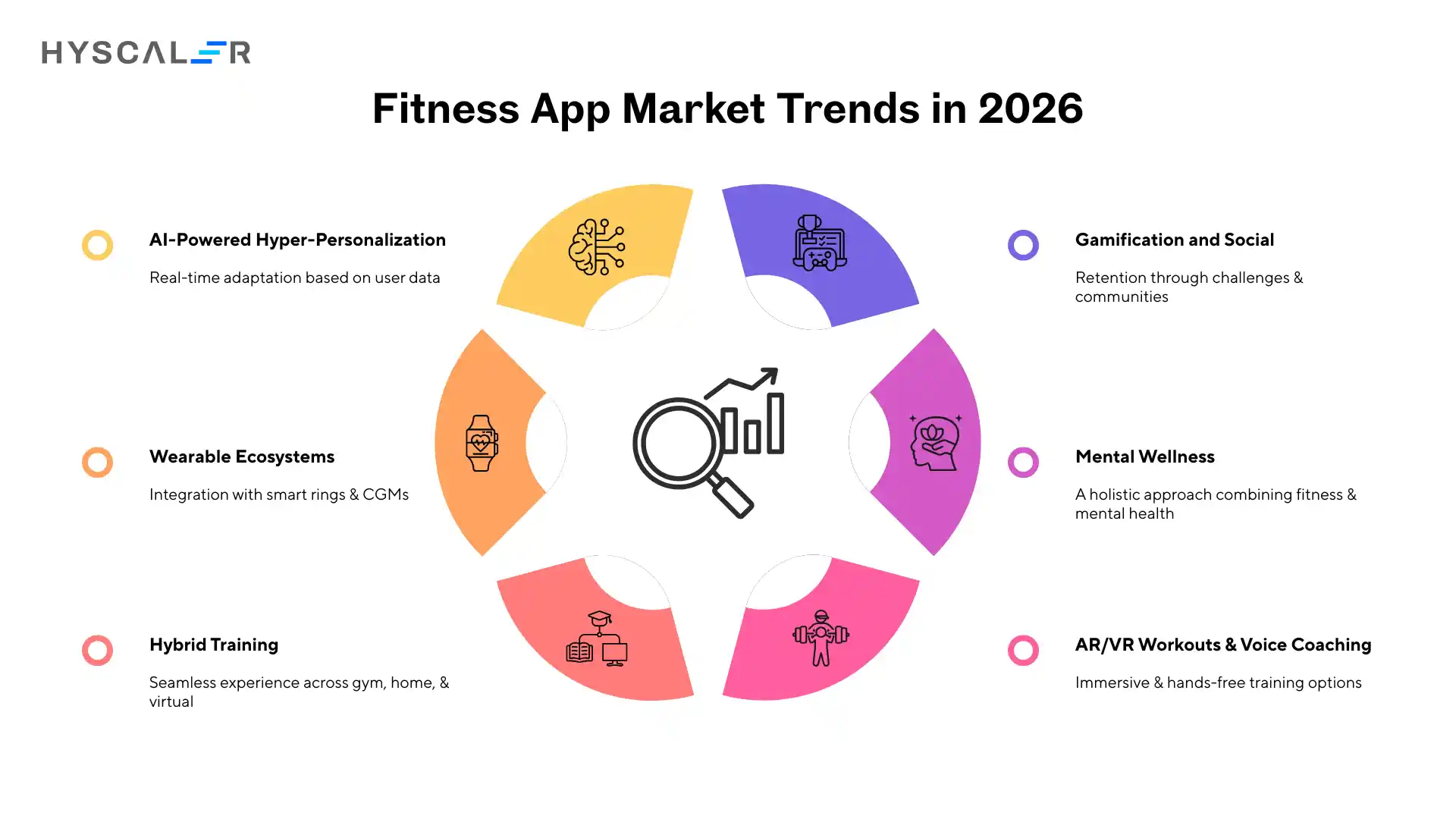
AI-Powered Hyper-Personalization
The era of one-size-fits-all workout plans is over. In 2026, users expect their app to adapt in real time, not based on an onboarding quiz from three months ago, but on what they did yesterday, how they slept last night, and what their heart rate variability says today. AI now powers training plan generation, adaptive weekly loads, smart recovery windows, and context-aware nudges that shift based on user behavior.
| Industry SignalHealth and fitness apps generated over $5 billion in 2024, with approximately 75% of that revenue coming from subscriptions, signaling that ongoing, personalized coaching consistently beats one-time purchase models. |
Wearable Ecosystems Expanding Beyond Smartwatches
Wearables in 2026 mean far more than step counts on a smartwatch. Smart rings (like Oura) are driving 24/7 coaching for recovery and sleep readiness. Consumer-grade Continuous Glucose Monitors (CGMs) such as Dexcom’s Stelo are entering the mainstream wellness conversation, pushing fitness apps toward more evidence-based nutrition guidance that goes well beyond calorie counting.
Fitness apps that integrate with this richer sensor ecosystem, heart rate, sleep stages, blood oxygen, HRV, and glucose can offer users a genuinely comprehensive picture of their metabolic fitness.
Hybrid Training: Gym + Home + Virtual
Users in 2026 train across multiple environments and expect the app to stitch their experience together. Gym memberships in the US reached 64.2 million in 2024, yet behavior data shows more flexible scheduling and blended formats. Winning apps help users stay consistent, whether they’re at the gym, at home, or following a virtual coach, with unified scheduling, habit loops, and cross-environment progress tracking.
Gamification and Social Accountability
Leaderboards, streaks, challenges, achievement badges, and community features are now retention mechanisms, not just engagement gimmicks. In 2026, successful apps build smaller, stickier community circles, micro-groups around specific goals or training styles rather than broadcasting into a generic global feed.
Mental Wellness Integration
The boundaries between fitness, sleep, and mental health apps are blurring. Apps like Calm sit consistently in the top-grossing fitness charts despite being primarily a meditation product. Users increasingly want a holistic health experience in a single app or expect their fitness app to integrate seamlessly with mindfulness and sleep platforms.
AR/VR Workouts and Voice Coaching
Augmented reality form correction, immersive virtual workout environments, and hands-free voice coaching are moving from novelty to expected features in the premium segment. Computer vision-based form analysis, here the app’s camera watches your squat and corrects your posture in real time, is now commercially viable and increasingly demanded by users.
Types of Fitness Apps in 2026
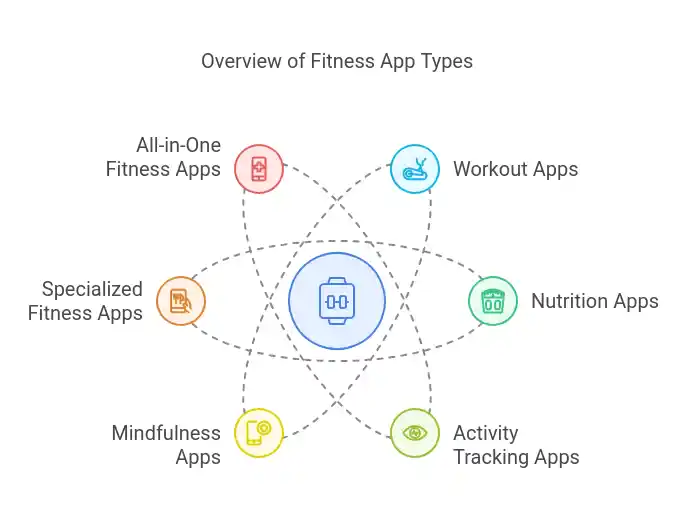
There is no single type of fitness app. The right category depends on the specific problem you intend to solve for your users. Understanding the primary categories also shapes your feature set, tech stack, and monetization approach.
Workout & Exercise Guide Apps
These apps act as digital personal trainers, guiding users through structured exercise routines with video demonstrations, audio cues, and progress tracking. They work for all fitness levels and are built for people who want structure and results without needing a gym. Key capabilities include AI-generated training plans, form correction via computer vision, and gamified achievements. Examples: Nike Training Club, Freeletics, Centr.
Activity Tracking Apps
Activity trackers run quietly in the background, recording steps, distance, calories, GPS routes, heart rate, and sleep. They appeal to users who want health awareness without committing to a structured workout program. The best of these integrate deeply with wearable ecosystems and provide predictive health insights. Examples: Strava, Fitbit, Garmin Connect.
Nutrition & Diet Apps
Nutrition apps help users understand what they eat and how it maps to their health goals. They require extensive food databases, barcode scanners, macro tracking, meal planning tools, and increasingly AI-powered recommendations that account for the user’s activity data. The challenge is maintaining engagement beyond the first excited week. Examples: MyFitnessPal, Lose It!, Cronometer.
Mindfulness & Mental Wellness Apps
This category covers guided meditation, stress relief, breathing exercises, mood tracking, and sleep optimization. AI can now recommend sessions based on the user’s biometric state, suggesting a shorter, restorative meditation when HRV is low, for example. Sensory-friendly UI design is critical to avoid overwhelming users. Examples: Calm, Headspace, Insight Timer.
Virtual Coaching & Personal Trainer Apps
These platforms connect users with human trainers or AI coaches via video calls, asynchronous feedback, and custom program delivery. They require robust video/audio infrastructure, strong data privacy practices, and multi-tenant architecture when supporting multiple trainer businesses. Recovery-focused apps with provider-shareable progress reports also fit this category.
Wearable-Integrated & Metabolic Fitness Apps
Apps in this category are built around real-time biometric data from smartwatches, rings, CGMs, and IoT health devices. They use AI for predictive recovery alerts, personalized performance coaching, and adaptive programming. The technical challenge is reliably syncing data across multiple device models and vendors from Apple, Google, Garmin, Oura, and others.
All-in-One / Super Fitness Apps
Combining workouts, nutrition, mindfulness, sleep, and social features in a single platform, these apps target users who want a unified health experience. Building one from scratch is expensive, but the retention and monetization potential is highest in this category. Examples: Whoop, Apple Fitness+, Peloton app.
| App Type | Primary Audience | Monetization Fit |
|---|---|---|
| Workout Guide | Home fitness beginners, intermediate athletes | Subscription, In-App Purchases |
| Activity Tracker | Health-aware adults, outdoor enthusiasts | Freemium + Wearable partnerships |
| Nutrition | Weight management, performance athletes | Subscription, Premium meal plans |
| Mindfulness | Stress-prone professionals, sleep sufferers | Subscription |
| Virtual Coaching | Serious athletes, rehab patients | Premium subscription, Per-session fees |
| Metabolic/Wearable | Biohackers, performance athletes | Premium subscription + hardware |
| All-in-One | Health enthusiasts wanting the full picture | High-value annual subscription |
Must-Have Features for a Fitness App in 2026
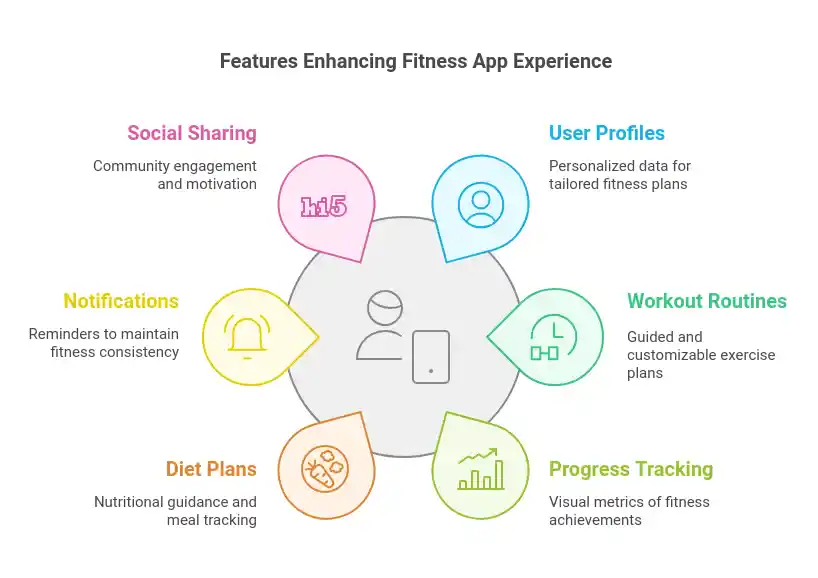
Feature decisions made early in development directly shape how well an app retains users and generates revenue. In 2026, the baseline for a competitive fitness app is higher than it was even two years ago.
Core Features (MVP Essentials)
- Engaging onboarding with short quizzes (not long boring forms) to capture fitness goals, experience level, and preferences
- Personalized user profiles with editable fitness goals, dietary preferences, and connected devices
- Exercise library with high-quality video demonstrations and step-by-step instructions
- Progress tracking with visual dashboards, calories burned, workouts completed, streaks, PRs
- Push notifications and reminders with user-controlled granularity (types, frequency, timing)
- Wearable and Apple Health / Google Fit integration for automated data sync
- In-app purchases and subscription management via App Store / Play Store billing
AI-Powered Features (2026 Standard)
- AI coaching engine that generates and adapts workout plans based on performance history, recovery data, and stated goals
- Smart deload and rest-day recommendations based on HRV, sleep quality, and training load
- Computer vision form analysis using the device camera to detect and correct movement errors
- Natural language AI chatbot for nutrition questions, workout modifications, and motivation
- Predictive drop-off detection identifying users at risk of churning and triggering re-engagement flows
Social & Community Features
- Micro-community groups around specific goals, training styles, or challenges
- Friend challenges, leaderboards, and shared achievements
- In-app social feed for sharing workout completions and milestones
- Live and on-demand virtual classes with real instructor interaction
Nutrition & Wellness Features
- Barcode scanner with a verified food database (millions of items)
- Macro and micronutrient tracking with visual breakdowns
- AI-generated meal plans tailored to fitness goals and dietary restrictions
- Sleep quality monitoring and actionable sleep hygiene recommendations
- Mindfulness sessions and breathing exercises are integrated within the workout flow
Analytics & Feedback Features
- Detailed workout analytics volume, intensity, muscular balance, weekly trends
- Health score or readiness index synthesizing multiple biometric inputs
- Shareable progress reports (useful for users working with coaches or healthcare providers)
- In-app feedback loops for users to rate workouts and provide qualitative notes
Virtual Classes and Live Training
- Virtual classes and live training sessions offer real-time engagement with professional instructors.
- Users can join live workouts or access a library of on-demand classes.
- These interactive features bring the feel of a personal trainer into the digital space, providing guidance and support during workouts.
The Fitness App Development Process in 2026
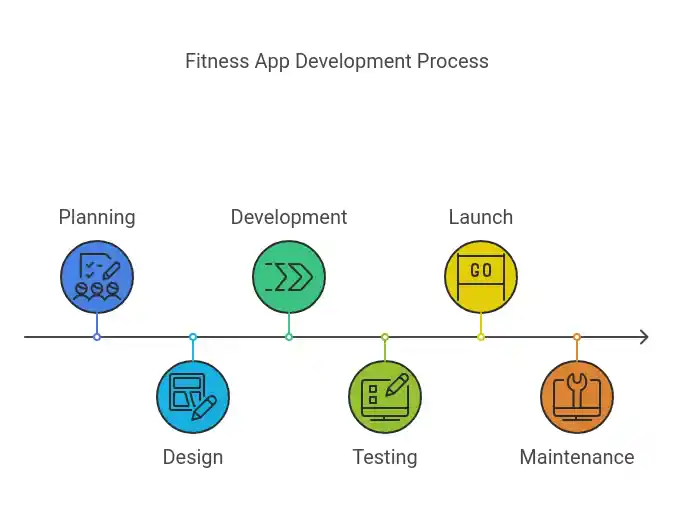
Building a fitness app in 2026 is a structured journey with six key phases. Teams that skip or rush any one of these phases typically discover the cost during post-launch, when fixing problems is five to ten times more expensive.
Phase 1: Discovery & Market Validation
Every successful fitness app begins with a specific user problem, not a feature list. Define who your user is with precision: a busy working professional with 20 minutes a day, a postpartum mother rebuilding strength, a competitive cyclist improving power output. The narrower your initial target, the faster you can build something those users love.
- Conduct competitor analysis, identify gaps in top-ranked apps via user reviews.
- Define your unique value proposition clearly before any design begins
- Determine platform strategy: iOS first, Android first, or cross-platform MVP
- Establish compliance requirements early (GDPR, HIPAA, COPPA as applicable)
- Create a business case with cost estimates and ROI projections
Phase 2: UX/UI Design & Prototyping
Fitness app design in 2026 is about reducing friction during workouts. Users should not be fumbling with the UI when their hands are sweaty and their heart rate is at 160 BPM. Design for the context of use.
- Create low-fidelity wireframes mapping the core user flows
- Build clickable high-fidelity prototypes and test with real target users
- Apply color psychology: blue builds trust, green signals health, and orange drives action
- Design for accessibility WCAG 2.1 AA as the baseline
- Iterating on onboarding, specifically the first-session experience, determines 30-day retention
Phase 3: Technology Stack Selection
Your technology choices determine cost, performance, scalability, and long-term maintainability. In 2026, cross-platform frameworks have matured to the point where most fitness apps can be built with a single codebase without sacrificing native performance.
| Layer | Recommended Technologies | Considerations |
|---|---|---|
| Frontend (Mobile) | React Native, Flutter | Cross-platform for most apps; Swift/Kotlin for performance-critical features |
| Backend | Node.js, Django, FastAPI | FastAPI is gaining traction for AI-heavy fitness apps |
| Database | PostgreSQL, MongoDB, Firebase | PostgreSQL for structured health data; Firebase for real-time features |
| AI/ML | TensorFlow Lite, Core ML, OpenAI APIs | On-device inference for privacy; cloud APIs for complex personalization |
| Cloud | AWS, Google Cloud, Azure | Choose based on team expertise and compliance needs (HIPAA BAA availability) |
| Wearables | Apple HealthKit, Google Fit, Garmin SDK, Fitbit API | Plan for multi-vendor complexity from the start |
| Video/Streaming | MUX, AWS IVS, Agora | For live classes and on-demand video content |
| Analytics | Mixpanel, Amplitude, Firebase Analytics | Instrument retention and drop-off funnels from launch day |
Phase 4: Development (Agile & Iterative)
Use agile sprints of two weeks with clear deliverables per sprint. Build the core loop first, the minimum feature set that delivers real value to a real user. Launch to a closed beta before investing in advanced features.
- Sprint 1-2: Authentication, user profiles, onboarding flow
- Sprint 3-4: Workout library, video playback, basic tracking
- Sprint 5-6: Progress dashboard, notifications, wearable sync
- Sprint 7-8: AI personalization engine, nutrition basics
- Sprint 9-10: Social features, payments, subscription management
- Sprint 11-12: Beta testing, performance optimization, compliance audit
Phase 5: Testing & Quality Assurance
Fitness apps require an especially rigorous testing approach because users rely on them during physical activity, where UI errors are highly disruptive.
- Functional testing across all supported device models and OS versions
- Performance testing under low-battery, poor-connectivity, and background-sync scenarios
- Wearable integration testing across multiple device brands
- Security penetration testing and data privacy audit
- Beta launch with real users, minimum 200 testers for meaningful feedback
- Accessibility testing against WCAG 2.1 AA standards
Phase 6: Launch, Marketing & Maintenance
A successful launch is the result of marketing that starts months before the app goes live, not on launch day. Post-launch, the app is a living product that requires continuous investment.
Release update cycles every 2-4 weeks based on user feedback and analytics
App Store Optimization (ASO): keyword research, compelling screenshots, video preview
Micro-influencer partnerships (1K-100K followers) for authentic fitness community reach
Referral programs turning early users into growth drivers
Content marketing: fitness guides and blog content, building organic search traffic
Post-launch: monitor crash rates, Day 1/7/30 retention, and revenue per user
How Much Does It Cost to Build a Fitness App in 2026?
Development costs in 2026 vary widely based on feature complexity, team location, and whether you are building natively or cross-platform. The following breakdown reflects realistic market rates as of 2026.
Feature-Level Cost Estimates
| Feature Category | Estimated Cost Range | Hours (approx.) |
|---|---|---|
| Business Analysis & Planning | $8,000 – $15,000 | 150 – 300 hrs |
| UX/UI Design | $8,000 – $18,000 | 120 – 250 hrs |
| User Auth & Onboarding | $3,000 – $6,000 | 60 – 100 hrs |
| Workout Library & Video | $8,000 – $18,000 | 150 – 300 hrs |
| Progress Tracking & Dashboard | $5,000 – $10,000 | 100 – 180 hrs |
| AI Personalization Engine | $12,000 – $30,000 | 200 – 450 hrs |
| Nutrition Tracking + Food DB | $6,000 – $14,000 | 120 – 250 hrs |
| Wearable & HealthKit Integration | $8,000 – $20,000 | 150 – 300 hrs |
| Social Features & Community | $6,000 – $14,000 | 120 – 200 hrs |
| Payments & Subscriptions | $4,000 – $8,000 | 80 – 140 hrs |
| Push Notifications & Reminders | $2,000 – $5,000 | 40 – 80 hrs |
| QA Testing & Security Audit | $8,000 – $18,000 | 200 – 400 hrs |
| Deployment & App Store Launch | $2,000 – $5,000 | 50 – 100 hrs |
| Annual Maintenance (Year 1) | $12,000 – $30,000 | 250 – 500 hrs |
Total Cost by App Tier
| App Tier | Cost Range | What You Get |
|---|---|---|
| MVP / Startup | $40,000 – $80,000 | Core workout/tracking features, basic AI, single platform, freemium monetization |
| Mid-Market | $80,000 – $200,000 | Full feature set, cross-platform, wearable integration, subscription model, social features |
| Enterprise / Super App | $200,000 – $600,000+ | Advanced AI coaching, live streaming, multi-tenant architecture, full compliance, dedicated DevOps |
| Cost Note: Rates vary significantly by region. Eastern European developers typically charge $25–$55/hr, while North American teams range from $100–$200/hr. AI-augmented development tools in 2026 can reduce total development hours by 20–40% compared to traditional approaches. |
Compliance Requirements for Fitness Apps in 2026
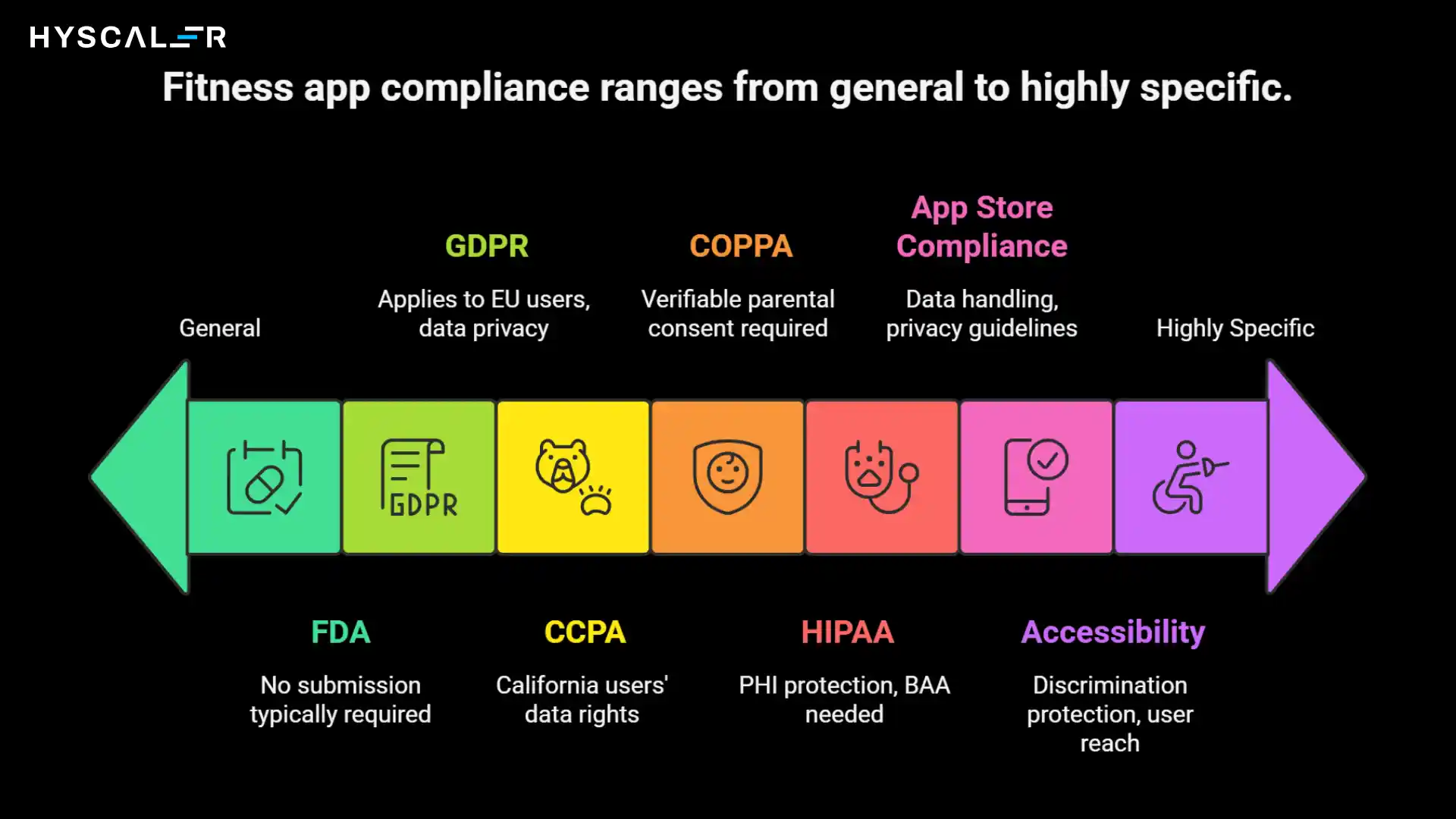
Non-compliance is not just a legal risk; it kills user trust and can result in removal from app stores. Most fitness apps fall under FDA requirements for low-risk general wellness devices, meaning no FDA submission is typically required. However, other frameworks are non-negotiable.
GDPR (European Union)
If your app has any users in the EU, GDPR applies regardless of where your company is incorporated. Requirements include explicit consent before collecting health data, clear privacy policies, user rights to access/correct/delete their data, data minimization principles, and breach notification within 72 hours.
HIPAA (United States)
If your app stores, transmits, or processes Protected Health Information (PHI), including when working with healthcare providers or insurance companies, HIPAA compliance is mandatory. This requires a signed Business Associate Agreement (BAA) with your cloud provider, end-to-end encryption, audit logs, and access controls.
CCPA (California Consumer Privacy Act)
For apps with California users, CCPA grants rights to know what data is collected, opt out of data sales, and delete personal information. In 2026, this effectively applies to any fitness app with meaningful US user numbers, given California’s population.
COPPA (Children’s Online Privacy Protection Act)
If your app is directed at or knowingly collects data from users under 13, COPPA mandates verifiable parental consent before any data collection, a clear and accessible privacy policy, and additional data security requirements.
App Store Compliance
Both Apple App Store and Google Play have specific health app guidelines covering data handling, user privacy, subscription disclosure, and content accuracy. Health and fitness apps may require additional review cycles. Understand these requirements before your first submission to avoid costly delays.
Accessibility (WCAG 2.1 / ADA)
Accessibility compliance protects against discrimination lawsuits in the US and ensures your app reaches the widest possible user base. Requirements include adequate color contrast, screen reader compatibility, keyboard navigability, and text alternatives for visual content.
Monetization Models for Fitness Apps in 2026
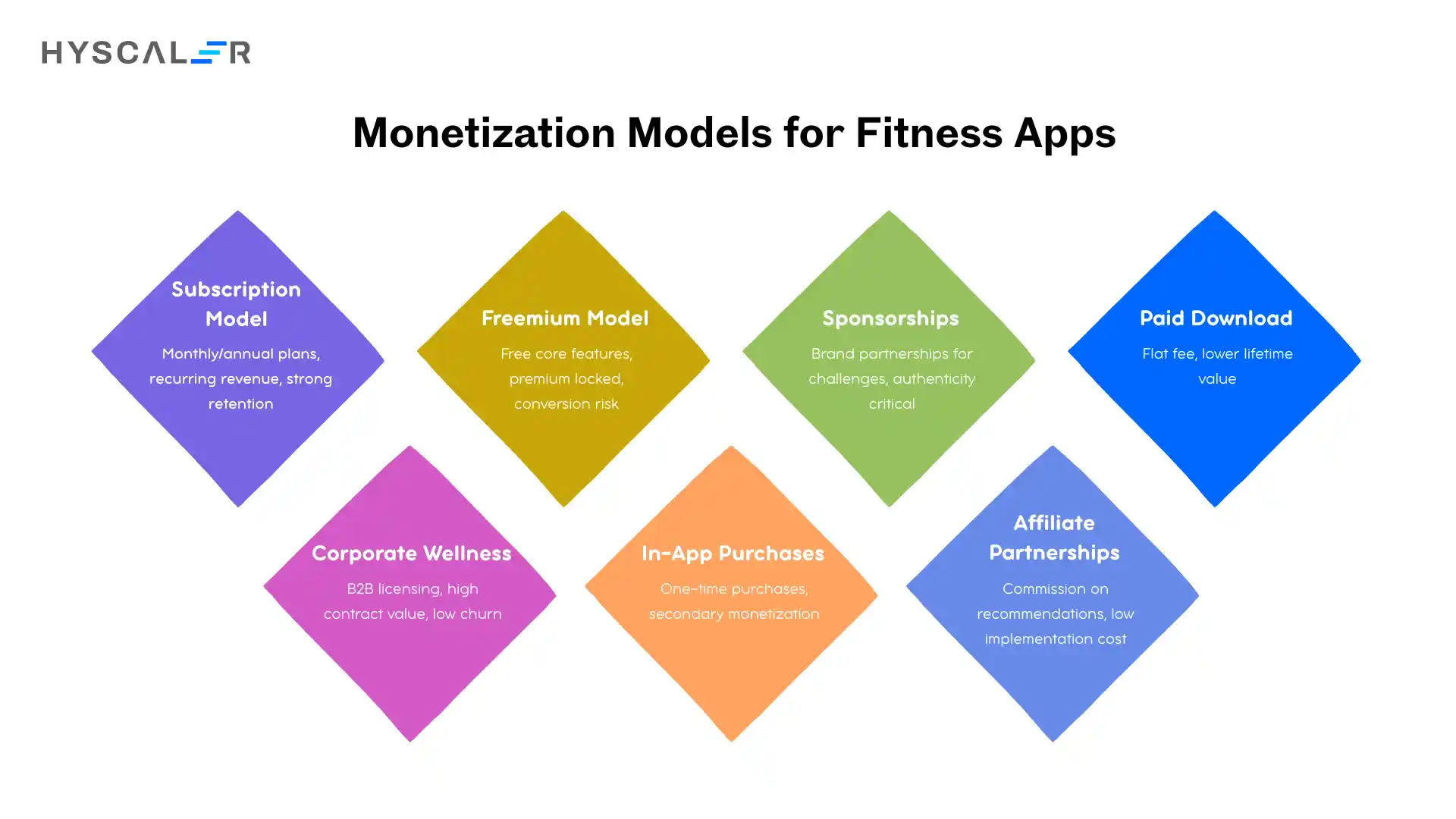
Revenue model decisions made at the design stage are extremely difficult to reverse post-launch. The data from 2024-2026 is clear: subscriptions dominate, accounting for approximately 75% of top-grossing fitness app revenue. Here are all viable models with honest assessments.
Subscription Model (Recommended Primary)
Monthly or annual plans providing access to premium content, AI coaching, or advanced features. This is the dominant model among top-grossing apps, including MyFitnessPal, Peloton, Strava, and Calm. Annual subscriptions significantly improve LTV (lifetime value) and reduce churn. Price points in 2026 typically range from $9.99/month to $49.99/month, depending on the depth of coaching.
- Best for: apps with regularly updated content, AI coaching, live classes
- Advantage: predictable, recurring revenue and strong retention incentive
- Challenge: must continuously deliver enough value to justify renewal
Freemium Model
Free access to a core feature set with premium features locked behind a paywall. The risk is giving away too much for free and making the premium unappealing, or too little and failing to acquire users. The key is making the free tier genuinely useful while reserving the most engaging features for premium. Effective conversion rates for well-designed freemium fitness apps range from 2% to 8%.
In-App Purchases
One-time purchases of specific content: individual training programs, custom nutrition plans, recipe packs, or exclusive workout collections. Sell branded workout gear, accessories, and apparel like sweatshirts. Works well as a secondary monetization layer on top of a freemium or subscription model, but is rarely sufficient as the primary model.
Corporate Wellness
B2B licensing to employers who provide the app as an employee wellness benefit. This is an underutilized but rapidly growing segment in 2026, as companies invest in preventive health programs. Corporate deals typically have higher contract values and lower churn than consumer subscriptions.
Affiliate & Brand Partnerships
Earning commission on equipment, supplement, or activewear recommendations made within the app. Works naturally in apps that already include equipment suggestions or workout guides. Low implementation cost since no new features are required. Amazon Associates and direct brand programs are common starting points.
Sponsorships & Branded Challenges
Partnering with fitness brands, supplement companies, or gyms to sponsor in-app challenges, content series, or events. Provides a revenue boost while giving partners access to an engaged health-conscious audience. Authenticity is critical; users quickly disengage from sponsorships that feel misaligned with the app’s mission.
Paid Download
A flat fee for permanent app ownership with no subscription. Appeals to users wary of recurring charges, but delivers lower lifetime value per user and makes ongoing content investment harder to fund. Best suited for apps with a fixed, evergreen content library rather than continuous coaching products.
How to Ensure the Security of User Data Collected Through a Fitness App
Securing user data in fitness apps is crucial. Here are some detailed steps to ensure data security:
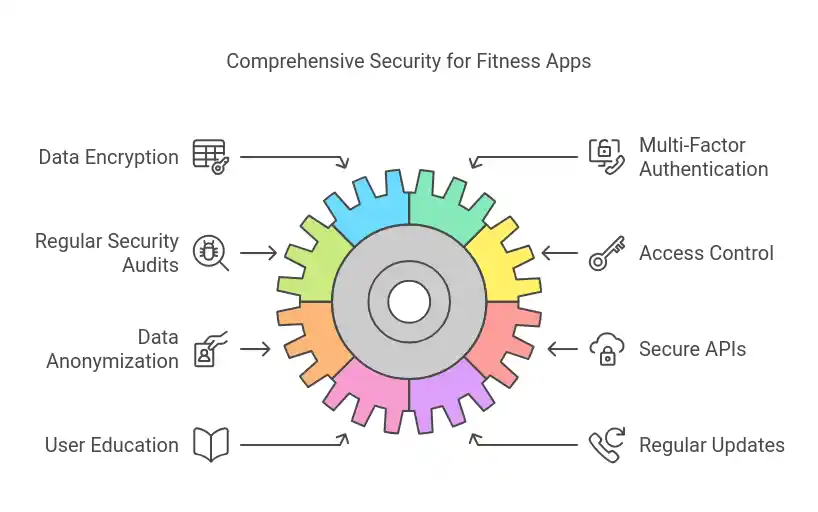
Health and fitness data is among the most sensitive personal information users entrust to an app. A single breach can destroy user trust permanently. Security architecture must be designed in from day one; retrofitting security is enormously expensive.
Data Encryption
All data must be encrypted in transit using TLS 1.3 and at rest using AES-256 encryption. This applies to data stored in the app, on the device, and in cloud databases. Health data should never be transmitted in plaintext under any circumstances.
Multi-Factor Authentication (MFA)
Offer and strongly encourage MFA for all user accounts. Biometric authentication (Face ID, fingerprint) provides an excellent balance of security and convenience in fitness apps where users frequently log in during workouts. Enforce strong password policies as a baseline.
Role-Based Access Control (RBAC)
Implement least-privilege access principles throughout. Only admins should access aggregate user data for analytics. Personal health data should be accessible only to the account holder and explicitly authorized parties. Log all data access events for audit compliance.
Regular Security Audits & Penetration Testing
Commission an independent security audit before launch and at least annually post-launch. Penetration testing simulates real attacks and uncovers vulnerabilities that internal teams often overlook. Patch identified vulnerabilities before they become exploitable.
Data Minimization & Anonymization
Only collect the data actually needed for app functionality. When using health data for analytics or AI model training, anonymize and aggregate it first to ensure it cannot be traced back to individual users. This is both a privacy best practice and a compliance requirement under GDPR.
Secure API Design
Use an API gateway to manage and monitor all external API traffic. Implement token-based authentication (OAuth 2.0 / JWT) for all API endpoints. Rate-limit API calls to prevent abuse. Regularly rotate API keys and secrets. Never expose sensitive credentials in client-side code.
User Education
Provide in-app guidance on creating strong passwords, recognizing phishing attempts, and understanding what data the app collects and why. A transparent privacy dashboard that shows users exactly what data is stored and gives them one-click deletion options builds significant trust and improves retention.
Key Performance Benchmarks for Fitness Apps
Set these benchmarks before launch and use them to evaluate whether your app is performing at an industry-competitive level.
| KPI | Industry Benchmark | What It Tells You |
|---|---|---|
| Discovery-to-Install Conversion | ~28% | App Store listing quality and targeting accuracy |
| Day-1 Retention | 25–35% | Onboarding experience effectiveness |
| Day-30 Retention | 3–10% (avg), 30%+ (top apps) | Core habit loop strength |
| Daily Active Users (DAU) | ~9.4% of installs | Daily engagement and utility |
| Freemium Conversion Rate | 2–8% | Free-to-play value proposition clarity |
| Average Revenue Per User (ARPU) | $3–$12/month | Monetization efficiency |
| App Store Rating | 4.0+ stars (95% of top 100 apps) | Overall product quality and support |
| Monthly Active Users Growth | 10–15% MoM (growth stage) | Acquisition and retention balance |
Conclusion
Fitness app development in 2026 is one of the most compelling opportunities in mobile technology, but it is also one of the most competitive. The market does not reward the apps that launch fastest. It rewards the apps that understand their users deeply, deliver a genuinely useful daily habit, and improve continuously based on real feedback.
The defining features of winning apps in 2026 are AI personalization that adapts to each individual, wearable integration that provides a meaningful view of health beyond step counts, and community features that create accountability and belonging. These are no longer differentiators; they are table stakes for any app hoping to compete with the top-grossing charts.
Build with a specific user and a specific problem in mind. Launch an MVP, measure relentlessly, and iterate. Prioritize compliance and security from day one; they are far cheaper to build in than to retrofit. And choose a monetization model that creates aligned incentives between your business growth and your users’ health outcomes.
FAQs
What are the initial steps to start developing a fitness app?
This process typically begins with thorough market research to understand existing solutions and identify gaps. Developers need to define their app’s concept clearly, set goals, and plan their budget. Assembling a skilled team comprising developers, designers, and marketers is crucial to bringing the app vision to life.
How long does it take to develop a fitness app?
The timeline varies depending on the complexity of the app. Basic apps, which include essential features, might take around 3-6 months to develop. Intermediate apps with more features can take 6-9 months, while advanced apps with comprehensive functionalities may take 9-12 months. The development timeline includes stages like planning, designing, coding, testing, and launching.
What technologies are used in fitness app development?
For the frontend, popular technologies include React Native and Flutter, which provide cross-platform capabilities. Backend development might involve Node.js or Django, and databases like MongoDB or PostgreSQL are commonly used. Integrating fitness tracking APIs and payment gateways is also part of the tech stack consideration, ensuring the app meets user needs efficiently.
How do I ensure my app complies with regulations?
Fitness apps must adhere to data protection laws such as GDPR in the European Union and HIPAA in the United States, ensuring the secure handling of personal and health information. Compliance involves regular audits, user consent mechanisms, and robust data protection measures. For apps targeting children, COPPA compliance is necessary to protect their personal information.
What features are essential in a fitness app?
Essential features include user profiles for personalized tracking, workout routines for guided exercises, diet plans for nutrition management, and progress tracking for monitoring achievements. Notifications and reminders keep users engaged, while social sharing features allow them to connect with friends and fitness communities. Integration with wearables enhances the user experience by providing comprehensive health data.
How do I monetize my fitness app?
There are various models to consider, such as the freemium model, which offers basic features for free with optional premium upgrades. Subscription models charge users on a monthly or yearly basis for access to premium content. In-app purchases allow users to buy additional features or content, while ad-supported models generate revenue through advertisements. Partnerships and sponsorships with fitness brands can also provide additional revenue streams.
How can I ensure the security of user data?
Ensuring user data security is a top priority in fitness app development. Measures include data encryption to protect information during transmission and storage, secure authentication methods like multi-factor authentication, and regular security audits to identify and address vulnerabilities. Access control mechanisms and data anonymization techniques further enhance security. Educating users about best practices and providing regular updates to address emerging threats are also crucial.
What are the costs involved in developing a fitness app?
Costs can vary widely based on the app’s complexity and feature set. Basic apps might cost between $15,000 and $30,000, while more advanced apps can range from $60,000 to $120,000. These estimates include design, development, testing, and post-launch support.