Table of Contents
The numbers are brutal. Nearly 80% of AI initiatives fail, almost twice the failure rate of traditional IT projects. Yet the global generative AI market is racing toward $1.3 trillion. Bridging those two realities is where a true business opportunity emerges. Businesses that invest in professional generative AI development services with the right strategy, the right partner, and the right process are the ones actually closing it.
This guide breaks down everything you need to know, from what generative AI development services actually include, to how the build process works, to what separates a high-performing AI partner from an expensive disappointment.
What Are Generative AI Development Services?
Generative AI development services cover the full lifecycle of building, integrating, optimizing, and maintaining AI systems that create original outputs of text, code, images, structured data, audio, and video.
This is fundamentally different from traditional AI, which predicts or classifies from fixed inputs. When delivered by experienced providers, generative AI development services produce net-new content, a distinction that makes them powerful levers for business transformation, but also more complex to implement correctly. A well-scoped generative AI development engagement goes far beyond handing you a model; it includes data strategy, architecture design, integration engineering, compliance planning, and long-term model governance.
The organizations seeing real ROI from generative AI development services aren’t the ones moving fastest. They’re the ones moving most deliberately.
Core Generative AI Development Services
Modern generative AI development companies offer a layered portfolio. Here’s how each service maps to real business outcomes.
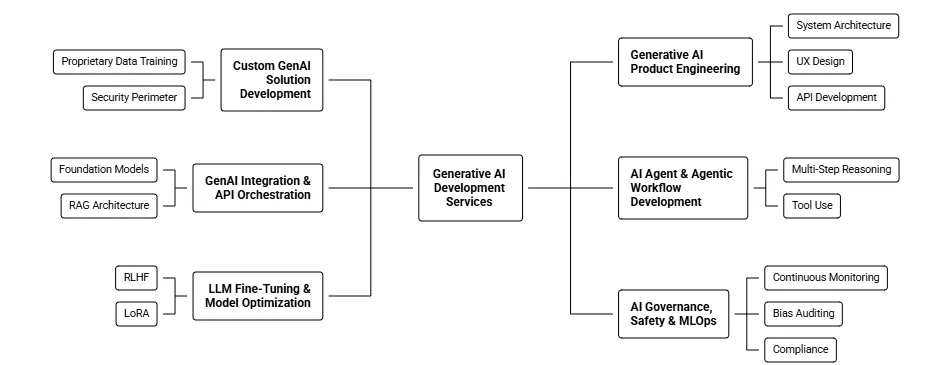
1. Custom GenAI Solution Development
When off-the-shelf models won’t cut it due to niche data, regulatory requirements, or IP ownership, custom generative AI development services are the answer. This involves training or fine-tuning models on proprietary data, keeping everything within your security perimeter.
Best for: Financial services, legal, healthcare, defense, and any domain where data sovereignty is non-negotiable.
2. Generative AI Product Engineering
End-to-end generative AI development services for AI-powered software products, from internal productivity tools to market-ready SaaS platforms. This service covers system architecture, UX design, model selection, API development, and go-to-market readiness, treating AI as a product rather than a feature.
Best for: Startups building AI-native products, enterprises launching internal copilots, and businesses looking to commercialize AI capabilities as a standalone offering.
3. GenAI Integration & API Orchestration
A core pillar of professional generative AI development services is connecting foundation models GPT-4o, Claude, Gemini, and Llama into existing enterprise systems through robust API layers, middleware, and data pipelines. This includes the RAG (Retrieval-Augmented Generation) architecture to ground model responses in your proprietary knowledge base.
Best for: Organizations that want to augment existing software with AI capabilities without rebuilding core infrastructure from scratch.
4. AI Agent & Agentic Workflow Development
The frontier of enterprise generative AI development services right now. Autonomous agents capable of multi-step reasoning, tool use, and task execution without constant human oversight. When built correctly, they reduce operational workload dramatically; when built carelessly, they introduce significant risk.
Best for: Operations-heavy teams looking to automate complex, multi-step workflows across CRM, ERP, support, and back-office systems.
5. LLM Fine-Tuning & Model Optimization
Quality generative AI development services include taking a foundation model and making it meaningfully better for your specific use case using RLHF, LoRA, QLoRA, and instruction-tuning techniques. The result is a more accurate, cost-efficient, and compliant system than a general-purpose model alone can provide.
Best for: Businesses with sufficient proprietary data, domain-specific terminology, or strict accuracy requirements that general-purpose models consistently fail to meet.
6. AI Governance, Safety & MLOps
The most overlooked layer of generative AI development services operationalizing AI responsibly through continuous monitoring, drift detection, bias auditing, compliance with the EU AI Act and NIST AI RMF, and automated model lifecycle management. Skipping this layer is one of the leading causes of production AI failures.
Best for: Any organization running AI in production, particularly those in regulated industries or scaling AI across multiple business units simultaneously.
The Generative AI Development Lifecycle
Industries Where Generative AI Creates the Sharpest ROI
Generative AI development services don’t deliver uniform value across every sector. These industries are seeing the most measurable impact from targeted investments:
- Financial Services: Automated report generation, intelligent document processing, regulatory compliance summarization, and fraud narrative analysis
- Healthcare & Life Sciences: Clinical documentation automation, drug discovery acceleration, and medical literature synthesis
- Legal & Compliance: Contract review and generation, regulatory change monitoring, and due diligence automation
- Retail & E-Commerce: Personalized product description generation, customer service automation, and review synthesis
- Manufacturing: Predictive maintenance documentation, quality control reporting, and technical manual authoring
- Education & EdTech: Adaptive curriculum generation, personalized assessment creation, and multilingual content localization
How to Choose the Right Generative AI Development Partner
The vendor landscape is crowded. Every agency now claims generative AI development services expertise. Separating genuine capability from marketing requires a clear framework.
What to Look For:
- Demonstrated production deployments with measurable outcomes, not polished demos
- Deep ML engineering capability beyond prompt engineering and API wrappers
- Domain familiarity with your industry’s data, regulations, and compliance requirements
- Transparent data handling policies with clear ownership and sovereignty terms
- A defined evaluation methodology with real performance benchmarks
- MLOps maturity is the ability to manage models post-deployment, not just ship them
Red Flags Worth Walking Away From:
- No discovery phase, jumping straight to development without understanding the problem
- Over-reliance on a single model provider (fragile architecture, captive pricing)
- No plan for post-deployment monitoring or model drift management
- Vague answers about data provenance, training data ownership, or privacy controls
- Success stories that are all prototype demos, with no production metrics
The Build vs. Buy vs. Fine-Tune Decision
One of the most consequential early decisions in any generative AI development services engagement:
| Approach | Best For | Data Privacy | Customization | Time to Value |
|---|---|---|---|---|
| API Integration (GPT, Claude) | Rapid prototyping, general tasks | Shared | Limited | Days–weeks |
| RAG on Open-Source Models | Private knowledge bases | Private | High | Weeks |
| Fine-Tuned Foundation Model | Domain-specific, compliance-heavy | Private | Very High | Months |
| Fully Custom Pre-training | Sovereign AI, full IP ownership | Full control | Complete | 6–18 months |
Architecture decisions made in week two are expensive to reverse in week twelve. Getting this call right up front, ideally guided by an experienced generative AI development services partner, is worth significant deliberation.
What’s Shaping Generative AI Development Today
The landscape for generative AI development services has shifted dramatically in a short time. These are the trends defining the next wave of enterprise adoption:
- Agentic AI is moving from research to production. Autonomous agents executing multi-step workflows across enterprise systems are the dominant architectural pattern in advanced generative AI development deployments.
- Small Language Models (SLMs) like Phi-3 and Gemma are making on-device and edge deployments viable, eliminating cloud dependencies for latency-sensitive use cases and reshaping how generative AI development services are architected.
- Multimodal models are collapsing historically separate AI verticals into unified systems capable of reasoning across text, images, audio, and code simultaneously.
- AI regulation is no longer theoretical. The EU AI Act is in force, making auditability and explainability hard engineering requirements in any serious generative AI development services engagement.
Conclusion
Generative AI development services, done right, are among the highest-leverage investments an enterprise can make today. Done wrong, they become expensive proof that hype outpaced strategy.
The difference almost always comes down to three things: choosing the right problem, working with the right generative AI development services partner, and respecting the process rigor that production AI actually demands. Start there, and the odds shift decisively in your favor.
FAQs
What’s the difference between generative AI and traditional AI development services?
Traditional AI classifies or predicts from fixed inputs; generative AI development services produce net-new content like text, images, and code, requiring different architectures, evaluation methods, and governance frameworks.
What are generative AI development services?
Generative AI development services are end-to-end solutions for building, integrating, fine-tuning, and maintaining AI systems that generate original text, code, images, and data outputs for business use cases.
How much do generative AI development services cost?
Costs range from $20,000–$50,000 for a scoped PoC to $500,000+ for a fully custom enterprise generative AI development engagement, depending on complexity, data requirements, and deployment scale.
How do generative AI development services handle data privacy?
Reputable generative AI development services providers offer private deployment options, on-premise fine-tuning, and clear data governance frameworks to ensure your proprietary data is never used to train public models.
What is MLOps, and why is it part of generative AI development services?
MLOps covers the deployment, monitoring, retraining, and lifecycle management of AI models in production — without it, even the best generative AI development work degrades rapidly after launch.
What is RAG, and why does it matter in generative AI development services?
RAG (Retrieval-Augmented Generation) grounds a model’s responses in your proprietary knowledge base, dramatically reducing hallucinations. It’s a foundational technique in enterprise generative AI development services.
Do I need custom generative AI development services, or can I just use an API?
API-first approaches work for general tasks; custom generative AI development services are necessary when you have proprietary data, strict compliance requirements, or need outputs beyond what off-the-shelf models deliver.