Table of Contents
Artificial intelligence is now becoming the building block of every company.
And not every AI can meet your needs.
The era of generic AI tools, deployed broadly and tuned for nobody in particular, is giving way to something far more powerful: custom AI solutions designed specifically around the unique challenges, data, and goals of each organization.
This is the world that custom AI solution providers inhabit.
They are the architects of custom-made intelligence, the companies and teams that sit at the intersection of deep technical expertise and real-world business understanding.
And as AI adoption accelerates across every industry, their role has never been more critical.
A deep dive into the companies powering business transformation through tailored artificial intelligence
What Is a Custom AI Solution Provider?
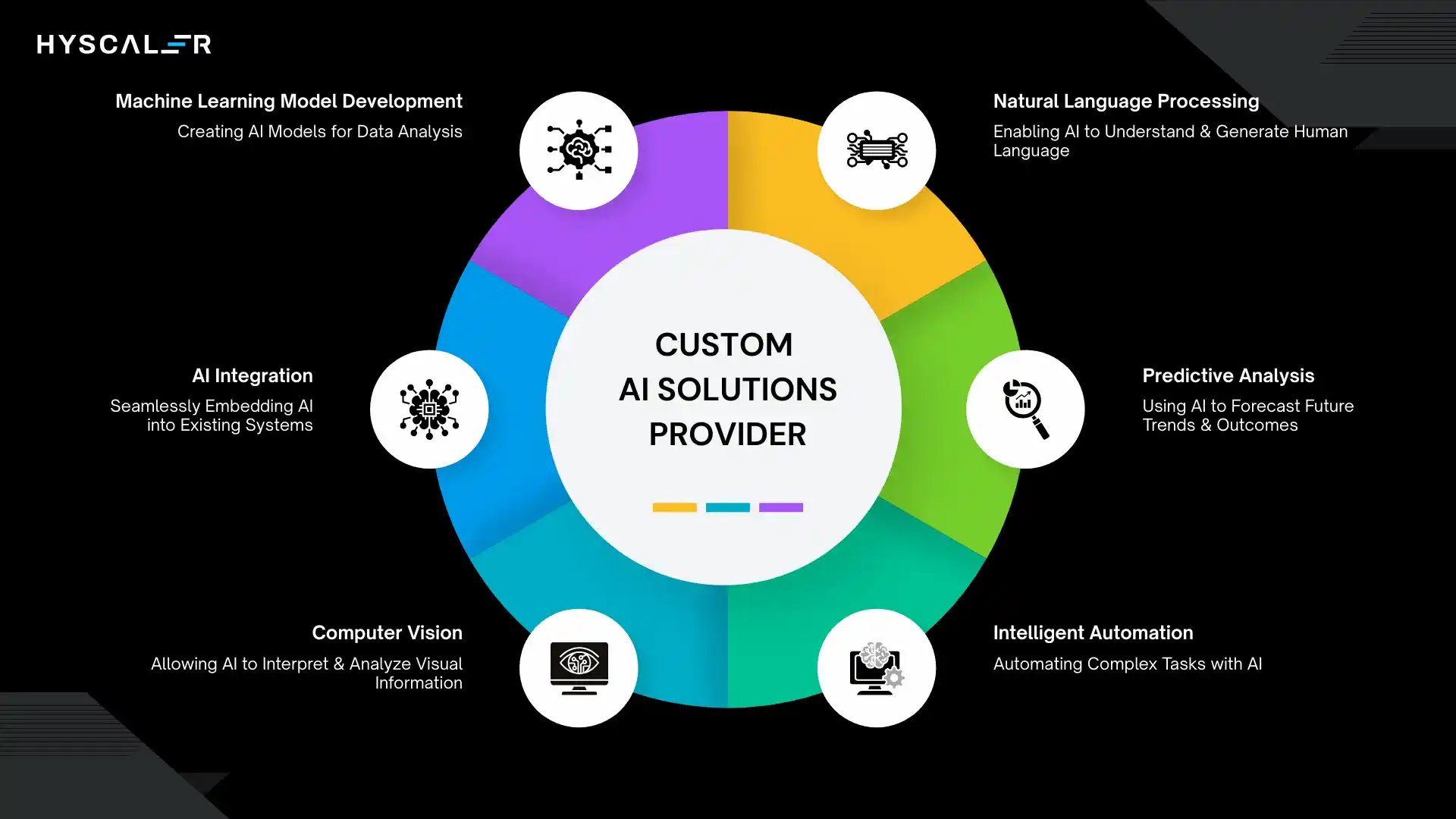
A custom AI solution provider is a specialized company or team that designs, builds, and deploys artificial intelligence systems tailored to the specific needs of a client or industry.
Unlike off-the-shelf software vendors, these providers do not sell packaged products.
Instead, they engage deeply with a client’s workflows, data infrastructure, and strategic objectives, then engineer AI systems from the ground up to address those precise requirements.
Custom AI providers typically offer a broad range of capabilities, including machine learning model development, natural language processing, computer vision, predictive analytics, intelligent automation, and AI integration into existing enterprise systems.
They may serve a single industry vertically, such as healthcare, finance, or manufacturing, or operate horizontally across sectors.
What defines them is not just technical skill, but the commitment to understanding the client’s business deeply before writing a single line of code.
Why Businesses Are Turning to Custom AI
The appeal of off-the-shelf AI tools is understandable.
They are fast to deploy, relatively affordable, and require little in-house expertise.
But for organizations with complex operations, sensitive data, or a genuine need for competitive differentiation, generic tools quickly reveal their limitations.
Here is why forward-thinking businesses are choosing custom over commodity:
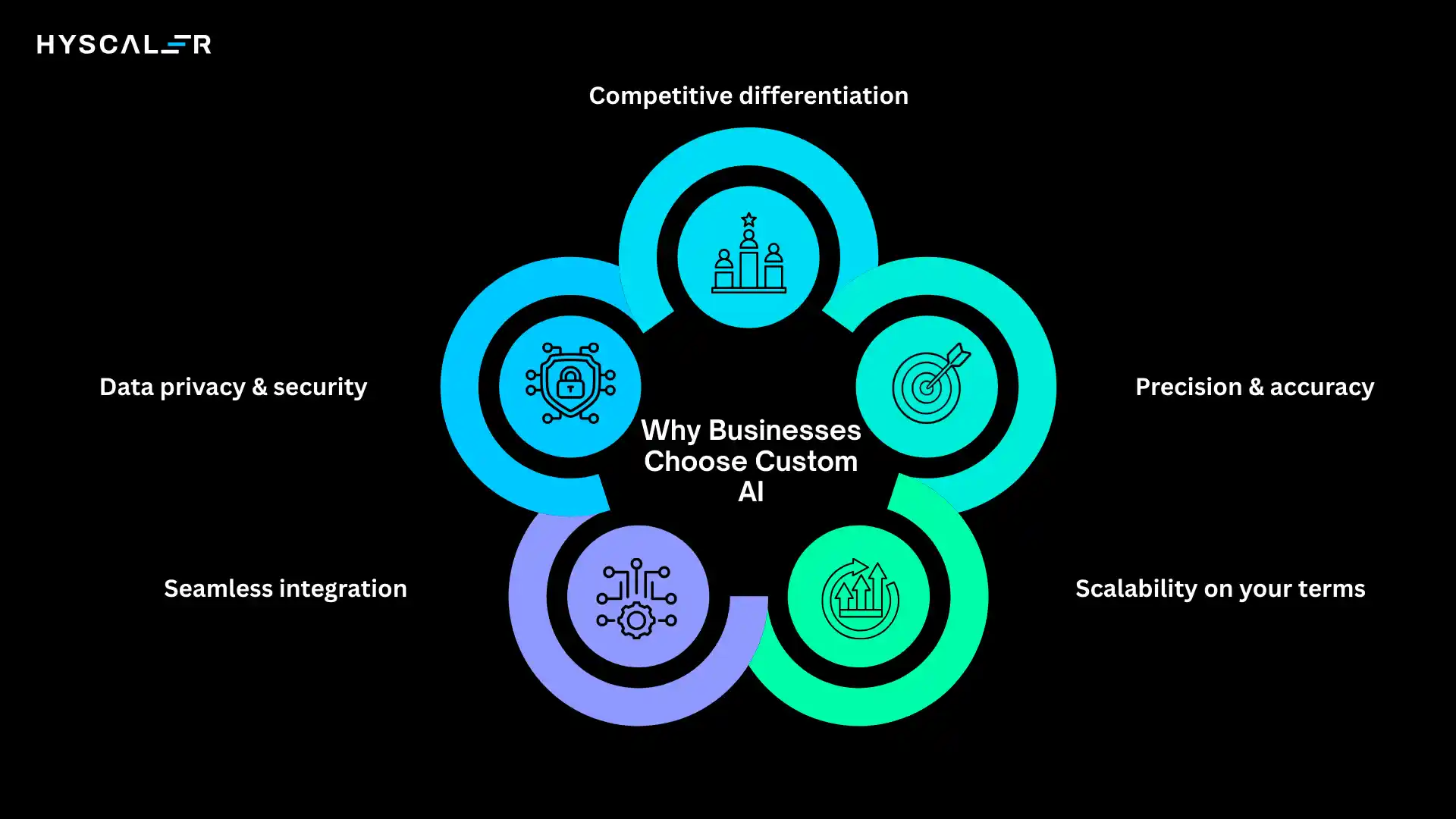
- Competitive differentiation: A custom AI model trained on proprietary data provides insights that no competitor using the same generic tool can replicate.
- Precision and accuracy: Industry-specific models vastly outperform generalist ones because they understand the domain’s terminology, patterns, and edge cases.
- Data privacy and security: Custom systems can be architected to keep sensitive data entirely within a company’s infrastructure, rather than sending it to third-party cloud services.
- Seamless integration: Bespoke solutions are built to connect naturally with existing enterprise systems, ERP, CRM, and legacy databases, eliminating the awkward workarounds that generic tools require.
- Scalability on your terms: A custom AI system grows with the organization, adapting as business needs evolve rather than waiting for a vendor to release an update.
The Custom AI Development Process
Building a custom AI solution is a collaborative, iterative journey.
The best providers follow a structured yet flexible process that ensures the final product genuinely solves the client’s problem rather than simply demonstrating technical sophistication.
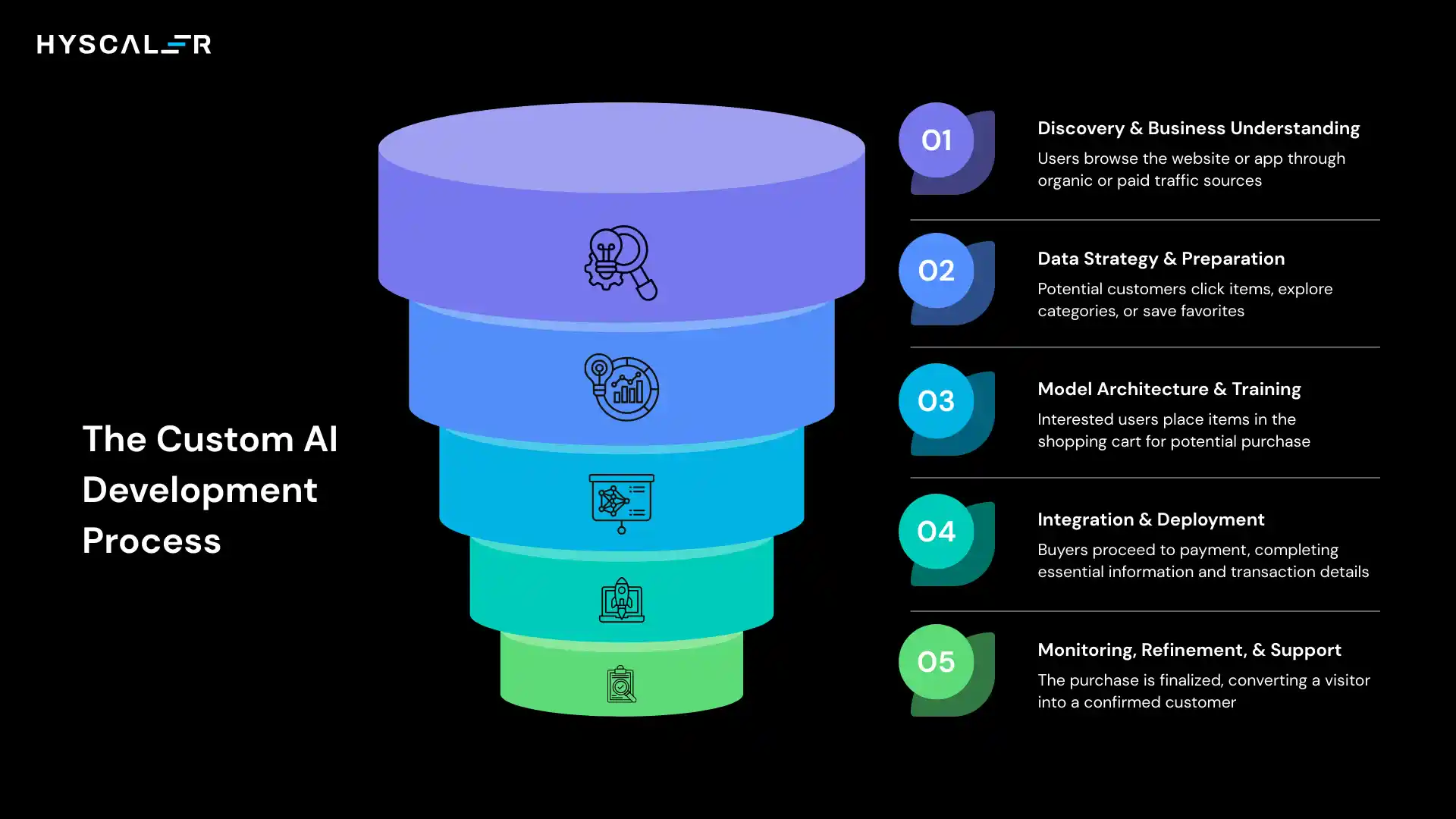
1. Discovery and Business Understanding
Before any model is trained, the provider must understand the business deeply.
This involves stakeholder interviews, process mapping, data audits, and competitive analysis.
The goal is to precisely define the problem worth solving and the measurable outcomes that will define success.
2. Data Strategy and Preparation
AI is only as good as the data behind it.
Custom providers invest heavily in data collection, cleaning, labeling, and governance.
They assess data quality, identify gaps, and design pipelines that feed the model with the right signals.
In some cases, they help clients build data collection strategies from scratch.
3. Model Architecture and Training
With data in hand, the team selects or designs the appropriate model architecture, whether that means fine-tuning a large language model, building a custom neural network, or developing an ensemble of specialized classifiers.
The model is trained iteratively, with continuous evaluation against real-world performance metrics.
4. Integration and Deployment
Building the model is only half the work.
Deploying it inside an existing enterprise environment, connecting it to databases, wrapping it in APIs, and embedding it into user-facing applications demands significant systems engineering.
The best custom providers handle both sides of this equation with equal competence.
5. Monitoring, Refinement, and Support
AI models degrade over time as the world changes.
Leading providers build ongoing monitoring into their engagements, tracking model performance, detecting drift, and retraining as needed.
The relationship does not end at launch; it evolves.
Industries Transformed by Custom AI
Custom AI is not confined to any single sector.
Its impact is being felt across the entire economy:
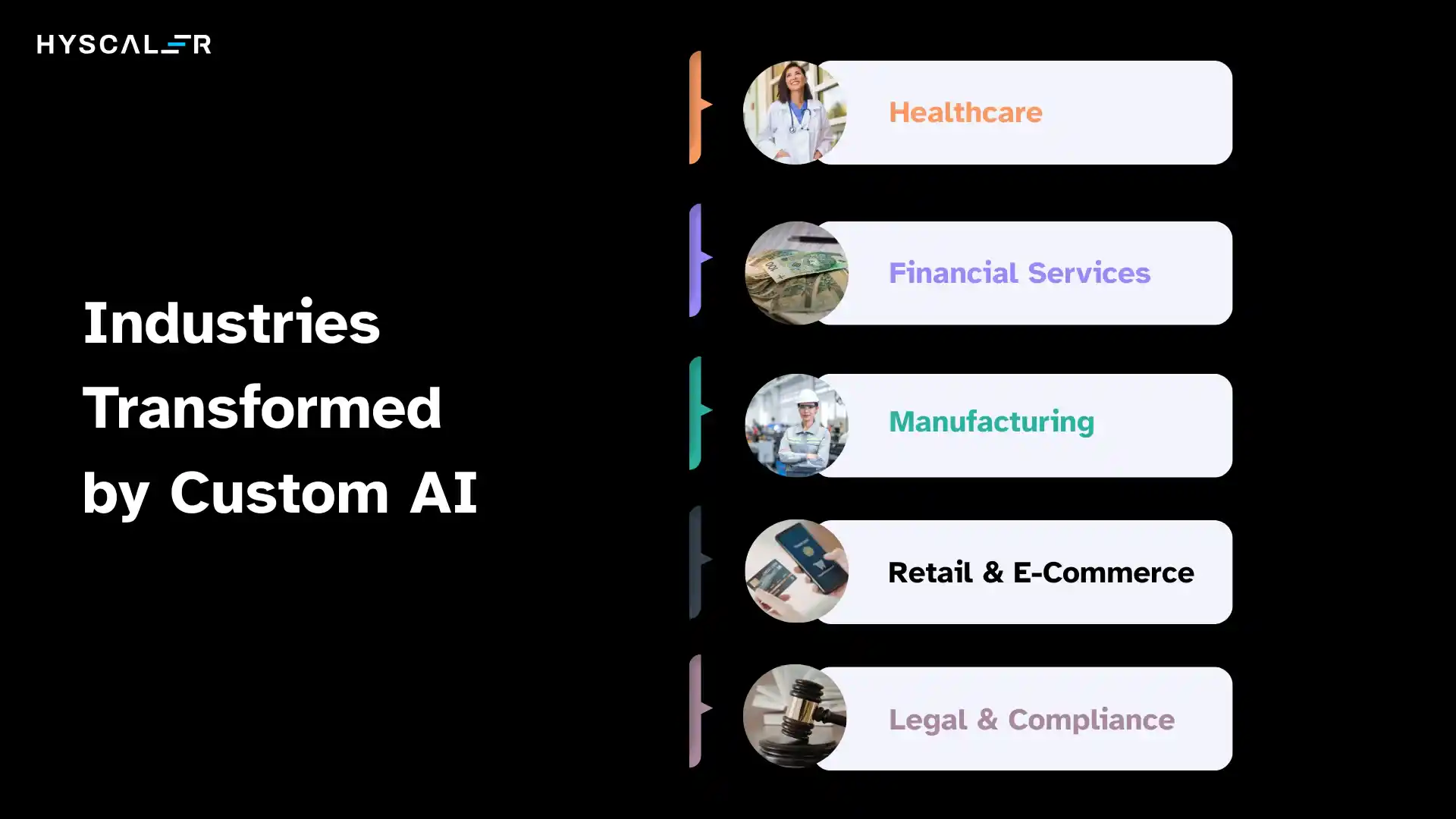
- Healthcare: AI systems trained on clinical data assist with diagnostic imaging, patient risk stratification, drug discovery, and personalized treatment planning, with accuracy tuned to specific patient populations.
- Financial Services: Custom fraud detection models, credit risk engines, and algorithmic trading systems built around a firm’s unique portfolio and risk appetite outperform generic alternatives significantly.
- Manufacturing: Predictive maintenance systems trained on machine-specific sensor data reduce unplanned downtime, while computer vision quality inspection catches defects at superhuman speed and precision.
- Retail and E-Commerce: Personalization engines built on a retailer’s own customer behavior data drive conversion rates and lifetime value far beyond what third-party recommendation tools achieve.
- Legal and Compliance: Firms use custom NLP models to analyze contracts, flag regulatory risks, and surface relevant case law, dramatically accelerating workflows that once consumed thousands of billable hours.
What to Look for in a Custom AI Provider
Choosing the right custom AI partner is one of the most consequential technology decisions a business can make.
The market is crowded, and not all providers deliver on their promises.
When evaluating candidates, organizations should look for the following qualities:
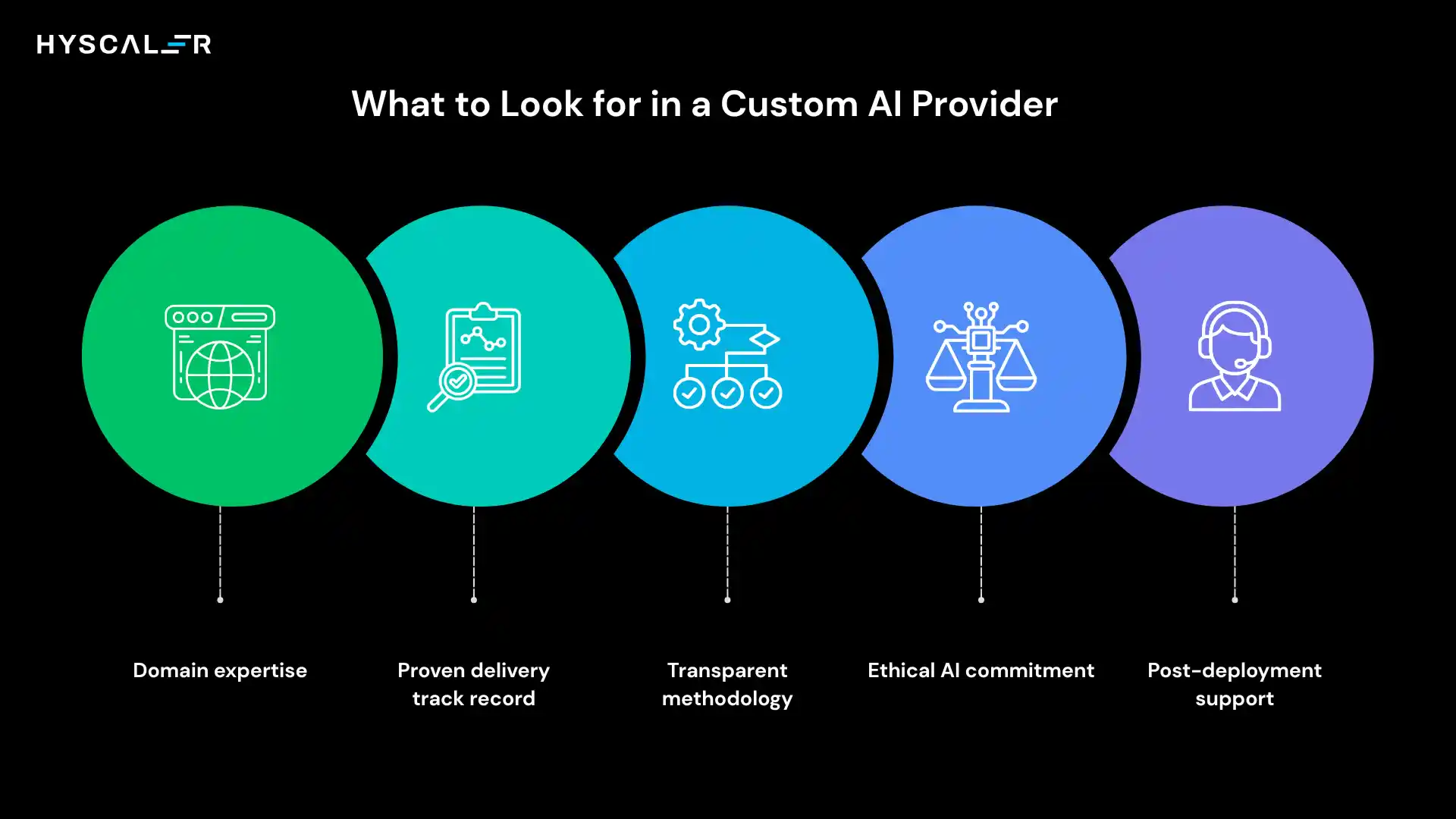
- Domain expertise: Do they have demonstrated experience in your industry? A provider who has solved similar problems before will move faster and avoid costly mistakes.
- Proven delivery track record: Ask for case studies, references, and measurable outcomes from past engagements. Strong providers are proud to show their work.
- Transparent methodology: The best providers explain what they are building, why they are building it that way, and what the risks and limitations are. Opacity is a red flag.
- Ethical AI commitment: Responsible providers build bias detection, explainability, and fairness considerations into their processes, not as afterthoughts, but as core design principles.
- Post-deployment support: AI is a journey, not a project. Look for providers who offer ongoing monitoring, retraining, and evolution of the system as your needs change.
The Road Ahead: AI That Belongs to You
The most strategically significant thing about a custom AI solution is something easy to overlook: it belongs to you.
The model, the training data pipeline, and the integration architecture, all of it, can be owned, controlled, and iterated upon by the organization that commissioned it.
This stands in stark contrast to SaaS AI tools, where the vendor retains control, and the client is perpetually dependent.
As AI becomes increasingly central to how businesses operate, compete, and create value, this distinction will matter enormously.
The companies that invest now in building proprietary intelligence, working with the right custom AI partners, will carry an advantage that compounds over time.
Custom AI solution providers are not selling software.
They are building intellectual infrastructure, the foundations upon which the next generation of industry leaders will run.
FAQ
What is a custom AI solution provider?
A custom AI solution provider designs and develops AI systems tailored to a company’s specific business needs, data, and workflows.
Why do businesses choose custom AI solutions instead of ready-made AI tools?
Custom AI solutions are built to match unique business processes, integrate with existing systems, and deliver more accurate results.
What services do custom AI solution providers typically offer?
They offer AI consulting, machine learning model development, AI integration, data engineering, and ongoing AI optimization.
Which industries benefit the most from custom AI solutions?
Industries like healthcare, finance, retail, manufacturing, logistics, and agriculture gain significant value from tailored AI systems.
How long does it take to build a custom AI solution?
Depending on complexity, development can take anywhere from a few weeks for prototypes to several months for full enterprise systems.
What technologies are commonly used in custom AI development?
Technologies include machine learning, natural language processing (NLP), computer vision, predictive analytics, and generative AI.
Are custom AI solutions secure for enterprise use?
Yes. They are built with enterprise-grade security, compliance standards, and data privacy controls.
How much do custom AI solutions typically cost?
Costs vary widely based on scope, but projects usually range from tens of thousands to several hundred thousand dollars.
Can custom AI solutions integrate with existing enterprise software?
Yes. Most solutions are designed to integrate with CRMs, ERPs, cloud platforms, and other enterprise systems.
How do companies choose the right custom AI solution provider?
Businesses should evaluate expertise, industry experience, portfolio, AI capabilities, and long-term support services.