Table of Contents
What does a CMMI Level 5-certified company actually do differently, and what does it mean for your project?
Most software vendors will tell you they follow “best practices”, but how do you verify those best practices claims?
Solution – CMMI Level 5 means an independent assessor verified that claim.
CMMI, Capability Maturity Model Integration, is a process improvement framework developed by Carnegie Mellon University’s Software Engineering Institute.
It has five levels.
The majority of companies that bother getting assessed land at Level 2 or 3.
Fewer than 5% of CMMI-assessed organisations worldwide have ever reached Level 5, which requires not just documented processes but a proven, measurable track record of continuous optimisation.
HyScaler is one of them.
If you’re evaluating IT partners in India for an AI, product engineering, or digital transformation engagement, this page explains what that certification actually means for your day-to-day experience working with us, and why it should be part of your vendor checklist.
The Five CMMI Levels
CMMI is not a single pass/fail exam.
It’s a maturity scale assessed by trained appraisers using a process called a SCAMPI appraisal.
Here’s what the levels mean in practice:
| Level | Name | What it means for clients |
|---|---|---|
| 1 | Initial | Processes are ad hoc. Success depends on individual heroics. |
| 2 | Managed | Basic project management is in place. Projects are planned and tracked. |
| 3 | Defined | Processes are standardised and documented across the organisation. |
| 4 | Quantitatively Managed | Quality and performance are measured statistically. Variation is understood and controlled. |
| 5 | Optimising | The organisation actively uses data to improve processes. Root causes of defects are identified and eliminated systematically. |
Most IT buyers know to ask about ISO certifications or SOC 2 reports.
Fewer think to ask about CMMI.
It’s worth asking, because the difference between Level 3 and Level 5 is the difference between a company that has documented processes and one that measures whether those processes are actually working.
What CMMI Level 5 Requires in Practice
To reach Level 5, a company has to satisfy process areas across all five maturity levels, including two that are specific to the top tier:
- Causal Analysis and Resolution (CAR): When something goes wrong, a bug escapes into production, a sprint overruns, the team is required to trace the root cause and change the underlying process, not just patch the immediate problem.
- Organisational Performance Management (OPM): The organisation must use statistical data to set quantitative improvement targets, track progress against them, and adjust when the data says something isn’t working.
These aren’t aspirational goals.
An independent SCAMPI A appraiser reviews evidence: meeting records, process metrics, defect data, retrospectives, and improvement logs.
If the evidence isn’t there, the rating isn’t granted.
| The SEI estimates that fewer than 5% of CMMI-assessed organisations worldwide hold a Level 5 appraisal. In India’s IT sector, where CMMI adoption is highest globally, Level 5 organisations still represent a small minority of active vendors. |
What Does This Mean for Your Project?
Certifications don’t ship software – Processes do.
Here’s how CMMI Level 5 discipline shows up on the work HyScaler does with clients.
Predictable Delivery
At Level 4 and above, delivery performance is tracked statistically.
HyScaler measures sprint velocity, defect escape rates, and rework frequency over time.
When a project starts to drift from its baseline, not after it has already gone off the rails, the data flags it.
Clients don’t absorb schedule surprises at the end of a quarter.
Defects Caught Earlier
Level 5 requires formal defect prevention, not just defect tracking.
Before a sprint begins, the team reviews historical defect data for similar work and adjusts the testing strategy accordingly.
The aim is to stop defects from entering the codebase rather than finding them later at significantly higher cost.
Post-Incident Learning that Actually Changes Behaviour
When something does go wrong, a production incident, a missed requirement, a rework cycle, the Causal Analysis and Resolution process kicks in.
Root cause is documented.
A corrective action is logged against the specific process step that failed.
The same failure is less likely to happen again, on your project or anyone else’s.
Consistent Quality Across Teams
One of the hardest things to maintain in a growing IT firm is quality consistency as headcount increases.
CMMI Level 5 requires that process improvements be institutionalised, not just adopted by one team lead, but embedded in how every project is run.
New engineers inherit a tested playbook, not a blank slate.
| This matters particularly for AI and blockchain engagements, where requirements evolve rapidly, and the cost of rework is high. Predictable process discipline is a risk management tool. |
HyScaler and CMMI Level 5: the context
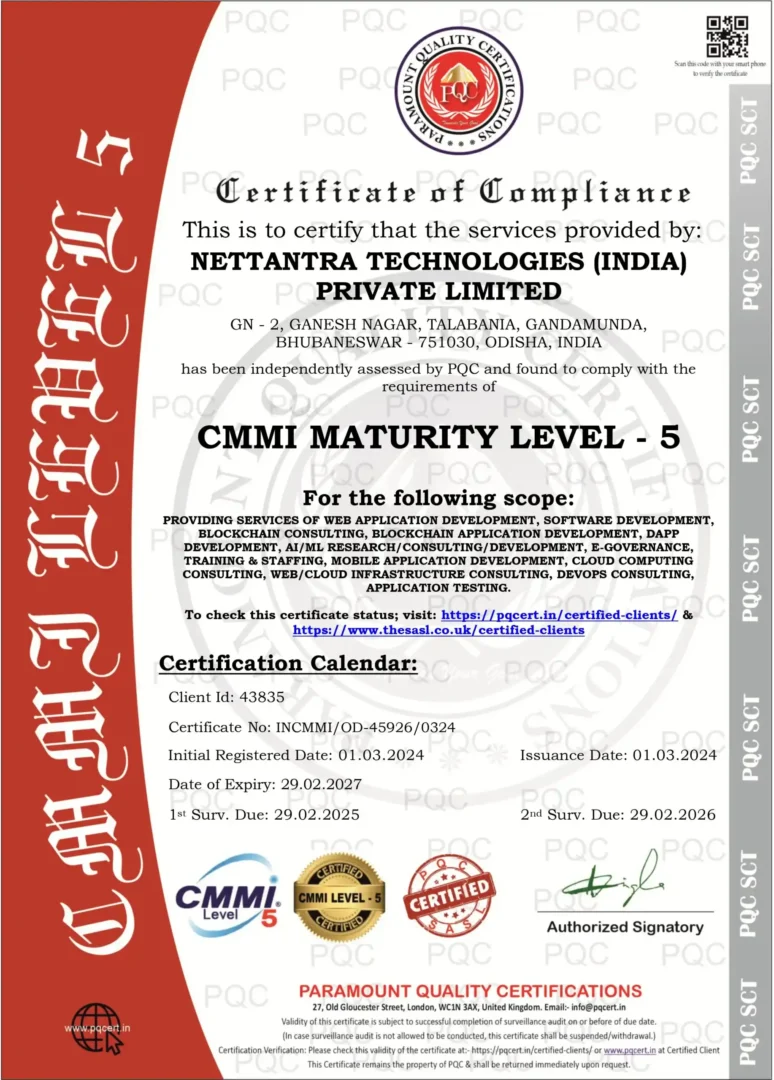
HyScaler, registered as NetTantra Technologies (India) Private Limited, operates as an AI, blockchain, IT, and healthcare consulting company serving clients across the US, UK, and India.
The company achieved a CMMI Level 5 appraisal, placing it in a small peer group that includes firms significantly larger by headcount.
The practical advantage of that size-to-maturity ratio: you get the process rigour of an enterprise vendor with the responsiveness and accountability of a mid-sized team.
A decision made by a client today doesn’t have to travel through three layers of account management before it reaches an engineer.
HyScaler’s active service lines, AI/ML development, blockchain and Web3, DevOps, IoT, and healthcare software, all benefit from the same underlying process discipline.
Whether the engagement is building a RAG-based information retrieval system or deploying an EMR for a specialty clinic, the quality framework is identical.
Comparing CMMI Level 5 Firms in India: What to Look for
When evaluating IT partners, here’s how CMMI certification fits alongside other common due diligence criteria:
| Criterion | What to ask |
| CMMI Level | Ask for the appraisal certificate, not just a self-declared claim. Certificates include the assessed organisation name, level, and appraisal date. |
| ISO 27001 | Information security management. Essential for any engagement that handles sensitive or regulated data. |
| Process documentation | Ask to see a sample sprint retrospective and how resulting actions are tracked to closure. |
| Defect metrics | A Level 5 firm should be able to share anonymised defect escape rate data. If they can’t, that’s a signal. |
| Reference clients | Ask for clients in a similar domain who can speak to delivery consistency, not just the final output. |
Common questions
Does CMMI Level 5 Mean Every Project Will Be Delivered on Time?
No certification guarantees outcomes.
What Level 5 does is create a system in which problems are detected early, root causes are addressed rather than papered over, and the team continuously improves based on real data.
Projects still face scope changes, evolving requirements, and technical unknowns.
CMMI reduces the process-related causes of failure; it doesn’t eliminate all risk.
Is CMMI Level 5 Relevant for Smaller Engagements?
Yes. The process discipline applies regardless of project size.
For a 12-week MVP engagement, the benefit shows up in sprint consistency and fewer rework cycles.
For a multi-year platform build, it shows up in delivery predictability and institutional knowledge transfer as teams scale.
How do I Verify a CMMI Level 5 Claim?
Ask the vendor for their SCAMPI appraisal certificate.
Certificates issued by accredited lead appraisers show the organisation name, assessed service lines, maturity level, and appraisal date.
You can also verify active appraisals through the CMMI Institute’s published data.
What About Agile Development and CMMI? Are They Compatible?
They are.
CMMI has been adapted for Agile contexts, and the two are not in conflict.
The process areas that matter most at Level 5, statistical measurement, causal analysis, and performance management, are applied at the programme level rather than prescribing how individual sprints are run.
Agile ceremonies can (and should) remain lightweight.
Who Should Care most about CMMI Level 5?
Not every buyer needs to prioritise this certification. Here’s where it matters most:
- Regulated industries: Healthcare, fintech, and government projects where auditability and process documentation are compliance requirements.
- Large-scale or long-horizon engagements: The compounding benefit of continuous improvement is most visible over 12+ month programmes.
- Enterprise clients with internal quality teams: If your own organisation has a quality function, a CMMI Level 5 partner can align more naturally with your internal standards and audit requirements.
- High-stakes product launches: Where defects in production carry high commercial or reputational cost, the defect-prevention focus at Level 5 is directly valuable.
If you’re hiring a firm to build a landing page or run a short UI audit, CMMI Level 5 isn’t the primary filter.
If you’re building a healthcare platform, a financial application, or an enterprise AI system, it should be on your checklist.
The bottom line
CMMI Level 5 is a demanding certification to earn and maintain.
It requires an organisation to do more than document what it does; it has to prove, with data, that it consistently does it and that it gets measurably better over time.
HyScaler’s Level 5 appraisal is one signal among several you should evaluate when choosing an IT partner in India.
It sits alongside domain expertise, client references, team depth, and the specifics of how a firm has handled engagements similar to yours.
If you want to understand how our process discipline applies to a specific type of engagement, an AI system, a blockchain product, or a healthcare application, we’re happy to walk through the details.
| Contact HyScaler to discuss your project. Ask us about our CMMI appraisal, our defect metrics, and how our process model would apply to your specific engagement. |
FAQs
What is CMMI Level 5 in software development?
CMMI Level 5, called the Optimising level, is the highest maturity rating in the Capability Maturity Model Integration framework. It requires an organisation to measure process performance statistically and use that data to drive continuous, quantifiable improvement. It is assessed by independent appraisers using the SCAMPI methodology.
How many IT companies in India have CMMI Level 5?
India has the highest concentration of CMMI-assessed IT organisations globally, largely driven by export software and outsourcing markets. Level 5 organisations remain a minority even within India’s large IT sector. Most mid-sized firms hold Level 3 appraisals. Level 5 is held by a smaller group that includes large enterprises and a limited number of specialist firms.
Is CMMI Level 5 better than ISO 27001?
They measure different things. ISO 27001 is an information security management standard focused on data protection and risk controls. CMMI is a process maturity framework focused on software delivery quality and consistency. Enterprise clients often look for both, as they address separate dimensions of vendor risk.
What is the difference between CMMI Level 3 and Level 5?
At Level 3, processes are defined and standardised across the organisation. At Level 5, those processes are also statistically measured, and the organisation has a formal system for identifying improvement opportunities and implementing them based on quantitative evidence. Level 5 requires Causal Analysis and Resolution, meaning failures must be traced to root causes and used to change the underlying process.
Does CMMI Level 5 apply to Agile teams?
Yes. The CMMI framework has been updated to work alongside Agile methodologies. The process discipline operates at the programme and organisational level, not at the individual sprint level, so Agile teams retain their working practices while benefiting from the measurement and improvement infrastructure that Level 5 requires.