Table of Contents
Running a business is hard enough: your screen should actually match what’s on your shelves.
The transition from rigid, on-premise systems to the cloud is about more than just software; it’s about reclaiming your time and your confidence. Imagine a single source of truth that updates in real-time, integrates seamlessly with your favorite tools, and protects your data with enterprise-grade security.
This is where Cloud-Based Inventory Management changes the game.
It acts as a digital nervous system, replacing technical bottlenecks with limitless elasticity. While traditional systems keep you tethered to a physical server in a back office, the cloud provides a high-speed engine for expansion. It’s time to trade manual entry errors and server crashes for a platform that scales as fast as your vision, turning your warehouse from a cost center into a global competitive advantage.
Below, we break down the 10 definitive reasons why migrating to the cloud is the most critical upgrade your supply chain will face this year.
Why Cloud-Based Inventory Management?
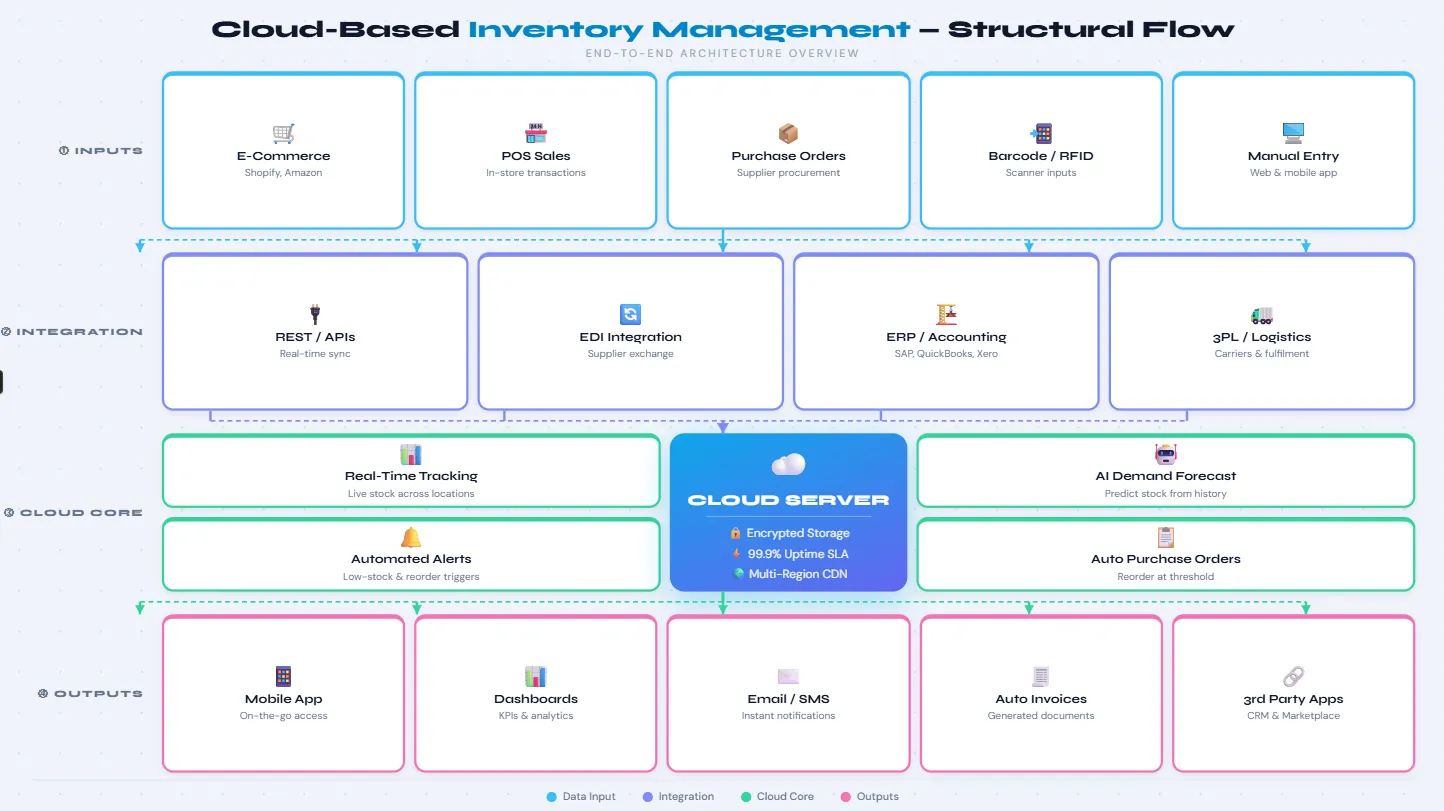
- Uses centralized cloud databases with real-time read/write operations to maintain a single source of truth for inventory.
- Enables event-driven synchronization across warehouses, POS, ERP, and eCommerce systems via APIs and webhooks.
- Supports elastic scalability to handle fluctuating transaction loads without performance degradation.
- Ensures high availability and fault tolerance through a distributed cloud infrastructure and automated failover.
- Implements security controls such as encryption, role-based access, and audit logging for data integrity and compliance.

The Problem With Traditional Inventory Systems
Most businesses start with spreadsheets or basic on-premise software. It works until it doesn’t. Expansion reveals the hidden weaknesses in manual inventory management:
| ⚠️ Traditional System Challenges | 💥 Business Impact |
| Manual data entry across multiple tools | Costly human errors and stock discrepancies |
| No real-time stock visibility | Stockouts, overstocking, and lost sales |
| System confined to one physical location | Zero flexibility for remote or multi-site teams |
| Expensive hardware and IT dependency | High overhead with slow, disruptive upgrades |
| No integration with eCommerce or shipping tools | Data silos and time-wasting duplicate entry |
| Limited reporting and zero forecasting | Reactive decisions instead of proactive planning |
Who Needs Cloud-Based Inventory Management?
Cloud-based inventory management isn’t built for one type of business; it’s built for any business that moves products. If you fall into any of these categories, this is for you:
- eCommerce & Retail: Manage stock across online and physical stores simultaneously
- Manufacturers: Track raw materials, work-in-progress, and finished goods in real time
- Distributors & Wholesalers: Coordinate multi-warehouse operations from a single platform
- Healthcare & Pharma: Maintain compliance-grade accuracy for critical inventory
- Food & Beverage: Monitor expiry dates, batch tracking, and perishable stock levels
- 3PL & Logistics Providers: Serve multiple clients with isolated, accurate inventory views
The 10 Reasons: In Depth
Reason 1: Real-Time Visibility Across Every Corner of Your Business
The Problem: You cannot optimize a process that remains in the dark.
One of the most immediate and powerful benefits of cloud-based inventory management is gaining a live, 360-degree view of your stock across every warehouse, store, or fulfillment center at any given moment.
A modern cloud-based inventory management system connects all your locations under one unified dashboard. Every movement of goods in, goods out, transfers, and returns is updated instantly and automatically. No lag. No discrepancies. No Monday morning surprises.
With a reliable cloud inventory system, your team can:
- Spot low-stock alerts before a stockout happens
- Track inventory movement across multiple sites in real time
- Eliminate the gap between what the system says and what’s actually on the shelf
Key Takeaway: Real-time visibility is the foundation of smart inventory decisions, and the cloud makes it effortless.
Reason 2: Dramatic Cost Savings That Go Straight to Your Bottom Line
The Problem: On-premises systems are bleeding your budget dry.
Running a traditional inventory setup isn’t cheap. Between server hardware, IT staff, software licenses, and emergency maintenance, the costs stack up fast without delivering proportional value. Every year, businesses pour thousands into simply keeping their outdated systems alive, let alone improving them.
Cloud-based inventory management flips the economics entirely. With a predictable, subscription-based pricing model, you eliminate capital expenditures and replace them with manageable monthly costs. Updates, backups, and new features are rolled out automatically: no surprise invoices, no emergency IT callouts, and no version upgrade fees.
Businesses adopting cloud-based inventory management software consistently report a measurable improvement in ROI within the first year, driven by:
- Eliminating server hardware and infrastructure costs completely
- Reducing reliance on in-house IT staff for maintenance and troubleshooting
- Cutting stock losses through smarter reordering and waste reduction
- Freeing up budget to reinvest in growth, marketing, and people
Key Takeaway: Cloud-based inventory management turns a cost center into a competitive advantage. A dollar saved is a dollar earned.
Reason 3: Unlimited Scalability Without the Growing Pains
The Problem: Your business grows. Your legacy system doesn’t.
Scaling an on-premise system means buying more servers, hiring more IT staff, and enduring disruptive upgrade cycles. Every growth milestone comes with a hefty infrastructure price tag and weeks of painful reconfiguration.
Cloud-based inventory management systems are architected for growth from the ground up. Adding a new warehouse? Done in minutes. Expanding into a new country? Your cloud platform is already global. Managing a sudden seasonal spike in orders? Capacity scales automatically without a single hardware purchase.
Think of it this way: whether you’re a startup processing 50 orders a day or an enterprise managing 50,000, your cloud platform delivers the same seamless performance. The system never becomes the ceiling on your growth; it becomes the engine of it.
Here is what effortless scaling looks like in practice:
- Launch a new warehouse location without any system reconfiguration
- Onboard new team members in hours, not weeks
- Handle peak season demand without slowdowns or crashes
- Add new sales channels, retail, wholesale, and online, under one roof
Key Takeaway: Scalability is built-in, not bolted on; your system is always ready for what comes next.
Reason 4: Manage Your Inventory Anytime, From Anywhere
The Problem: Your inventory data is trapped inside one building.
The workforce has gone mobile, and so has business. Owners manage operations from airports. Warehouse managers monitor KPIs from the shop floor. Sales reps check stock availability mid-conversation with a client. None of that is possible when your system only lives on one computer in the back office.
Cloud-based inventory management liberates your data. Your full inventory ecosystem stock levels, orders, supplier details, and live reports are accessible from any device, on any browser, in any timezone, with nothing more than an internet connection.
Whether your team is spread across one building or five continents, everyone stays connected, informed, and aligned:
- Office teams: access dashboards and run reports from their desktops
- Warehouse staff: update stock and process shipments from tablets on the floor
- Traveling managers: monitor operations and approve purchases from smartphones
- Sales reps: check live stock availability during client meetings in the field
Key Takeaway: Your inventory office is wherever you are; the cloud removes every geographical limit.
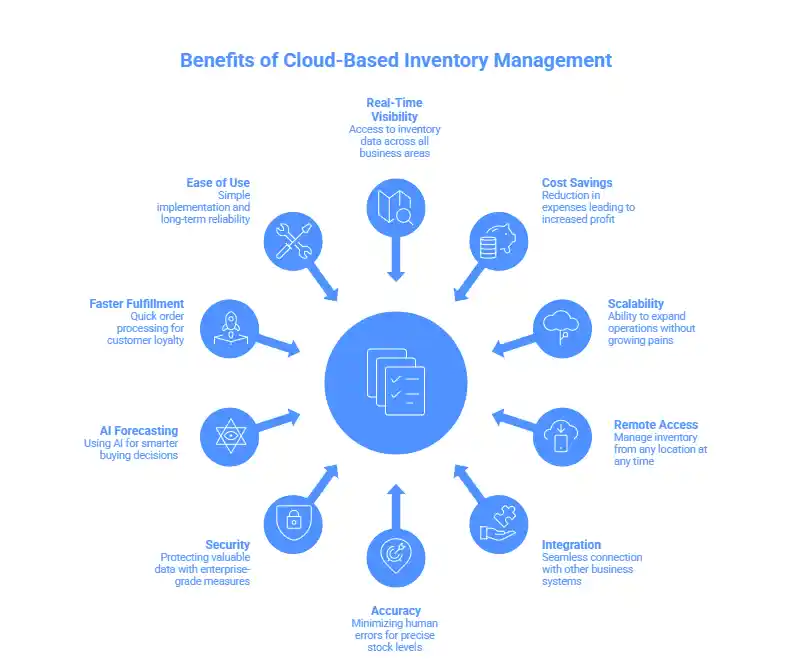
Reason 5: Seamless Integration With Your Entire Business Ecosystem
The Problem: Your business tools don’t talk to each other, and it’s costing you time and money.
Most growing businesses operate across a patchwork of platforms: an eCommerce store here, an accounting system there, a shipping portal somewhere else. When these systems are disconnected, data must be manually re-entered across each one. That wastes time, invites errors, and makes it nearly impossible to get a clear picture of your business.
Cloud-based inventory management software is designed with integration at its core. Leading platforms connect natively or via open API with the tools your business already relies on, turning your disconnected software stack into one synchronized, intelligent ecosystem.
A cloud-based warehouse management system that is wired into your existing tools becomes the operational nerve center of your business, eliminating silos and delivering a single, reliable source of truth across every department:
- Connect your eCommerce store so that online orders update stock automatically
- Sync with your accounting platform so every purchase and sale is reconciled instantly
- Link with shipping carriers so labels are generated and tracking numbers flow back in real time
- Feed your ERP with clean, live inventory data for accurate financial planning
Key Takeaway: True integration means no double entry, no silos, and no data chaos, just one connected, flowing system.
Reason 6: Near-Zero Human Errors and Maximum Stock Accuracy
The Problem: Manual tracking doesn’t just slow you down; it sets you up to fail.
Every miskeyed number, every forgotten stock update, every miscounted shelf is a problem waiting to escalate into a customer complaint, a write-off, or a costly emergency reorder. Human error is not a people problem; it is a systems problem. And cloud-based inventory management solves it at the source.
By automating the most error-prone parts of the inventory process, the system removes the risk of human fallibility from your day-to-day operations. Transactions are captured digitally the moment they happen. Stock counts update in real time. Reorder triggers fire automatically before shelves run dry. Nothing is left to memory, guesswork, or a sticky note.
Businesses switching to inventory management cloud solutions consistently report:
- A dramatic reduction in stock discrepancies across all locations
- Fewer picking and packing errors on the warehouse floor
- Elimination of duplicate or missed entries across connected systems
- Significant drop in write-offs caused by undetected overstock or spoilage
Key Takeaway: Automation doesn’t just make things faster; it makes your inventory data genuinely trustworthy.
Reason 7: Enterprise-Grade Security That Protects What Matters Most
The Problem: Your inventory data is more sensitive and more at risk than most businesses realize.
From supplier pricing and product margins to customer order histories and warehouse locations, your inventory data is a goldmine of sensitive business intelligence. A breach, a ransomware attack, or even accidental data loss can be devastating financially and reputationally.
Most small-to-mid-size businesses simply cannot afford the level of in-house cybersecurity that true data protection requires. Cloud-based inventory management solves this by giving every subscriber access to an enterprise-level security infrastructure, maintained and monitored 24/7 by dedicated security teams.
Leading cloud-based inventory software providers go far beyond basic protection. Here is what comes built into your subscription:
- End-to-end encryption for all data, both in transit and at rest
- Multi-factor authentication to lock out unauthorized access
- Role-based permissions so each team member only sees what they need
- Automatic cloud backups so your data is never lost, even in a disaster
- Compliance with GDPR, SOC 2, ISO 27001, and industry-specific standards
Key Takeaway: Cloud security is not just adequate; it is better protection than most businesses could ever build independently.
Reason 8: AI-Powered Demand Forecasting for Smarter Buying Decisions
The Problem: Buying too much or too little is silently draining your profits.
Overstock ties up working capital in slow-moving products. Understock means lost sales, disappointed customers, and emergency purchasing at premium prices. Striking the right balance manually, especially at scale, is nearly impossible. Most businesses end up reacting to problems instead of preventing them.
Modern cloud-based inventory management platforms transform this entirely through intelligent, AI-driven demand forecasting. By analyzing patterns across your historical sales data, seasonal trends, supplier lead times, and live market signals, the system tells you exactly what to order, how much, and when before a problem ever arises.
A cloud-based inventory management system with built-in forecasting intelligence empowers your buying team to:
- Predict demand peaks weeks in advance and stock up proactively
- Identify slow-moving or dead stock before it becomes a costly write-off
- Automate reorder triggers based on precise safety stock calculations
- Refine purchasing strategies continuously as the AI learns from new data
Key Takeaway: Stop reacting and start predicting. Cloud AI transforms guesswork into a precise, profitable purchasing strategy.
Reason 9: Faster Order Fulfillment That Turns Buyers Into Loyal Customers
The Problem: In the age of next-day delivery, slow fulfillment is a brand killer.
Customer expectations have never been higher. One delayed shipment, one wrong item, and one “out of stock” message at checkout, and that customer is gone, often permanently. Speed and accuracy in fulfillment are no longer differentiators; they are the baseline.
Cloud-based inventory management accelerates every single stage of the fulfillment journey. From the moment an order lands to the moment it reaches the customer’s door, every step is streamlined, automated, and trackable in real time. Nothing falls through the cracks. Nothing gets lost in translation between systems.
Businesses that deploy a cloud-based warehouse management system as part of their fulfillment workflow consistently experience:
- Faster order processing with automated pick lists generated instantly when an order is placed
- Fewer packing errors thanks to barcode-verified fulfillment workflows
- Seamless carrier integration that books shipments and generates tracking numbers automatically
- Higher customer satisfaction scores and lower return rates across the board
Key Takeaway: Fast, accurate fulfillment is your most powerful brand statement, and the cloud makes it your everyday standard.
Reason 10: Quick to Implement, Easy to Run, and Built for the Long Haul
The Problem: Fear of disruption keeps businesses stuck in systems that are holding them back.
The assumption that switching platforms means months of downtime, weeks of retraining, and endless IT headaches is one of the most common and most expensive misconceptions in business technology. It is the reason many companies stay with broken systems for far too long.
The reality of modern cloud-based inventory management is the opposite. Today’s leading platforms are engineered for fast, low-friction onboarding. Most businesses are fully operational within weeks, often days, with guided migration tools, intuitive interfaces, and hands-on support at every stage.
And once you are live, the system only gets better automatically, without any effort on your part:
- Dedicated onboarding specialists guide your setup from day one
- Video tutorials, help centers, and live training get your team confident fast
- Automatic updates deliver new features and improvements with zero downtime
- 24/7 support via chat, email, and phone means help is always one click away
- Regular performance reviews help you continuously optimize how you use the system
Key Takeaway: Switching to cloud-based inventory management is easier than you think, and the competitive edge it delivers starts from day one.
Conclusion
From clipboards to the cloud, the story of inventory management is a story of evolution.
Then ↓ Spreadsheets. Paper logs. On-premise systems that crashed under pressure, data locked in silos no one could access, reorder decisions made on gut feelings, and every growth milestone arriving with a painful, expensive IT overhaul. It worked until the world moved faster than the system could follow.
Now ↓ Cloud-based inventory management has rewritten the rules entirely: real-time visibility across every location, automation that eliminates human error at the source, integrations that connect every tool your business runs on, AI-driven forecasting that turns data into decisions, and a platform that scales as fast as your ambition does. The gap between these two worlds is not just technological; it is the difference between a business that reacts and a business that leads.
The shift has already begun. The only variable left is whether you are ahead of it or still catching up.
FAQs
What is cloud-based inventory management?
A system that stores and manages inventory data on remote servers accessed via the internet, rather than local hardware or software.
Is my inventory data safe in the cloud?
Yes. Leading cloud platforms use encryption, multi-factor authentication, and regular backups to keep your data secure.
Can I manage multiple warehouses or stores with one system?
Absolutely. Cloud systems are highly scalable; you can add users, locations, and features as your business expands.
Can cloud inventory management integrate with my existing tools?
Most cloud platforms offer built-in integrations or APIs to connect with e-commerce, accounting, ERP, and shipping tools.
Can I get real-time inventory updates and alerts?
Yes, real-time tracking and automated low-stock alerts are core features of cloud inventory systems.
Does cloud inventory management help with demand forecasting?
Yes. Advanced platforms use historical data and AI to predict demand, helping you avoid overstock and stockouts.
Can I migrate my existing inventory data to the cloud easily?
Most providers offer data import tools (CSV/Excel) and dedicated onboarding support to make the migration smooth.
How often is data backed up in cloud inventory systems?
Most providers back up data in real time or at frequent intervals (hourly/daily), minimizing the risk of data loss.