Table of Contents
Why AI Maturity Matters in 2026
Artificial intelligence has fundamentally transformed our daily lives.
Organizations are no longer asking whether they should adopt AI; they’re grappling with how to evolve from scattered experiments to cohesive, agentic AI systems that operate autonomously across their enterprises.
Yet, despite unprecedented investment in AI technologies, most organizations struggle to scale beyond proof-of-concept pilots.
Studies show that while over 80% of enterprises have launched AI initiatives, fewer than 20% successfully deploy AI at scale.
The gap between AI ambition and AI achievement has never been wider.
This is where AI maturity models become critical.
Rather than measuring simple adoption metrics, maturity models provide a strategic framework for assessing where your organization stands today and charting a realistic path toward AI-driven transformation.
They help calculate progress, identify capability gaps, and demonstrate tangible ROI to stakeholders.
In this comprehensive guide, we’ll explore the five stages of AI maturity, examine the core dimensions that determine organizational readiness, and provide actionable insights for advancing from initial awareness to autonomous AI systems that fundamentally reshape how your business operates.
What Is an AI Maturity Model?

An AI maturity model is a structured framework that assesses an organization’s capability to develop, deploy, and scale artificial intelligence solutions effectively.
It provides a systematic approach to evaluating AI readiness across multiple dimensions, from data infrastructure and technical capabilities to governance frameworks and organizational culture.
The difference between AI adoption and AI maturity is crucial.
Adoption means using AI tools or technologies, which many organizations do through isolated projects or vendor solutions.
Maturity, however, reflects how well AI is integrated into core business processes, how reliably it delivers value, and how prepared the organization is to evolve its AI capabilities over time.
Think of AI maturity models as roadmaps.
They don’t just show where you are; they illuminate the path forward, helping organizations understand which capabilities to build next, which investments to prioritize, and what organizational changes are needed to progress from experimental AI to transformational AI.
Why Organizations Need an AI Maturity Model
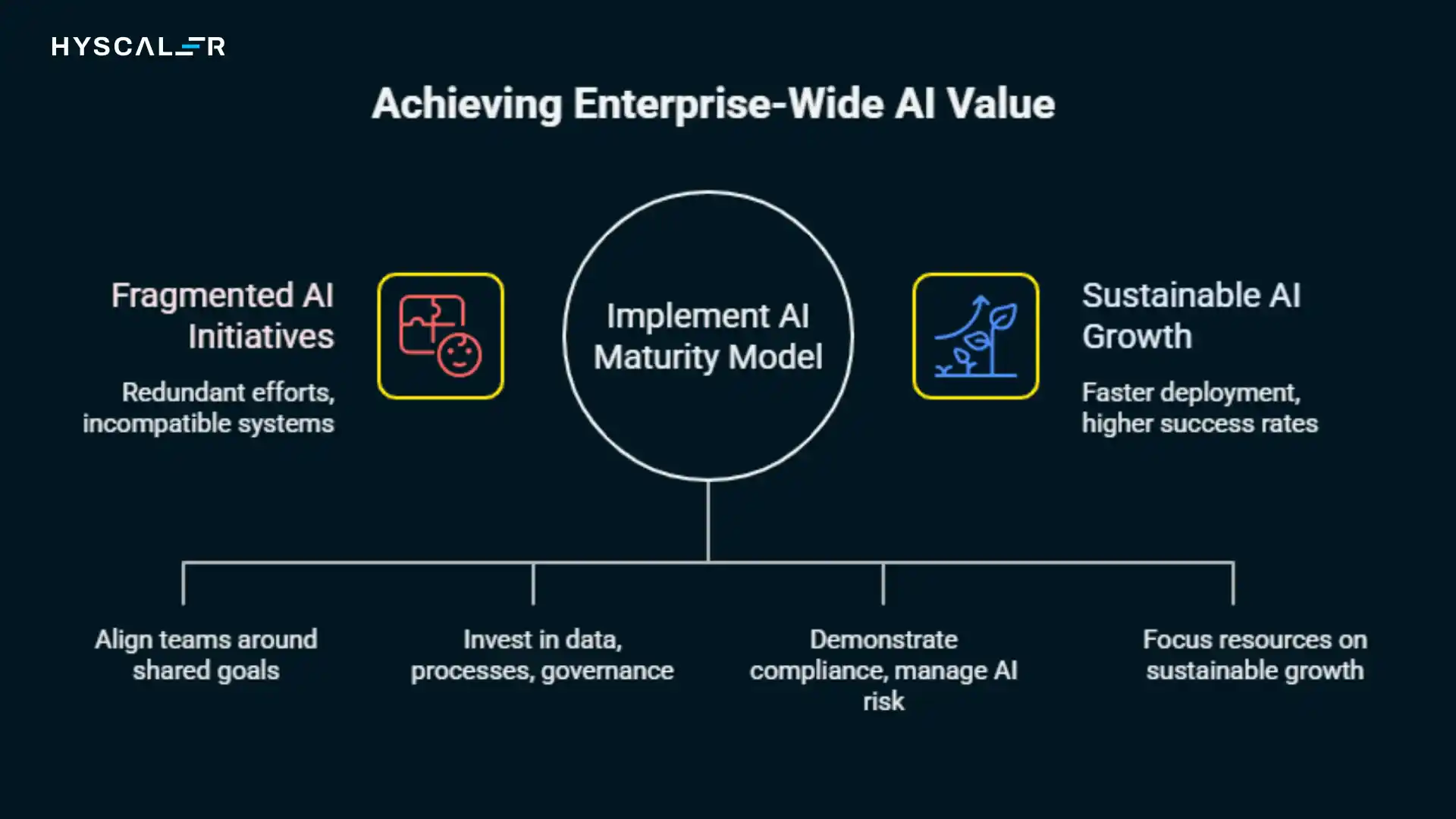
Without a clear maturity framework, AI initiatives often become fragmented across departments, each pursuing its own tools, methods, and objectives.
This creates redundant efforts, incompatible systems, and missed opportunities for enterprise-wide value creation.
AI maturity models address these challenges by providing a common language and assessment framework that aligns technical teams, business leaders, and stakeholders around shared goals.
They prevent the costly mistake of investing heavily in AI technology without the foundational data, processes, and governance structures needed to support it.
In 2026’s regulatory environment, maturity models have taken on additional importance.
With AI regulations like the EU AI Act and emerging frameworks worldwide, organizations need structured approaches to demonstrating compliance, managing AI risk, and ensuring responsible deployment.
Maturity assessments help identify governance gaps before they become regulatory violations.
Perhaps most importantly, maturity models accelerate time-to-value.
By identifying the specific capabilities you need to advance, you help you avoid premature scaling attempts and focus resources on the foundational elements that enable sustainable AI growth.
Organizations with clear maturity roadmaps typically see 40-60% faster deployment cycles and significantly higher success rates in moving AI projects from pilot to production.
Core Dimensions of an AI Maturity Model
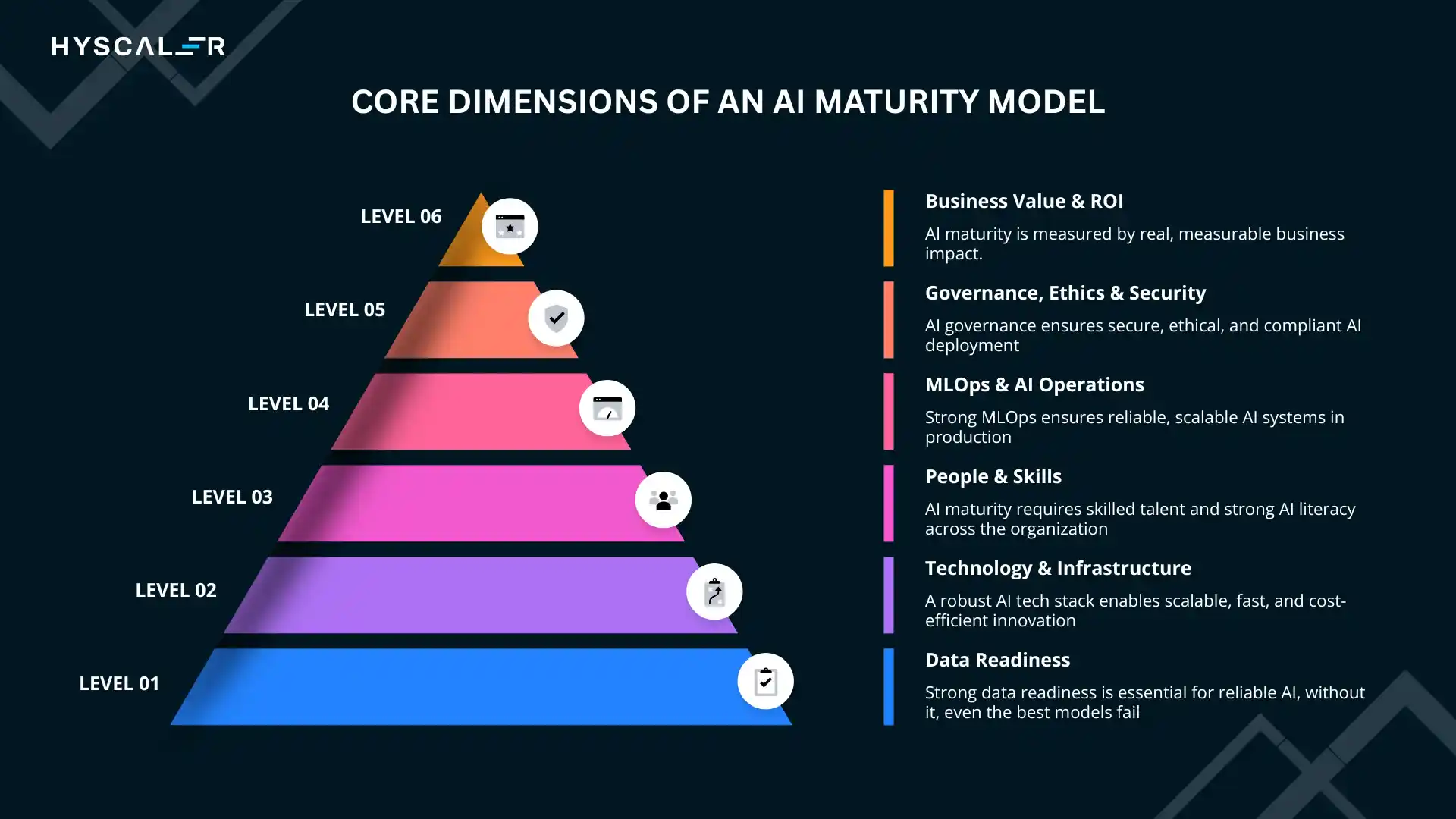
AI maturity isn’t determined by a single factor; it emerges from the interplay of multiple organizational capabilities.
Understanding these core dimensions helps organizations assess their strengths, identify weaknesses, and build balanced AI capabilities.
Data Readiness
Data forms the foundation of every AI system, making data readiness perhaps the most critical maturity dimension.
This encompasses data quality, availability, and accessibility across the organization.
Mature organizations maintain comprehensive data lineage, understanding where data originates, how it transforms, and what quality standards it meets at each stage.
Data governance and ownership structures determine how effectively organizations can leverage their information assets.
This includes establishing clear data ownership, implementing quality controls, ensuring proper documentation, and creating mechanisms for data discovery and access.
Without strong data readiness, even the most sophisticated AI models will produce unreliable results.
Technology & Infrastructure
The technological capabilities evaluate an organization’s technical foundation for AI development and deployment.
This includes cloud infrastructure, AI platforms, and the specific technology stacks used for large language models and other AI systems.
Mature organizations implement comprehensive tooling for the entire AI lifecycle, from experimentation and training through inference and orchestration.
They’ve moved beyond isolated tools to integrated platforms that support collaboration, reproducibility, and efficient resource utilization.
Infrastructure choices directly impact the speed, cost, and scalability of AI initiatives.
People & Skills
AI maturity requires both specialized technical talent and broad organizational AI literacy.
Technical teams need AI engineers, machine learning specialists, data scientists, and AI-focused product managers who can translate business needs into technical solutions.
Equally important is AI literacy across business teams.
Product managers, executives, and operational staff need sufficient understanding to identify AI opportunities, evaluate proposals realistically, and work effectively with technical teams.
The talent dimension includes not just hiring strategies but also training programs, knowledge sharing mechanisms, and career development paths that retain critical AI expertise.
MLOps & AI Operations
MLOps represents the operational maturity of AI systems, how effectively organizations deploy, monitor, and maintain AI models in production.
This includes model versioning, automated deployment pipelines, performance monitoring, and mechanisms for detecting and responding to model drift.
Mature MLOps practices ensure models remain reliable over time, degrade gracefully when they encounter novel situations, and can be updated or retrained systematically.
Observability tools provide visibility into model behavior, helping teams understand not just whether models are performing but why they behave as they do.
Without strong MLOps, organizations struggle to move beyond a handful of production models.
Governance, Ethics & Security
As AI systems become more autonomous and consequential, governance becomes critical.
This dimension encompasses responsible AI practices, explainability requirements, and bias mitigation strategies that ensure AI systems behave ethically and fairly.
Compliance with global AI regulations requires documented processes for risk assessment, human oversight mechanisms, and audit trails that demonstrate responsible development and deployment.
Security considerations include protecting training data, securing model artifacts, and preventing adversarial attacks or model theft.
Governance maturity often determines whether organizations can deploy AI in regulated industries or sensitive applications.
Business Value & ROI
Ultimately, AI maturity is measured by business impact.
This dimension assesses how effectively AI drives decision-making, creates competitive advantages, and delivers measurable returns on investment.
Mature organizations distinguish between automation – using AI to replace human tasks, and augmentation – using AI to enhance human capabilities.
They establish clear metrics linking AI initiatives to business outcomes, whether that’s revenue growth, cost reduction, customer satisfaction, or operational efficiency.
They also develop frameworks for evaluating AI opportunities and prioritizing investments based on strategic value rather than technical novelty.
The 5 Stages of the AI Maturity Model (2026 View)
Understanding where your organization sits on the maturity spectrum is essential for planning the right next steps.
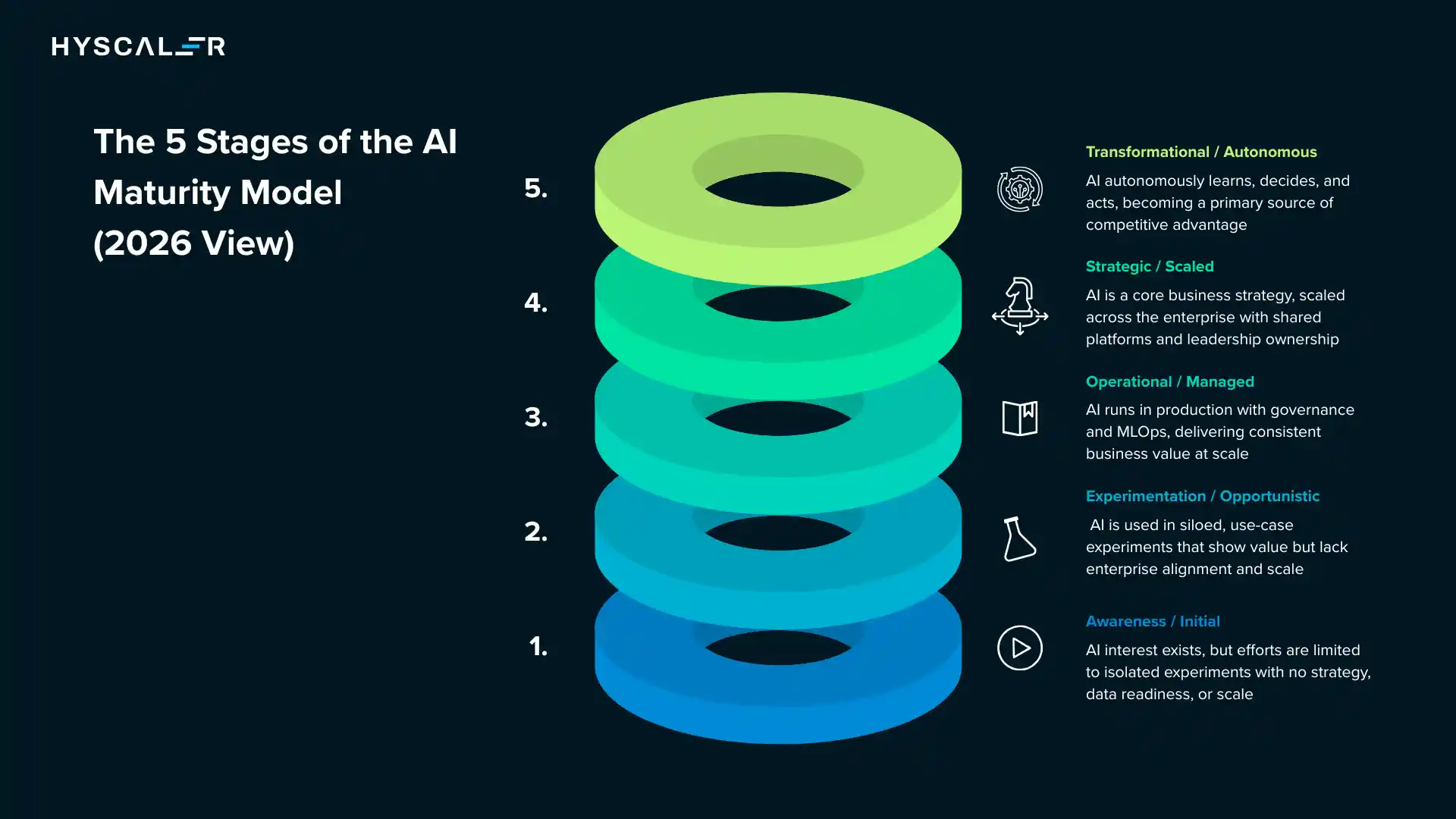
The five-stage model provides a progression from initial awareness through transformational AI capabilities.
Stage 1 – Awareness / Initial
Organizations at the awareness stage are characterized by curiosity about AI but lack a formal strategy or coordinated initiatives.
AI discussions happen in boardrooms with planning sessions, but implementation takes time.
So at this stage, there’s typically no idea about AI budget, and limited technical infrastructure, with minimal understanding of what successful AI deployment requires.
Data may exist, but it isn’t organized or accessible for AI applications.
Governance and ethical considerations are not yet understood.
In 2026, a common example is organizations experimenting with internal chatbots or simple automation tools without broader context or integration plans.
These initiatives rarely progress beyond demonstrations, and learnings aren’t captured or shared across the organization.
Stage 2 – Experimentation / Opportunistic
Organizations entering the experimentation stage begin implementing AI solutions at the department or function level.
Individual business units identify specific use cases and develop targeted solutions, though these remain far away from what is expected from an enterprise strategy.
Data pipelines start emerging to support specific projects, though they’re often built in an ad-hoc fashion without consideration for reuse or scaling.
Technical teams begin forming, though AI talent may be scattered across departments rather than centralized.
Success is measured primarily by whether individual projects work rather than their broader business impact.
A typical 2026 example includes marketing teams implementing predictive models for customer churn or sales forecasting tools that help prioritize leads.
These solutions demonstrate AI’s potential but operate in isolation from other business systems.
Stage 3 – Operational / Managed
The operational stage marks a critical transition, and AI models move into production environments where they support actual business processes.
Organizations develop repeatable processes for model development and deployment, implementing early MLOps practices to manage production systems.
Data infrastructure becomes more sophisticated, with centralized data platforms supporting multiple use cases.
Governance frameworks emerge to manage model risk and ensure quality.
AI teams grow and may begin consolidating into centers of excellence. Metrics shift from “does it work” to “what business value does it create?”
In 2026, operational maturity is evident in organizations running production fraud detection systems, personalized recommendation engines, or automated customer service solutions that handle real customer interactions at scale.
These systems require ongoing monitoring and maintenance but deliver measurable value.
Stage 4 – Strategic / Scaled
Strategic maturity represents the point where AI becomes central to business strategy rather than a supporting technology.
AI initiatives align with enterprise objectives, with executive leadership actively championing AI-driven transformation.
Shared AI platforms emerge, allowing multiple teams to develop and deploy solutions efficiently.
Organizations at this stage implement comprehensive MLOps platforms, sophisticated data governance, and enterprise-wide AI standards.
They’ve built or acquired substantial AI talent and created organizational structures that support AI at scale.
AI literacy pervades the organization, with business leaders fluent in AI capabilities and limitations.
The 2026 hallmark of strategic maturity is personalized customer experiences that span channels and touchpoints, powered by AI systems that share data and insights across the enterprise.
AI influences major business decisions, from product development to market expansion.
Stage 5 – Transformational / Autonomous
The transformational stage represents the frontier of AI maturity, where organizations operate autonomous AI systems that make and execute decisions with minimal human intervention.
Agentic AI systems don’t just analyze and recommend; they act on behalf of the organization within defined parameters.
These organizations implement continuous learning systems where AI models automatically retrain based on new data and feedback.
AI agents orchestrate complex workflows, coordinating multiple systems and adapting to changing conditions.
The organization’s competitive advantage increasingly derives from its AI capabilities rather than traditional assets.
In 2026, transformational organizations demonstrate capabilities like autonomous supply chain management, where AI systems dynamically adjust sourcing, inventory, and logistics based on real-time signals.
AI agents execute complete business workflows, from identifying opportunities through negotiation and fulfillment, operating within governance guardrails but requiring intervention only for exceptional cases.
AI Maturity Model vs Digital Maturity Model
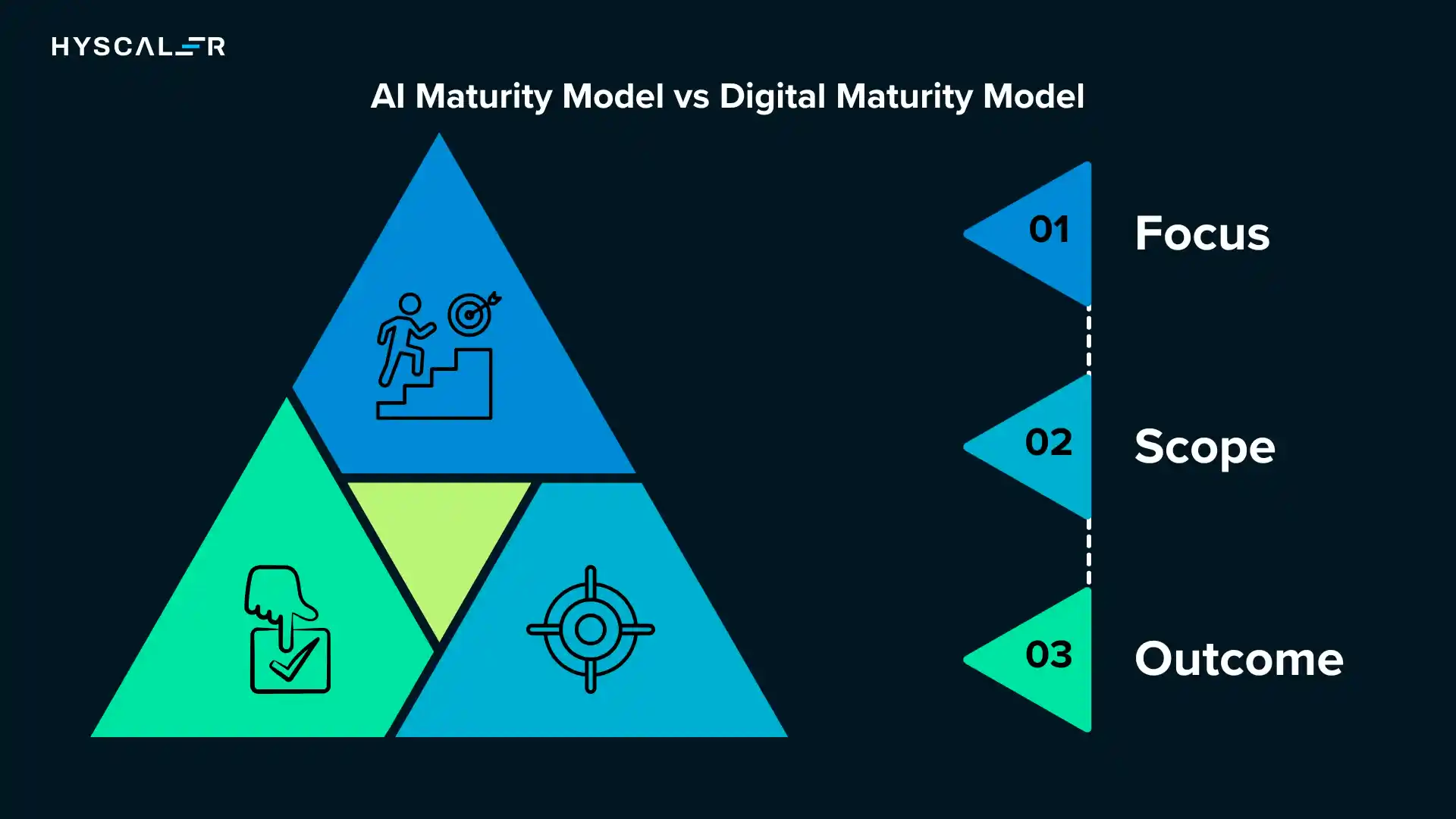
While related, AI maturity and digital maturity represent distinct organizational capabilities with different focuses and outcomes.
Focus: AI maturity centers on intelligence and automation, the organization’s ability to build systems that learn, reason, and act autonomously. Digital maturity focuses on digitization, moving from analog to digital processes and infrastructure.
Scope: AI maturity encompasses data quality, machine learning capabilities, agentic systems, and the infrastructure to support intelligent automation. Digital maturity addresses cloud adoption, application modernization, and IT transformation more broadly.
Outcome: AI maturity drives toward autonomous decision-making and self-optimizing systems. Digital maturity aims for operational efficiency, better information access, and improved digital experiences.
An organization can be digitally mature, with modern cloud infrastructure, digital workflows, and strong IT capabilities, while remaining at early AI maturity stages.
Conversely, AI leaders must build on solid digital foundations but extend well beyond basic digitization.
Popular AI Maturity Models & Frameworks
Several established frameworks provide structured approaches to assessing and advancing AI maturity, each with distinct emphases and strengths.
Gartner AI Maturity Model
Gartner’s framework emphasizes value realization and governance, focusing on how organizations translate AI investments into measurable business outcomes.
The model stresses the importance of balancing innovation with risk management and provides detailed guidance on governance structures needed at each maturity stage.
Gartner particularly emphasizes the role of AI in strategic decision-making and the organizational changes needed to become genuinely AI-driven.
Microsoft AI Maturity Framework
Microsoft’s approach takes a cloud-first perspective, reflecting the company’s Azure AI platform.
The framework places strong emphasis on responsible AI practices, integrating ethics and fairness considerations throughout the maturity journey.
Microsoft’s model is particularly detailed on the technical infrastructure required at each stage and provides concrete guidance on platform selection and implementation.
IBM AI Ladder
IBM’s AI Ladder framework presents maturity as a progression: collect data, organize data, analyze data, and infuse AI throughout the organization.
This model emphasizes the foundational importance of data management and the progression from basic analytics through machine learning to autonomous AI systems.
The framework is particularly useful for organizations with significant legacy systems and complex data landscapes.
Deloitte AI Maturity Model
Deloitte’s framework takes an enterprise-scale transformation lens, focusing on how AI maturity affects entire business models and competitive positioning.
The model emphasizes the organizational, cultural, and strategic changes required for AI transformation, not just technical capabilities.
Deloitte’s approach is particularly valuable for large enterprises navigating complex stakeholder environments and industry regulations.
How to Assess Your Organization’s AI Maturity
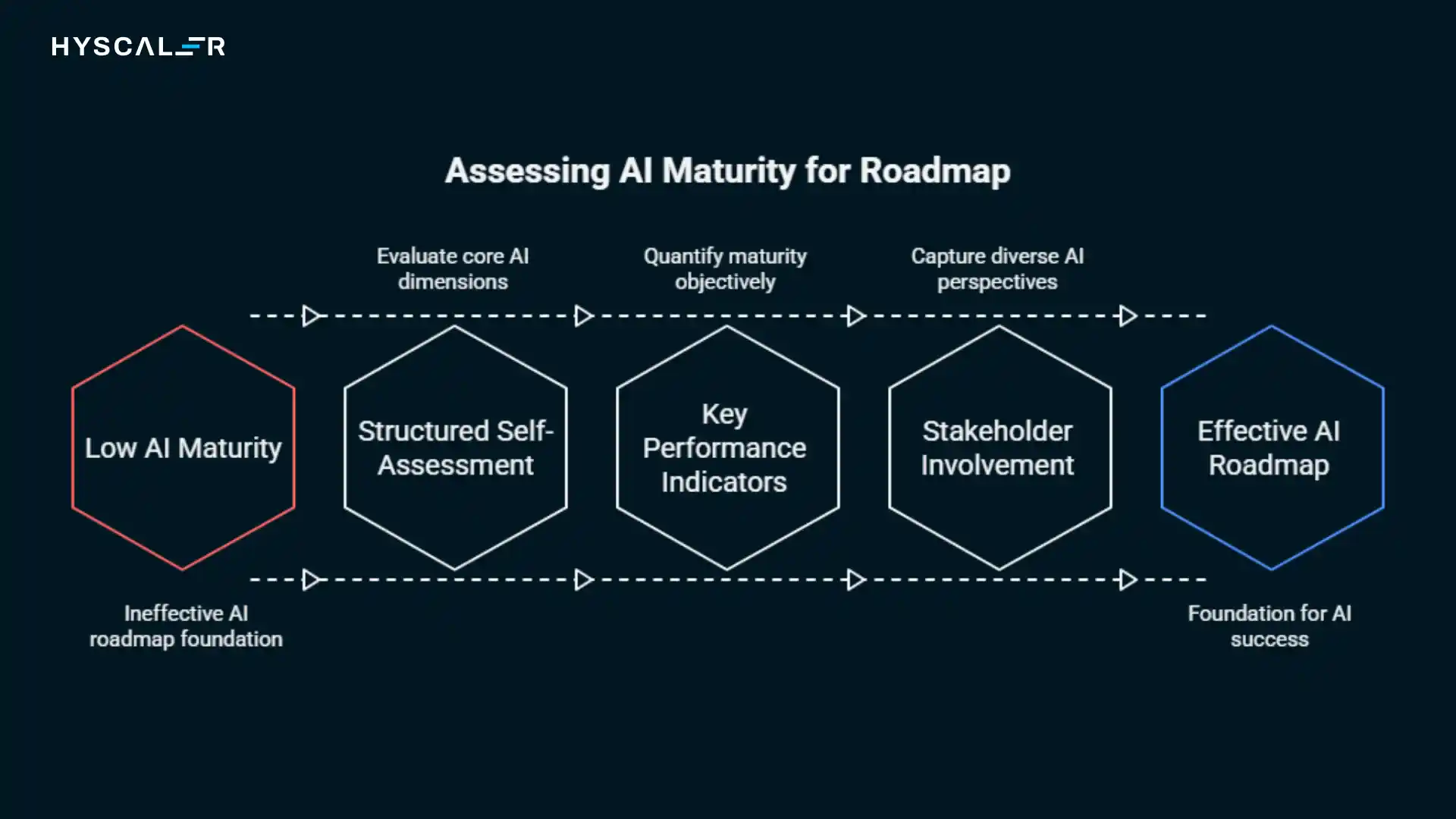
Conducting an honest maturity assessment provides the foundation for building an effective AI roadmap.
Rather than a one-time exercise, assessment should be an ongoing process that tracks progress and identifies emerging gaps.
Start with a structured self-assessment that evaluates each core dimension. For data readiness, examine data quality metrics, catalog coverage, and data accessibility.
For technology, inventory existing AI tools, platforms, and infrastructure.
For people, assess both technical skills and business AI literacy.
For MLOps, evaluate deployment processes, monitoring capabilities, and model lifecycle management. For governance, review existing policies, risk management frameworks, and compliance mechanisms.
For business value, analyze which AI initiatives have delivered measurable ROI.
Key performance indicators help quantify maturity objectively.
These might include the number of production AI models, percentage of data meeting quality standards, time from model development to deployment, model performance in production, AI-related revenue or cost savings, percentage of workforce with AI training, and compliance audit results.
Common gaps reveal themselves through this assessment.
Organizations often discover that while they have strong technical talent, they lack the data infrastructure to support ambitious AI projects.
Others find robust data foundations but insufficient MLOps capabilities to move models into production.
Many identify governance as a critical gap as they prepare for increased regulation.
The assessment should involve stakeholders across technical teams, business units, and leadership to capture different perspectives on AI readiness and identify disconnects between perception and reality.
How to Build an AI Maturity Roadmap
A maturity roadmap translates assessment insights into a concrete plan for advancing AI capabilities.
The most effective roadmaps address foundational gaps before pursuing advanced capabilities.
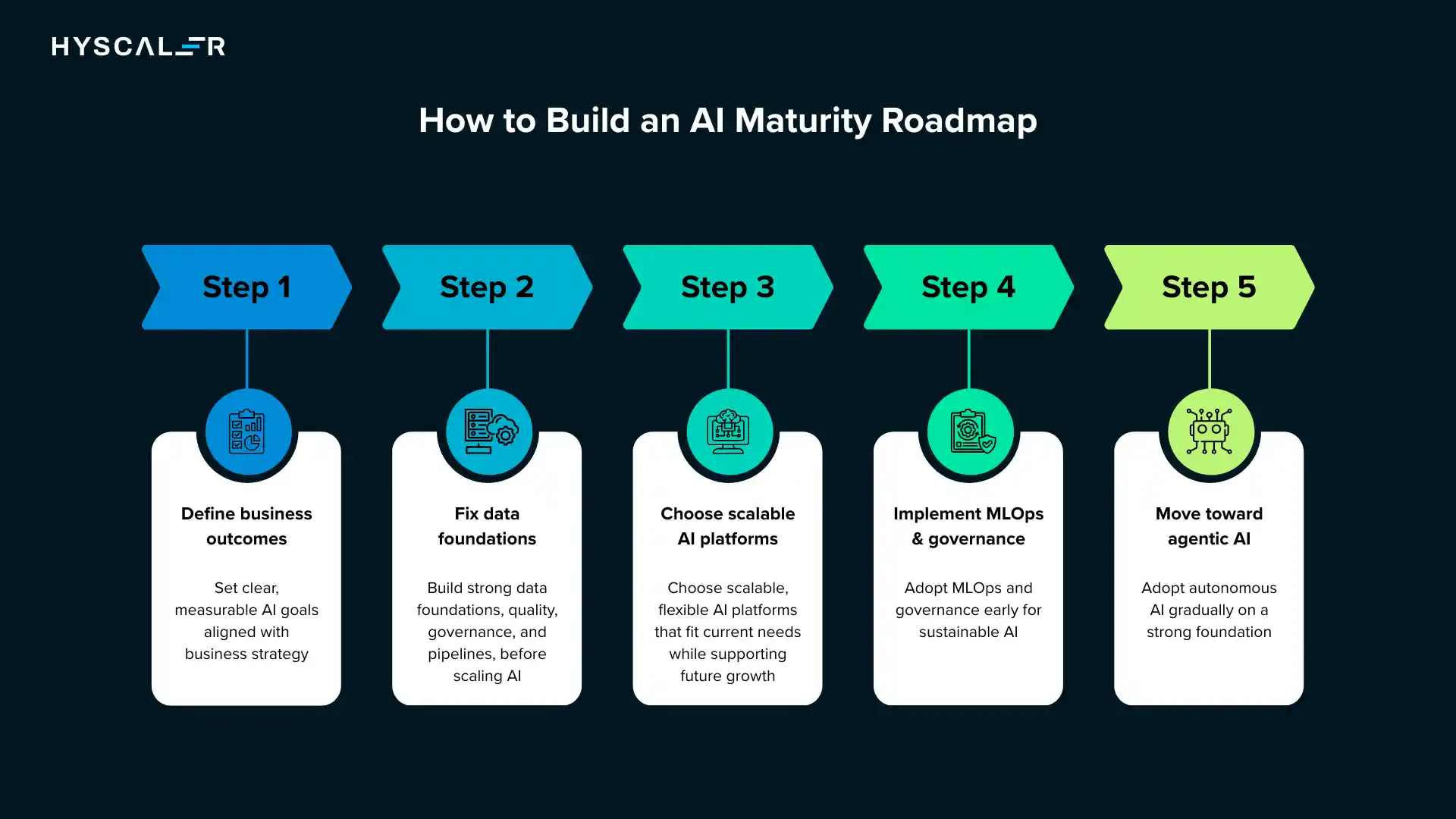
Step 1: Define business outcomes: Begin with clarity on what AI should accomplish for your organization.
Rather than generic goals like “become AI-driven,” identify specific business problems AI will solve or opportunities it will unlock.
These outcomes should be measurable, time-bound, and aligned with corporate strategy. Clear outcomes help prioritize investments and maintain focus as you encounter inevitable obstacles.
Step 2: Fix data foundations: Most organizations discover that data readiness is their primary constraint.
Before investing heavily in AI models or platforms, establish solid data foundations.
This includes implementing data quality processes, creating data catalogs, establishing governance structures, and building pipelines that make data accessible for AI applications.
Organizations that skip this step find themselves constantly reworking solutions as data problems emerge.
Step 3: Choose scalable AI platforms: Select technology platforms that can grow with your maturity.
Early-stage organizations might start with managed AI services that abstract complexity, while more mature organizations may need flexible platforms that support custom development.
The key is avoiding platform lock-in that limits future options while ensuring platforms integrate with existing technology stacks. Consider both current needs and future requirements as you evaluate options.
Step 4: Implement MLOps and governance: As you move AI into production, MLOps becomes critical.
Establish deployment pipelines, monitoring systems, and retraining processes before you have dozens of production models to manage.
Simultaneously, implement governance frameworks that scale, policies for model approval, risk assessment, bias testing, and compliance documentation.
Building these capabilities early prevents the chaos that emerges when organizations try to retrofit governance onto established AI operations.
Step 5: Move toward agentic AI: The progression to autonomous systems requires all previous capabilities working in concert.
Agentic AI demands robust data, sophisticated infrastructure, strong operational practices, and comprehensive governance.
Organizations should evolve toward agentic capabilities gradually, starting with narrow domains where autonomous decision-making creates clear value and risks are manageable, then expanding scope as confidence and capabilities grow.
AI Maturity Model Use Cases by Industry (2026)
AI maturity manifests differently across industries, though the underlying capabilities remain consistent.
Understanding industry-specific applications helps contextualize the maturity journey.
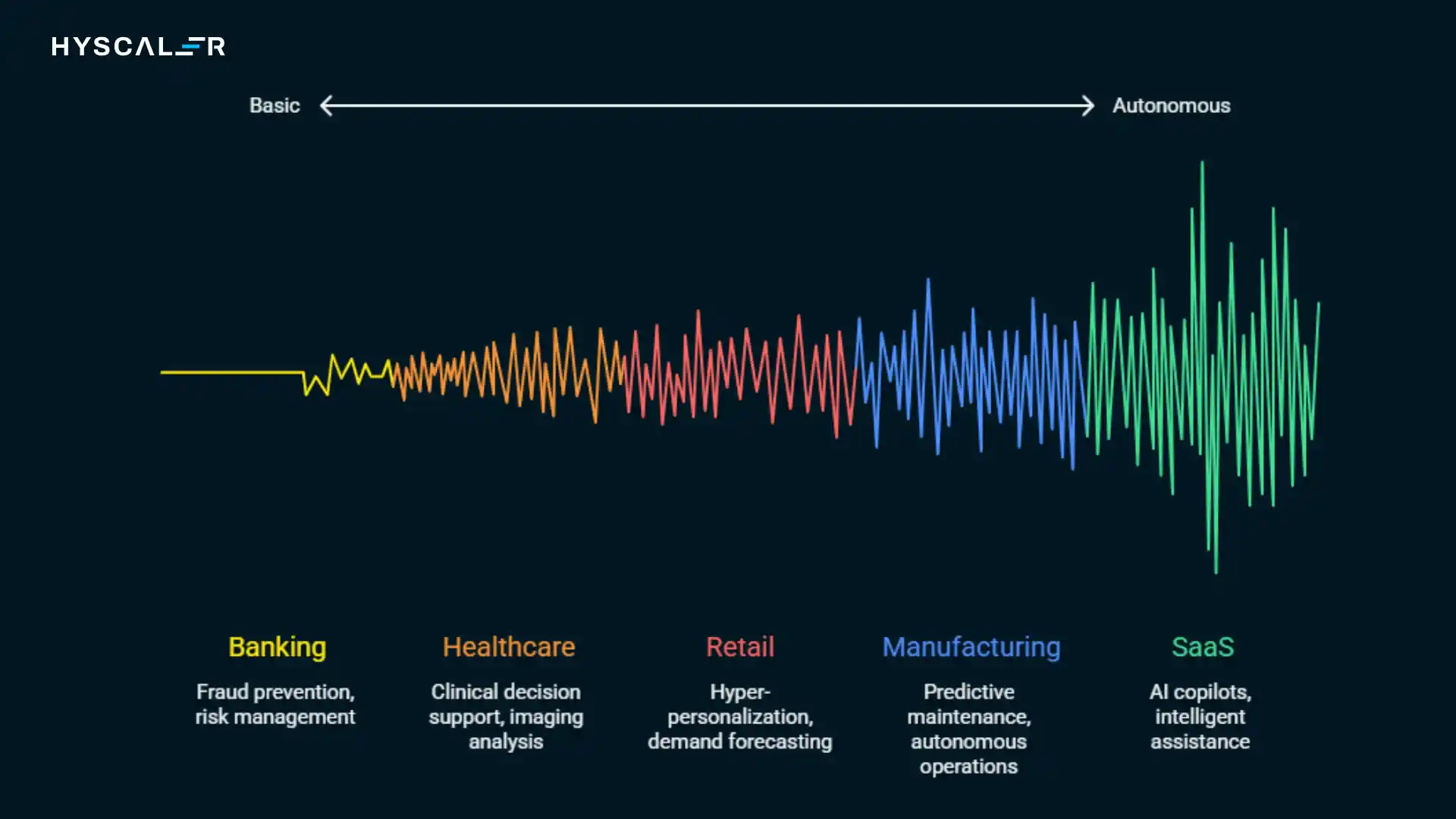
Banking, Financial Services, and Insurance: BFSI organizations at high maturity levels implement sophisticated fraud prevention systems that detect novel attack patterns in real-time and autonomous risk management platforms that adjust portfolios based on market signals.
Advanced institutions deploy AI agents that handle routine transactions, assess loan applications, and manage claims processing with human oversight only for exceptional cases.
Regulatory compliance drives strong governance practices in this sector.
Healthcare: Mature healthcare organizations leverage AI for clinical decision support, with systems that analyze patient data to recommend diagnoses and treatment plans.
AI assists in medical imaging interpretation, drug discovery, and patient monitoring.
The highest maturity healthcare institutions implement predictive systems that identify deterioration risks and optimize treatment protocols, though human clinicians remain central to decision-making given the stakes involved.
Retail: Retail maturity is evident in hyper-personalization capabilities that go beyond basic recommendations to predict needs, optimize pricing dynamically, and orchestrate omnichannel experiences.
Advanced retailers deploy AI for demand forecasting, Inventory management, and supply chain coordination.
At transformational maturity, AI systems autonomously manage merchandise selection, pricing, and promotion across thousands of products and locations.
Manufacturing: Manufacturing AI maturity progresses from predictive maintenance, forecasting equipment failures, to autonomous operations where AI systems manage production scheduling, quality control, and supply chain coordination.
Transformational manufacturers implement self-optimizing production lines that adjust parameters in real-time and coordinate with autonomous logistics systems to minimize inventory while ensuring delivery commitments.
SaaS: Software companies at high AI maturity embed AI copilots throughout their products, providing intelligent assistance that learns user preferences and automates routine workflows.
Advanced SaaS companies deploy AI agents that execute complex multi-step processes on behalf of users, from data analysis and report generation to system configuration and optimization recommendations.
Challenges in Advancing AI Maturity
The path to AI maturity is rarely smooth, and organizations encounter predictable obstacles at different stages.
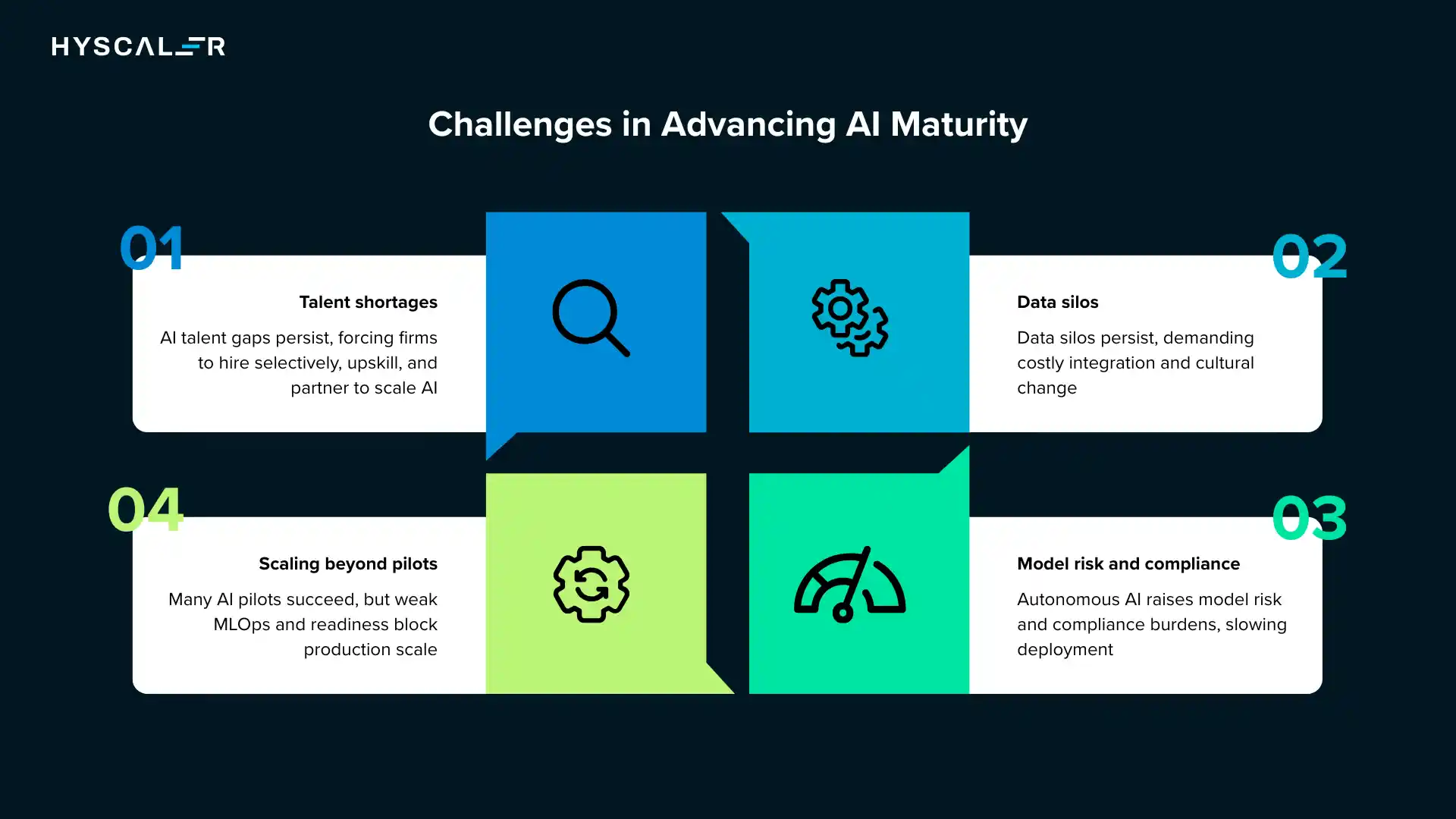
Talent shortages remain acute despite growing AI educational programs.
Competition for experienced AI engineers, machine learning specialists, and AI-savvy product managers is fierce, particularly in regions without strong tech ecosystems.
Organizations struggle to build teams large enough to support ambitious AI roadmaps.
Many address this through combinations of selective hiring, intensive training programs, and partnerships with AI vendors or consultancies.
Data silos persist despite years of digital transformation efforts.
Information remains locked in departmental systems, legacy applications, and incompatible formats.
Breaking down these silos requires not just technical integration but organizational change, overcoming territorial boundaries and establishing shared data ownership models.
The effort required often exceeds initial estimates.
Model risk and compliance challenges intensify as AI systems become more autonomous and consequential.
Organizations struggle to explain how complex models make decisions, validate that they behave fairly across demographic groups, and demonstrate compliance with evolving regulations.
The governance overhead can slow AI deployment, particularly in regulated industries where model failures carry significant penalties.
Scaling beyond pilots represents perhaps the most common maturity challenge.
Many organizations successfully build proof-of-concept models but fail to deploy them in production.
The gap typically stems from underestimating MLOps requirements, insufficient data infrastructure, or organizational resistance to AI-driven processes.
Moving from “it works in the lab” to “it delivers value in production” requires capabilities many organizations lack.
Future of AI Maturity Models (2026–2030)
As AI capabilities evolve, maturity models themselves must adapt to reflect new realities and expectations.
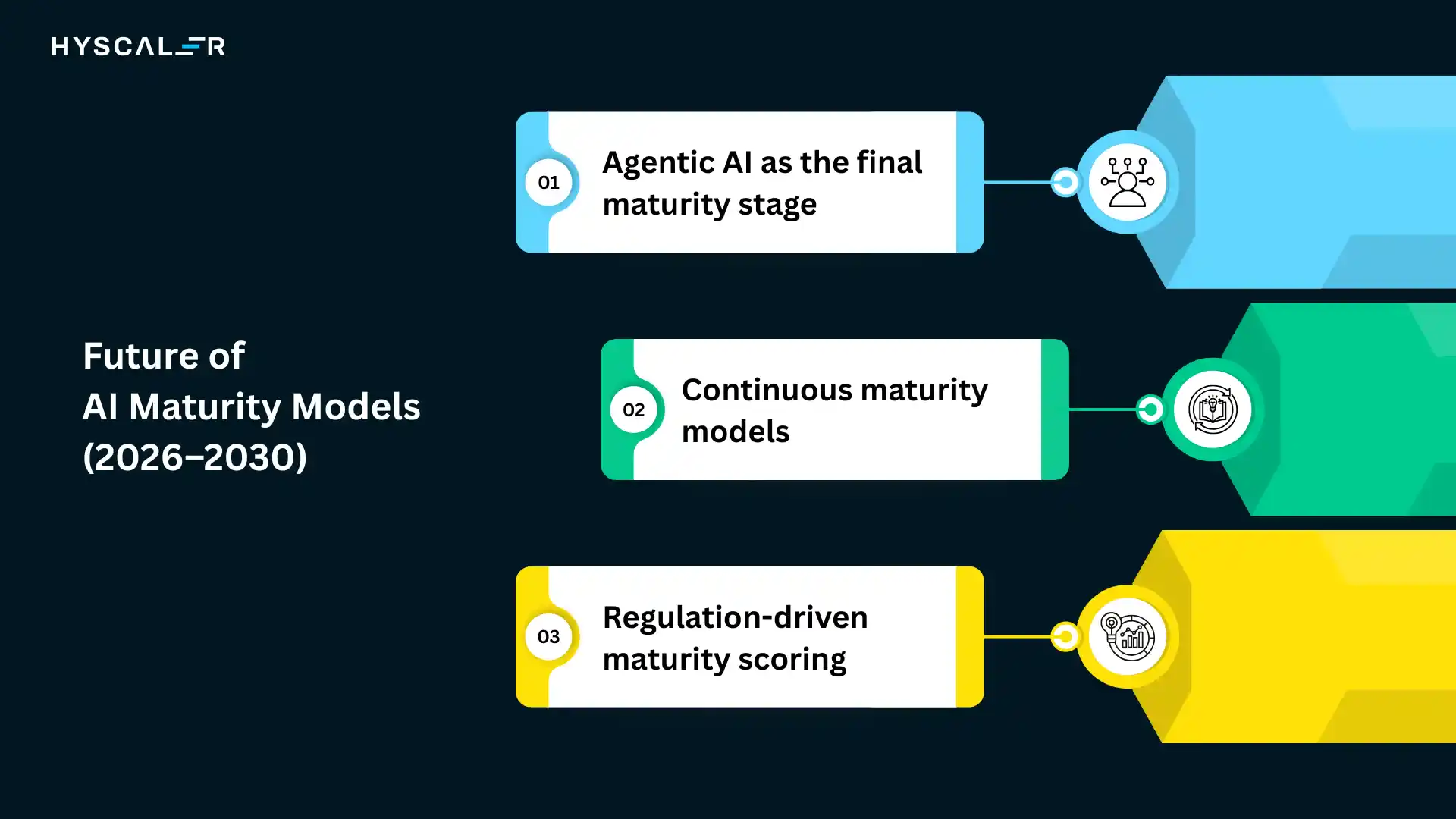
Agentic AI as the final maturity stage represents the current frontier, with autonomous systems that plan, execute, and learn from multi-step workflows.
Looking toward 2030, this stage will likely subdivide as the capabilities and autonomy of AI agents increase dramatically.
We may see maturity levels distinguished by the complexity of workflows AI can execute, the degree of human oversight required, and the sophistication of agent coordination in multi-agent systems.
Continuous maturity models will likely replace today’s discrete stages.
As organizations recognize that maturity isn’t linear, you can be advanced in some dimensions while basic in others, assessment frameworks will evolve toward multidimensional profiles rather than single maturity scores.
Organizations will track maturity across different domains, use cases, and business units simultaneously, with targeted improvement plans for each.
Regulation-driven maturity scoring seems increasingly likely as governments implement AI oversight.
Regulatory frameworks may establish minimum maturity requirements for specific AI applications, with formal assessment and certification processes.
Organizations may need to demonstrate specific maturity levels to deploy AI in regulated domains like healthcare, finance, or critical infrastructure.
This could standardize maturity assessment but might also create compliance burdens, particularly for smaller organizations.
Conclusion: From AI Adoption to AI Autonomy
The journey from initial AI awareness to transformational AI capabilities is neither quick nor easy, but it’s increasingly essential for competitive survival.
Organizations that approach AI maturely, with a realistic assessment of current capabilities, strategic investment in foundational elements, and patient progression through maturity stages, position themselves to capture AI’s full potential.
The five-stage maturity model provides a framework, not a prescription.
Organizations don’t need to master every dimension perfectly before advancing, nor do all industries or companies need to reach transformational maturity.
The key is understanding where you are, where you need to be given your strategic objectives, and what specific capabilities you need to build next.
Strategic maturity means more than deploying advanced AI technology.
It means aligning AI with business strategy, building organizational capabilities that support AI at scale, establishing governance that enables innovation while managing risk, and creating cultures where humans and AI systems collaborate effectively.
In 2026 and beyond, competitive advantage increasingly flows from AI maturity itself, from the organizational capabilities that allow you to experiment rapidly, scale successful initiatives efficiently, and evolve continuously as AI technology advances.
The question isn’t whether to invest in AI maturity but how quickly you can build the foundations that transform AI from experimental technology into transformational capability.
FAQs
What is an AI maturity model?
An AI maturity model shows how ready an organization is to use AI. It helps identify the current level of AI adoption and the steps needed to improve and scale it.
How many stages are in an AI maturity model?
Most AI maturity models include five stages:
1. Awareness – Early curiosity and isolated AI experiments.
2. Experimentation – Department-level AI use cases emerge.
3. Operational – Production AI models with basic MLOps in place.
4. Strategic – Enterprise-wide AI aligned with business goals.
5. Transformational – Autonomous, agentic AI systems with continuous learning.
Organizations advance through these stages by strengthening data, technology, talent, operations, and governance capabilities.
What is the highest level of AI maturity?
The highest level of AI maturity is the Transformational (Autonomous) stage. At this level, AI systems operate with minimal human intervention, autonomously making decisions, executing workflows, and continuously improving performance within defined governance guardrails.
How long does it take to move up AI maturity levels?
AI maturity progression typically takes 18–36 months per stage, depending on data readiness, investment, and organizational complexity.
1. Awareness → Experimentation: 12–18 months
2. Operational → Strategic: 24–36 months
3. Full Transformational maturity: often 3–5+ years from the start
Organizations with strong data and digital foundations usually advance faster than those building infrastructure from scratch.
Is the AI maturity model relevant for startups?
Yes, AI maturity models are relevant for startups. They help ensure strong data, governance, and MLOps foundations, avoid scaling risks, and demonstrate credibility to investors and enterprise customers.