Table of Contents
Intelligent automation reshapes how modern organizations operate. By 2026, almost 40% of enterprise applications will deploy task-specific AI agents. This is a staggerings jump from under 5% in 2025. This booming market also introduced many poor vendors. They often lack the MLOps maturity or deep industry expertise necessary for secure, enterprise-grade deployments.
Selecting the wrong automation partner risks more than delaying automation entirely. A poor fit does not just waste budget. It creates fragmented data silos, hindering long-term scaling. It leaves compliance gaps in regulated workflows. It consumes implementation time your organization cannot recover. Fifty percent of your peers already pilot or actively use AI. Therefore, the vetting decision carries real strategic weight.
Nearly two-thirds of global businesses already embed automation into daily workflows, focusing clearly on scalability and compliance. Leaders who delay partner selection cede operational ground that is difficult to recover.
If you are a CTO, founder, or an operations leader. You must steer your organizations toward becoming intelligent enterprises. Whether you compare platforms or manage operations to automate unstructured data processing, these seven criteria serve as a practical roadmap.
These practical steps will help with partner selection that aligns with your specific business objectives.
1. Proven Production Track Record – Not Just POCs
Evaluating an AI automation partner is critical. Distinguish between firms that only build prototypes and those that deploy secure, production-ready agentic AI. Pilot projects deliver quick wins. However, true enterprise transformation demands a partner that scales solutions across all departments and regions. This partner must maintain high operational trust.
The Difference Between a Demo and a Live Deployment
A Proof of Concept (POC) is designed to validate feasibility quickly, often using a small-scale version of a project to demonstrate potential accuracy or cost savings. These can frequently be launched in as little as 3–4 weeks.
A live deployment is a different category entirely. Unlike a demo, a production system must:
- Process unstructured data at scale: Move past basic scripts. Implement self-learning systems that reason through complex, real-world data. This includes contracts, clinical records, and financial documents.
- Integrate existing tech stacks: Connect the solution with ERP, CRM, and legacy databases. Avoid a “rip and replace” approach.
- Ensure security compliance: Operate within secure data pipelines. The system must comply with GDPR, ISO, HIPAA, and all other applicable regulations.
What to Ask: Uptime, Model Drift, and Incident Response
Assess the partner’s MLOps maturity. This ensures they can sustain and update AI systems in production long-term. Key questions follow:
- What uptime SLAs do you offer? Ensure your contract explicitly defines Service Level Agreements (SLAs). These SLAs must cover uptime, support response times, and data protection.
- How do you manage model drift? AI models degrade over time. Ask how they monitor drift, when results deviate from expected outcomes. Inquire how they maintain data validity.
- What is your incident response plan? A reliable partner provides robust post-implementation maintenance. They must proactively identify and resolve issues before users encounter them.
Green Flags vs. Red Flags in a Vendor’s Portfolio
| Green Flags | Red Flags |
| Industry-specific case studies with measurable outcomes | Portfolio consisting only of isolated pilots |
| Documented accuracy metrics tied to real deployments | “Black box” systems with no explainability |
| Ability to provide technical architecture documents | Missing ISO 27001, SOC 2, or HIPAA certifications |
| Transparency about model logic and limitations | Proposals that require rebuilding your existing infrastructure |
2. End-to-End Service Coverage – From Strategy to Monitoring
A company that builds without monitoring delivers an unsupported product. A single partner must own the entire lifecycle for true end-to-end coverage: strategy, custom development, systems integration, MLOps, and continuous performance tuning.
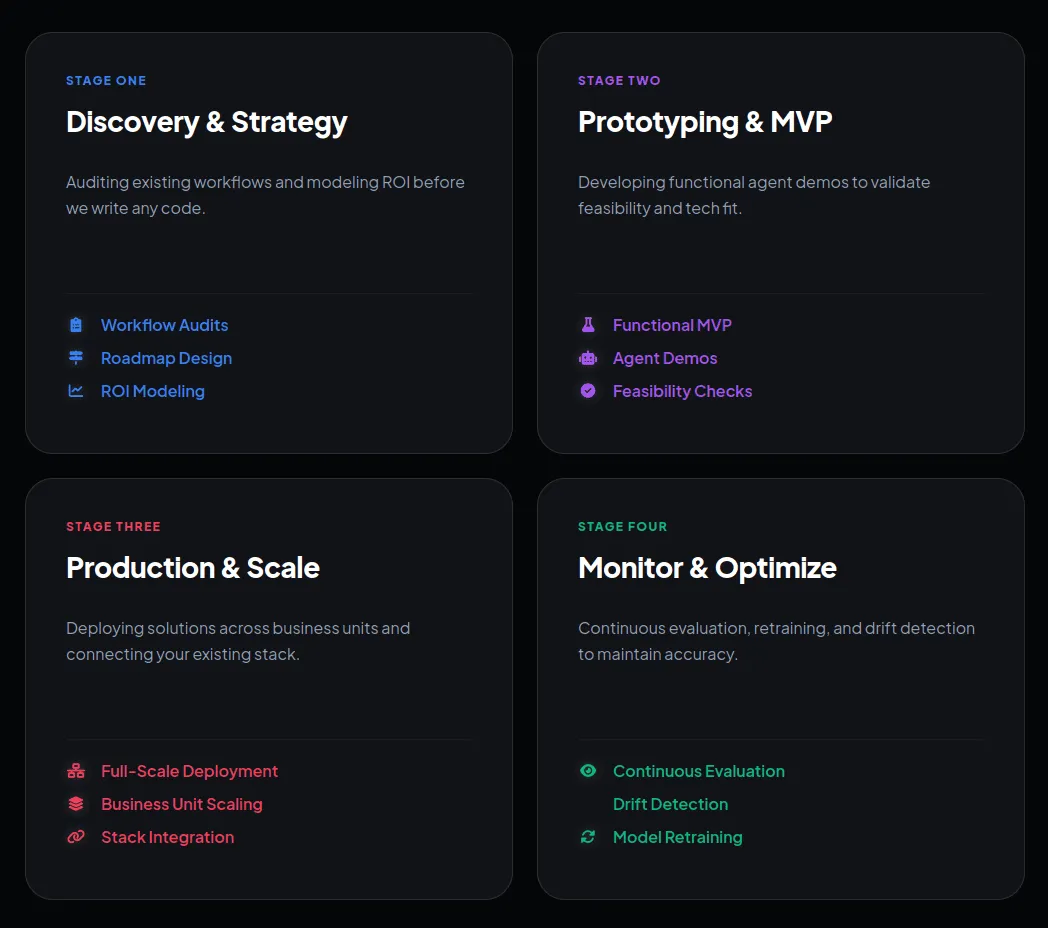
Verify four lifecycle stages. First, discovery and strategy involves workflow audits, roadmap design, and ROI modeling before coding begins. Second, prototyping creates a functional MVP or agent demo. This validates feasibility. Third, production and integration scales the solution across business units. It connects the solution to your existing stack. Fourth, monitoring and optimization requires continuous evaluation, drift detection, and model retraining as your business changes.
A partner who disappears after delivery is a vendor. A partner who owns the outcome across all four stages merits the investment.
3. Deep Systems Integration Expertise
AI that cannot connect to your existing stack delivers no value. This is one of the most common failure points in enterprise AI deployments , solutions built in isolation that become expensive data silos rather than productivity multipliers.
What Integration Expertise Actually Looks Like
A production-ready partner integrates solutions with your existing CRMs, ERPs, and legacy databases. They use APIs and secure data pipelines, not system replacements. The partner must show live integrations with common enterprise platforms. They should clearly explain how data flows between your systems and their AI layer.
Red Flag: Rebuild Proposals
If a vendor’s first recommendation is to replace your current infrastructure, treat this as a significant warning sign. The most capable partners work within your existing environment, not around it.
HyScaler’s systems integration excels beyond simple connectivity. Their on-premise RAG implementation revolutionized a document-heavy enterprise. It converted scattered PDFs, Word files, spreadsheets, and scanned images into a single, AI-searchable knowledge layer. This system resides fully within the client’s private network. It complies with GDPR, HIPAA, and ISO 27001. Their MCP-based agent integrations share this core philosophy: layer intelligent automation over your existing infrastructure. Do not replace it.
Questions to Ask
- Can you show me a documented integration with a system similar to ours?
- How do you handle data residency requirements when connecting to cloud-based tools?
- Do your agents operate in read-only mode by default, or do they require write access?
4. Agentic AI and Modern Stack Fluency
The move from traditional to intelligent automation demands a partner. This partner must grasp the shift from static scripts to dynamic, reasoning agents. Modern stack fluency transcends basic coding. It requires orchestrating autonomous systems. These systems manage the complexity of 2026 business environments.
Why RPA-Era Vendors Are Already Behind
Traditional Robotic Process Automation (RPA) vendors build static, rule-based systems. RPA excels at repetitive, rule-following tasks, such as simple data entry. It fails with unstructured data or evolving scenarios. Organizations applying hyperautomation in 2026 achieved 42% faster process execution and up to 25% productivity gains. RPA handles single steps. Modern agentic AI autonomously manages entire processes.
What Modern Fluency Looks Like
A partner with genuine modern stack fluency works across the following technologies:
- Large Language Models (LLMs): LLMs power modern automation’s reasoning. They enable systems to process unstructured data like contracts, clinical records, and financial agreements.
- Retrieval-Augmented Generation (RAG): RAG blends internal enterprise data with AI knowledge. This ensures context-aware automation; it prevents outdated or hallucinated information.
- Agentic Workflows: Self-learning agents use production data. They boost accuracy continually without requiring manual retraining.
- Model Context Protocol (MCP): MCP is the 2026 industry-standard protocol. It connects agents to tools, APIs, and data sources. Every major AI provider, including Anthropic, OpenAI, Google, Microsoft, and Amazon, now adopts this protocol.
Questions to Ask About Framework Experience
- Which specific LLMs have you deployed in production (GPT-4, Claude, Gemini)?
- Can you demonstrate a live agentic workflow , not a demo environment?
- How do you route between models to avoid vendor lock-in?
- What is your MLOps maturity level, and how do you handle model drift in production?
5. Industry-Specific Experience
Generic AI companies build generic , and often risky , solutions. Without tailored strategies that account for the unique operational and regulatory environment of a specific sector, AI systems can create compliance gaps, produce biased outputs, and fail to integrate with industry-specific tooling.
Key Industries and Their Specific Requirements
Healthcare: Automation must integrate with Electronic Health Records (EHRs) and EMR systems. It must not disrupt patient care workflows. Partners must demonstrate the ability to mitigate algorithmic bias. Flawed training data historically underestimated some patient demographics’ medical needs.
Finance: Systems must handle high-volume transactions. They must also comply with transatlantic data privacy mandates and market regulations. Critical capabilities include continuous Anti-Money Laundering (AML) monitoring, automated loan underwriting, and ledger integrity management during cross-border payments.
Manufacturing: The focus is predictive maintenance. This identifies equipment failures before they cause downtime. It is combined with AI-powered quality control. Computer vision catches defects more accurately than manual inspection.
Logistics: Requirements include AI-driven route optimization and advanced demand sensing. This prevents inventory overload or stockouts. Sustainability tracking balances carbon footprint goals with financial priorities.
How to Verify Domain Expertise
- Request case studies with measurable outcomes in your specific vertical , not just logos.
- Ask about their compliance knowledge for your industry’s legal frameworks (HIPAA, GDPR, EU AI Act, DPDP Act).
- Verify relevant certifications: ISO 27001, SOC 2, HIPAA compliance documentation, and any sector-specific accreditations.
HyScaler’s industry experience stems from documented, production-grade deployments across regulated sectors. In healthcare, HyScaler integrated legacy serial-port medical equipment with a modern EHR system for a US-based organization. In a separate project, HyScaler developed and scaled an EMR system for an NGO. This EMR managed tuberculosis patient records across a large, diverse population and significantly boosted provider productivity. For AI-driven document intelligence, their on-premise RAG implementation transformed unstructured document retrieval for a large enterprise. This solution delivered semantic search, RBAC, AES-256 encryption, and zero cloud dependency within a private network. Explore all case studies at hyscaler.com/case-studies.
6. Governance, Security, and Compliance Readiness
Governance is now a baseline requirement, not a differentiator. The EU AI Act’s high-risk AI system rules become fully enforceable on August 2, 2026. These rules cover AI used in hiring, credit scoring, healthcare, and law enforcement. Previous deadlines already passed: banned AI practices stopped in February 2025, and General Purpose AI model rules took effect August 2025.
Evaluate every AI automation vendor for compliance. If your operations involve these domains, vendor compliance is mandatory.
Data Privacy, Residency, and Access Control , What to Demand
- Secure Data Pipelines: AI firewalls and encryption safeguard sensitive enterprise data.
- Read-Only Architecture (Default): High-quality agent stacks respect existing database roles. They enforce the same row-level security as your current infrastructure.
- Role-Based Access Control (RBAC) and Data Loss Prevention (DLP): Explicit policies govern which users and systems interact with specific datasets.
- Full Audit Trails: The system logs every autonomous AI action. This makes actions traceable and available for compliance review.
Certifications and Frameworks to Verify
| Certification | What It Covers |
| ISO 27001 | Information security management |
| SOC 2 | Operational trust and data handling |
| HIPAA | Patient health information (healthcare) |
| GDPR | Data privacy for EU-adjacent operations |
| CMMI Level 3 | Process maturity and delivery consistency |
| EU AI Act compliance | High-risk AI system governance (enforceable Aug 2, 2026) |
The Hidden Risk: MCP Authentication Gaps in Agentic Stacks
More vendors build agentic workflows with MCP-based architectures. This created a critical security gap: many MCP servers ship without strong authentication. The protocol currently treats authentication as an optional recommendation, not a mandatory requirement. Consequently, static credentials, missing token validation, and unauthenticated client connections frequently appear in production deployments.
Before signing with a vendor, ask:
- Do you enforce MCP OAuth 2.0 with short-lived tokens (5–15 minute TTL)?
- How do you implement sender constraints (MTLS or DPoP) in your agentic stack?
- How do your MCP servers integrate with enterprise identity providers like Okta or Azure AD?
7. Transparent Pricing and Long-Term Partnership Mindset
Selecting an AI automation partner is not a software purchase. It is a strategic decision. This decision shapes how your organization shares data and operates across departments for years. A partner who clarifies pricing and long-term engagement differs fundamentally from a vendor who delivers and vanishes.
What Good Pricing Structure Looks Like
A reliable partner avoids vague estimates. They present a phased, milestone-based structure. This structure aligns with the successful completion of specific project stages.
- Discovery and Audit: Initial workflow reviews and strategy shaping.
- Prototyping: A functional MVP or agent demo, typically achievable in 3–4 weeks.
- Production and Integration: Scaling the solution across business units and connecting to existing tech stacks.
- Ongoing Support: Monitoring, drift detection, and performance optimization post-launch.
The best partners tie their success to your outcomes. They use ROI modeling and cost-benefit analysis during planning. This ensures the project justifies its cost through measurable KPIs like cycle time reduction or cost savings.
The 80/20 Rule of AI Value
One of the most important insights in modern automation is this: technology accounts for roughly 20% of an initiative’s value. The other 80% comes from data readiness, process redesign, change management, and governance. Even the most advanced AI model will fail if the organization lacks the readiness to support it.
A partner who understands this will spend as much time on data quality, staff alignment, and governance frameworks as they do on model selection. A vendor who leads with tool features and skips these conversations is selling you the 20%.
Signs You Are Talking to a Partner vs. a One-Off Vendor
- They ask about your business goals before recommending a technology stack.
- They provide a post-implementation support plan with defined SLAs before the contract is signed.
- They can explain their model logic clearly, the “explainability test.”
- They proactively monitor for model drift and schedule performance reviews.
- They have referenceable clients willing to speak about the post-launch relationship, not just the delivery phase.
Frequently Asked Questions
What does an AI automation solutions company actually do?
AI automation companies leverage ML and NLP to streamline workflows and automate human tasks. Services include consulting, custom AI development, integration with existing systems (e.g., ERPs, CRMs), and MLOps support. Their core goal is to transition organizations from simple rule-based scripts to powerful agentic AI systems. These systems reason through unstructured data, coordinate processes, and autonomously manage end-to-end business operations.
How much does AI automation typically cost in 2026?
Project scope, complexity, and delivery model significantly impact costs. Budgets typically range from under $5,000 for limited pilots to $20,000+ for enterprise-grade, multi-department rollouts. Reliable partners use phased, milestone-based pricing. You pay only for validated delivery at each stage, avoiding a large upfront commitment. Costs increase as you scale the number of agents, integrate more systems, or extend into new business units.
How long before we see ROI from AI automation?
Most modern AI automation deployments reach full production in 8–10 weeks. A working prototype delivers in 3–4 weeks. ROI timelines depend heavily on the specific use case. Organizations automate financial close and report up to 30% faster cycle times. Document processing deployments cut processing costs by 40–60%. A credible partner must provide ROI modeling during the discovery phase, not after deployment.
What is the difference between RPA and agentic AI automation?
Robotic Process Automation (RPA) handles repetitive, rule-based tasks. It processes data entry, routes invoices, and completes forms using predefined “if-then” logic. RPA cannot adapt to new scenarios or reason through unstructured data.
Agentic AI uses LLMs and ML to analyze patterns. It reasons through unstructured data, such as contracts and clinical records, and makes autonomous decisions. These systems improve over time using production data; they require no manual retraining. In 2026, the difference matters: RPA executes steps, Agentic AI manages entire processes.
How do I know if a company is production-ready vs. just a demo shop?
A production-ready company demonstrates MLOps maturity , the ability to maintain, monitor, and update AI over its full operational lifespan. Look for:
1. Technical architecture documents from previous deployments (not just visual mockups)
2. Documented uptime SLAs and incident response plans
3. Evidence of post-launch monitoring, drift detection, and model retraining
4. Enterprise security features: audit trails, RBAC, data encryption, and read-only agent architectures
If they lead every conversation with demos and struggle to answer questions about post-deployment operations, they are a demo shop.
What industries benefit most from AI automation?
High-impact results are most consistently documented in:
1. Finance (BFSI): Fraud detection, automated underwriting, cross-border payment reconciliation, AML monitoring
2. Healthcare: Diagnostic imaging, clinical documentation, patient onboarding, predictive readmission reduction
3. Logistics and Supply Chain: Route optimization, demand forecasting, predictive maintenance
4. Manufacturing: Quality control via computer vision, equipment failure prediction
5. Other sectors: Retail, insurance, real estate, telecommunications, and the public sector
What questions should I ask before signing with an AI automation company?
1. Can you provide technical architecture documents from a previous production deployment?
2. How do you handle model drift , and what does your retraining process look like?
3. Which specific LLMs have you deployed (GPT-5, Claude, Gemini, custom)?
4. Are there clearly defined SLAs in the contract for uptime, incident response, and data protection?
5. How is data security managed , do you use AI firewalls, RBAC, encryption, and read-only agent architectures?
6. How do your MCP servers handle authentication in production environments?
7. What does post-launch support look like , and what is the escalation path if something breaks?
The Right Partner Makes or Breaks Your AI Initiative
Choosing an AI automation partner is a critical decision. It defines how your organization operates for the next decade. A poor match fragments data, wastes budget, and creates compliance risk. The right partner builds a unified, scalable workflow. This system handles enterprise complexity and evolves with your business.
Use this checklist to evaluate every partner you speak with:
The 7-Point Partner Checklist
- Proven Production: Deploy live solutions. Measure outcomes, avoid just demos.
- End-to-End Coverage: Span strategy through MLOps, not just development.
- System Integration: Connect to existing CRMs, ERPs, and legacy databases. Avoid rebuilding.
- Modern Stack Fluency: Master LLMs, RAG, MCP, and agentic workflows.
- Industry Experience: Show documented case studies. Understand your vertical’s compliance.
- Governance & Security: Meet ISO, CMMI, HIPAA, GDPR, and EU AI Act compliance, as needed.
- Transparent Partnership: Ensure milestone-based, outcome-tied pricing. Detail post-launch support.
HyScaler brings together the technical depth, production track record, and governance maturity that this decision demands. Book your free AI strategy consultationto begin building your intelligent enterprise today.