Table of Contents
Artificial intelligence is shifting from one-size-fits-all tools to domain-specific intelligence.
While general AI like ChatGPT is flexible, it often falls short in high-stakes environments like healthcare or finance, where accuracy, compliance, and deep context are critical.
Vertical AI addresses this gap.
It is purpose-built for specific industries, trained on domain data, and designed to align with real workflows, delivering more precise and actionable outcomes.
It’s AI that operates within a domain, and it’s becoming the next major evolution in enterprise technology.
This guide explores what Vertical AI is, how it works, its benefits, use cases, and how organizations can adopt it effectively.
What is Vertical AI?
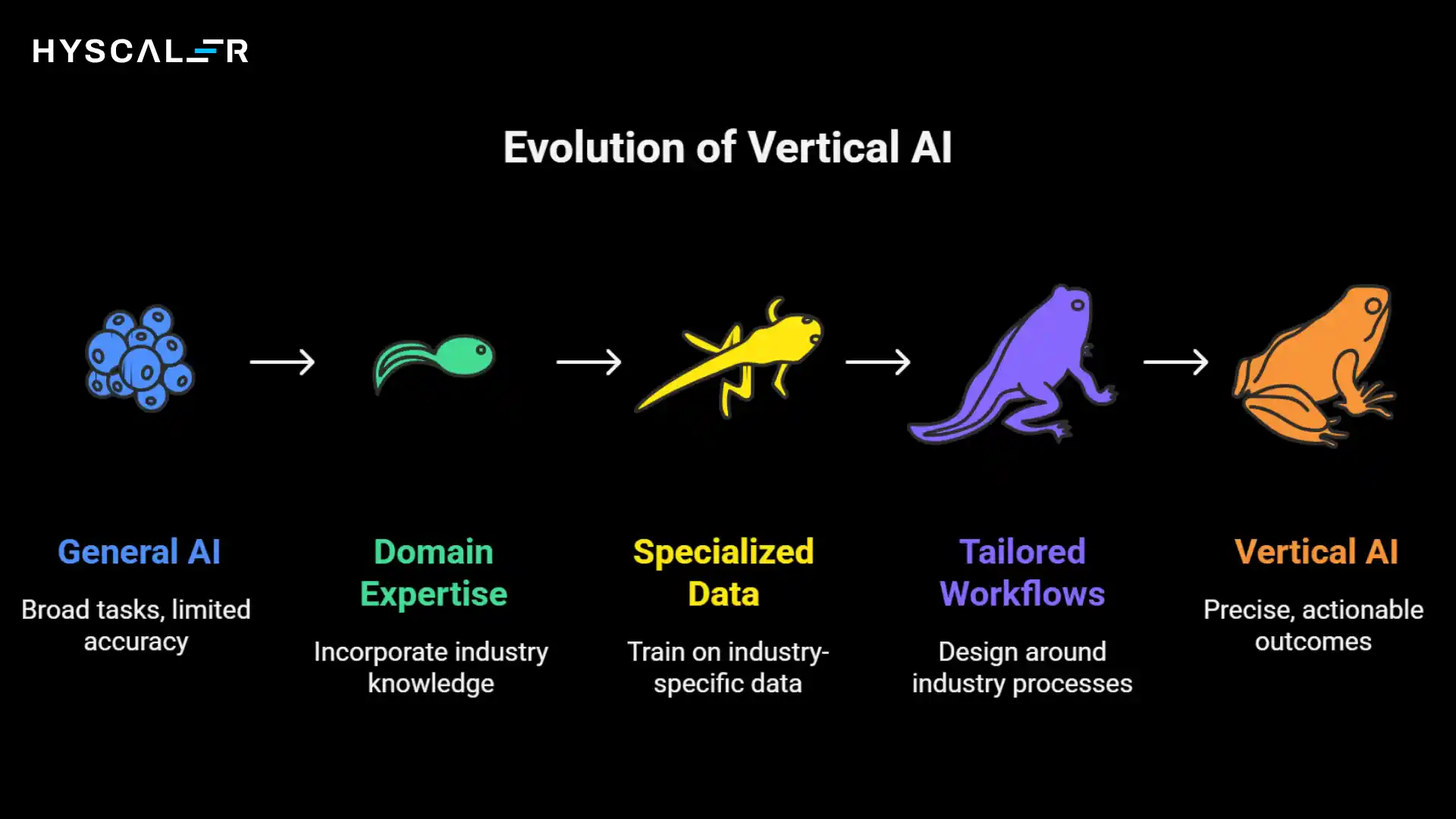
Vertical AI refers to AI systems built for a specific industry or business function, using domain expertise, specialized data, and tailored workflows.
Unlike general-purpose AI that handles broad tasks, Vertical AI is optimized for depth over breadth, delivering more accurate and actionable outcomes within a defined context.
Key characteristics:
- Trained on domain-specific data (e.g., clinical records, legal documents, financial transactions)
- Designed around industry workflows and decision-making processes
- Focused on solving specialized business problems, not generic tasks
Examples:
- Healthcare: Clinical documentation assistants trained on medical data
- Finance: Fraud detection systems using transaction and regulatory data
- Legal: AI tools for research and contract drafting
It’s purpose-built to solve high-value, domain-specific problems with precision.
Vertical AI vs Horizontal AI
Horizontal AI is general-purpose, trained on broad datasets to handle many tasks (e.g., writing, coding, translation).
It’s flexible but can lack deep domain accuracy.
The table below summarizes the key differences:
| Feature | Horizontal AI | Vertical AI |
|---|---|---|
| Purpose | General-purpose AI | Industry-specific AI |
| Training Data | Broad, generic datasets | Domain-specific datasets |
| Accuracy | Moderate for specific tasks | High for the target domain |
| Workflows | Requires customization | Pre-built domain workflows |
| Integration | Generic APIs | Deep enterprise integration |
| Cost Efficiency | Lower upfront, less ROI | Higher ROI in the domain |
| Examples | ChatGPT, Gemini | Nuance (Health), Palantir (Finance) |
It is worth noting that neither is mutually exclusive.
Many Vertical AI systems are built on top of foundational models, large language models that provide general reasoning capabilities, then fine-tuned and augmented with domain-specific data and logic.
The key differentiator is the intentional specialization layered on top of that foundation.
How Vertical AI Works
It is built through a layered approach that combines specialized data, domain workflows, intelligent automation, and deep system integration.
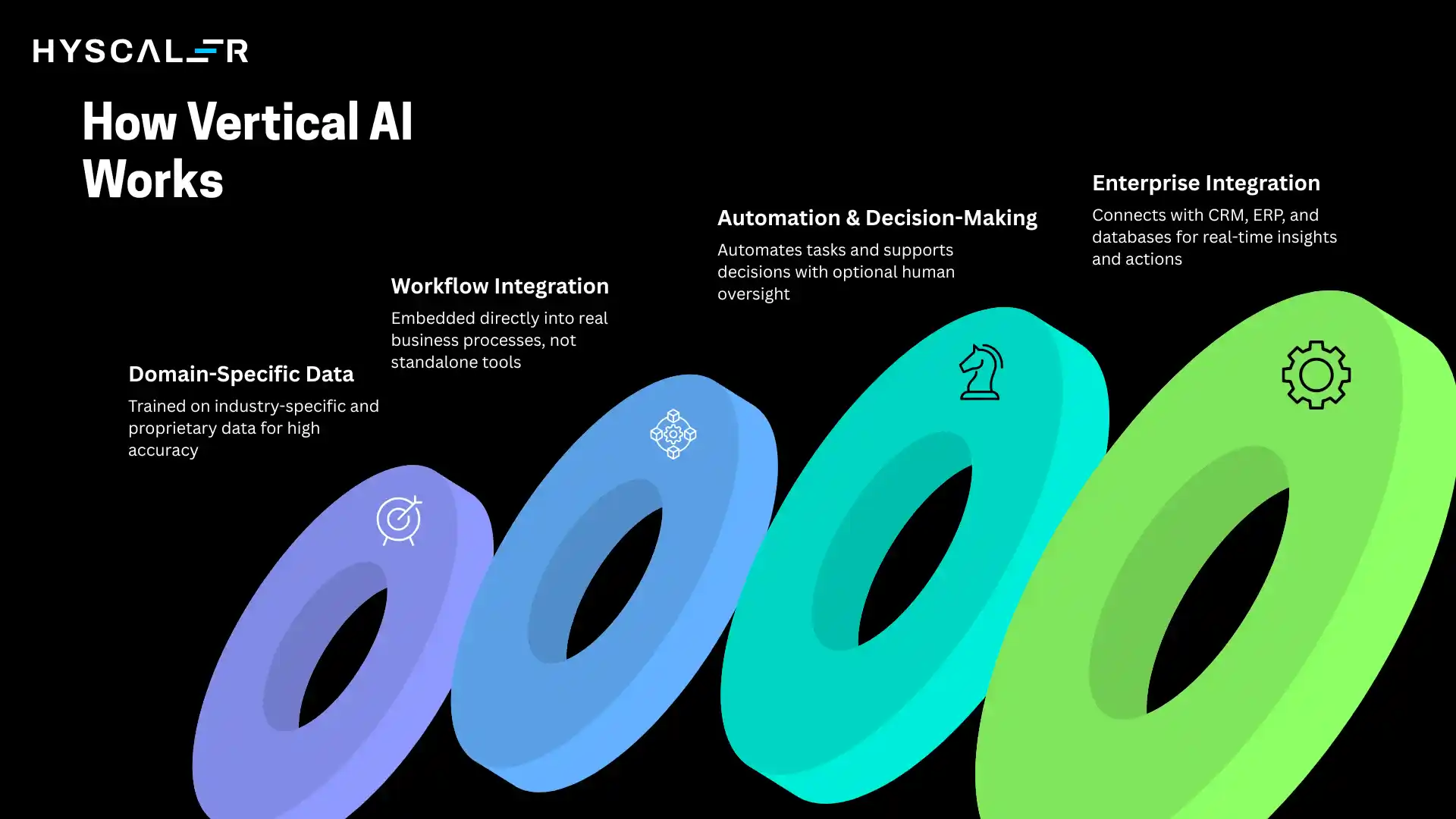
Domain-Specific Data
Trained on industry-native data (e.g., clinical records, legal documents, financial transactions), often enhanced with proprietary enterprise data for higher accuracy.
Workflow Integration
Embedded directly into real business processes, acting within workflows (e.g., generating clinical notes, monitoring transactions), not as a standalone tool.
Automation & Decision-Making
Handles both repetitive and complex tasks, from fully automated actions (e.g., fraud blocking) to AI-assisted decisions with human oversight.
Enterprise Integration
Connects with core systems like CRM, ERP, and databases via APIs, enabling real-time context, actions, and insights.
In essence, Vertical AI works by combining deep domain understanding with operational integration to deliver precise, actionable outcomes.
Key Benefits
Organizations adopting Vertical AI see strong gains in accuracy, efficiency, and decision-making.
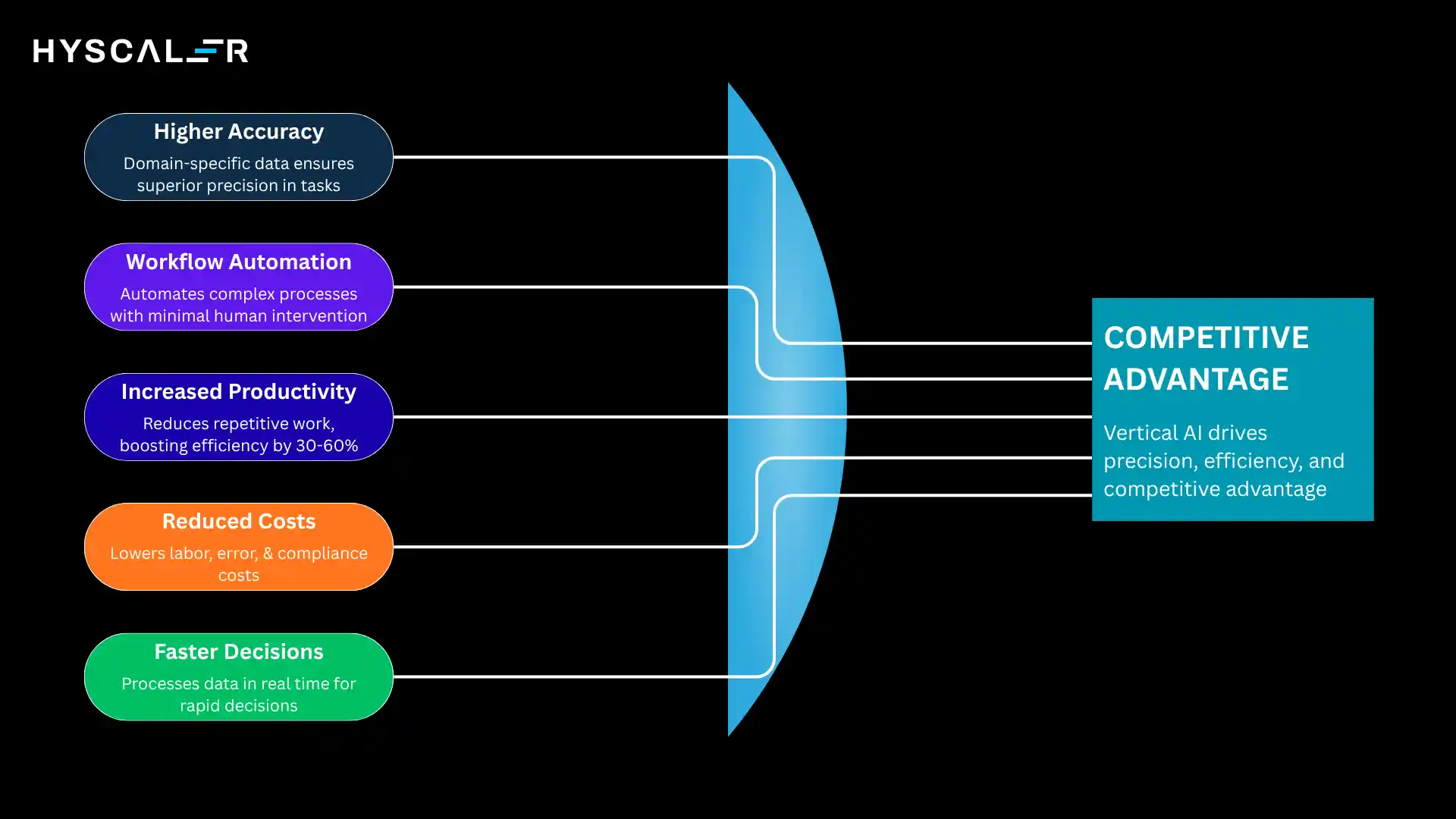
Higher Accuracy
Trained on domain-specific data, it delivers superior precision in specialized tasks (e.g., legal review, medical coding).
Workflow Automation
Automates complex, end-to-end processes (e.g., insurance claims processing) with minimal human intervention.
Increased Productivity
Reduces repetitive work, enabling professionals to focus on high-value tasks, often improving efficiency by 30-60%.
Reduced Operational Costs
Lowers labor, error, and compliance costs while improving speed and scalability.
Faster Decision-Making
Processes large datasets in real time, enabling rapid, high-quality decisions in critical domains like finance and cybersecurity.
It drives precision, efficiency, and competitive advantage at scale.
Real-World Use Cases
Vertical AI is already driving impact across industries by delivering automation, accuracy, and scalability.
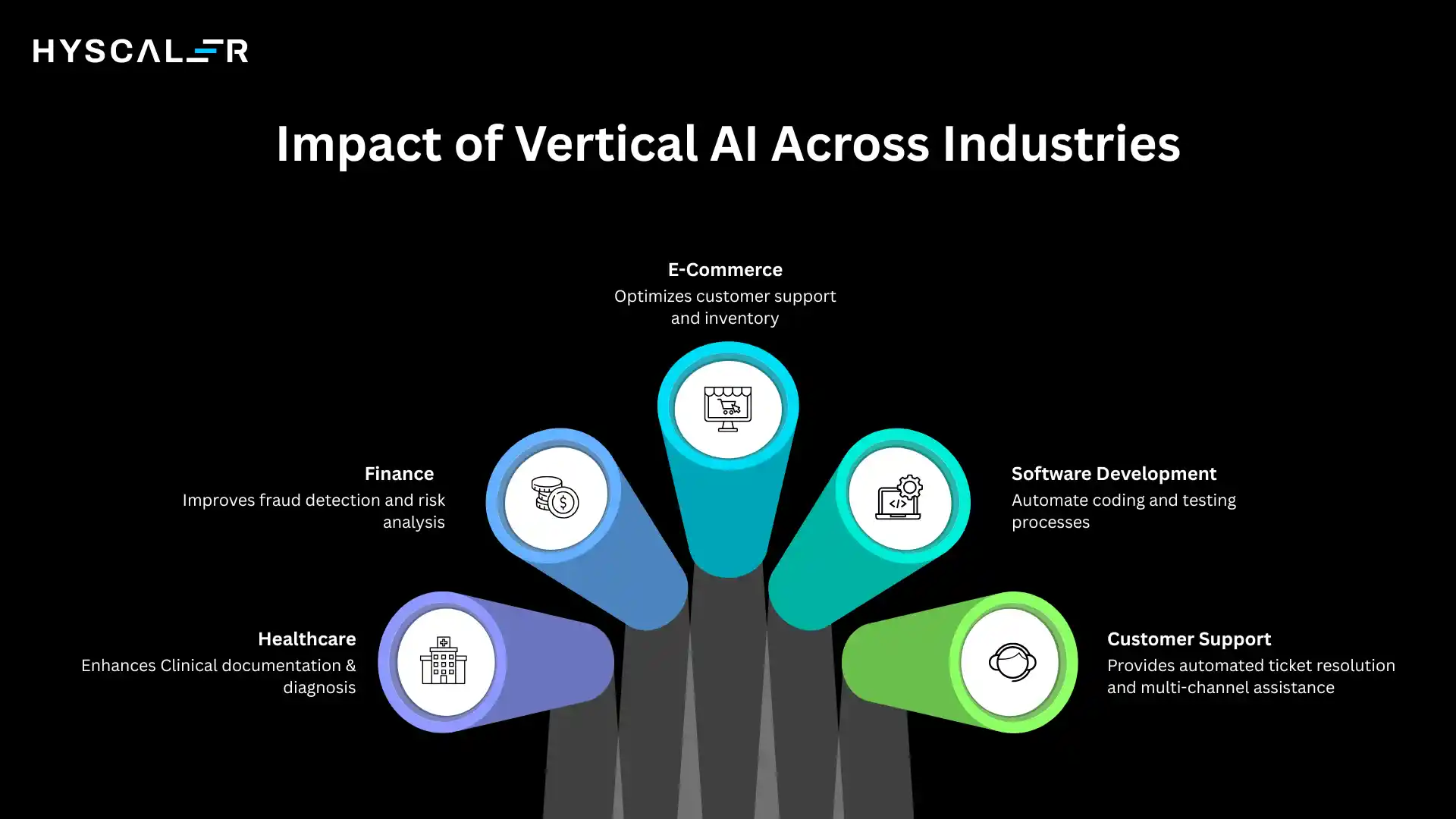
Healthcare
- Clinical documentation automation (e.g., AI-generated notes)
- Diagnosis support from medical imaging
- Automated coding and prior authorization
Finance
- Real-time fraud detection
- Risk analysis for loans, claims, and investments
- Regulatory compliance monitoring
E-commerce
- End-to-end customer support automation
- Demand forecasting and inventory optimization
- Personalized recommendations at scale
Software Development
- AI coding agents tailored to codebases
- Automated testing and quality assurance
- DevOps monitoring and incident response
Customer Support
- Automated ticket classification and resolution
- AI agents handling multi-channel interactions and backend actions
It transforms industries by embedding intelligence directly into core operations.
Vertical AI vs SaaS: The Next Evolution
Vertical AI marks a fundamental shift in how enterprise software delivers value.
Over the past three decades, enterprise software has evolved in two major waves.
The first wave was custom-built systems, expensive, slow, and hard to maintain.
The second wave, SaaS, made powerful software accessible via subscription.
Platforms like Salesforce (CRM), Workday (HR), and ServiceNow (IT) improved productivity, but still relied on humans to operate them.
Traditional SaaS model:
Humans use software to analyze data, make decisions, and take action.
Vertical AI model:
AI agents operate autonomously, understanding context, making decisions, and executing tasks, while humans define goals and review outcomes.
This is a shift from tool → agent.
The impact is economic as much as technological.
SaaS pricing is tied to user seats because humans do the work.
Vertical AI shifts value to outcomes, since agents perform the work without needing seats.
As a result, enterprises can scale operations without scaling headcount.
AI agents work continuously, handle thousands of tasks simultaneously, and reduce the cost and variability of knowledge work.
With analysts predicting a major shift toward AI-driven platforms by 2028, early adopters in industries like finance, healthcare, and professional services are already gaining a significant competitive edge.
Challenges of Vertical AI
Despite its transformative potential, Vertical AI is not without challenges.
Organizations considering adoption should approach these thoughtfully rather than allowing them to stall progress.
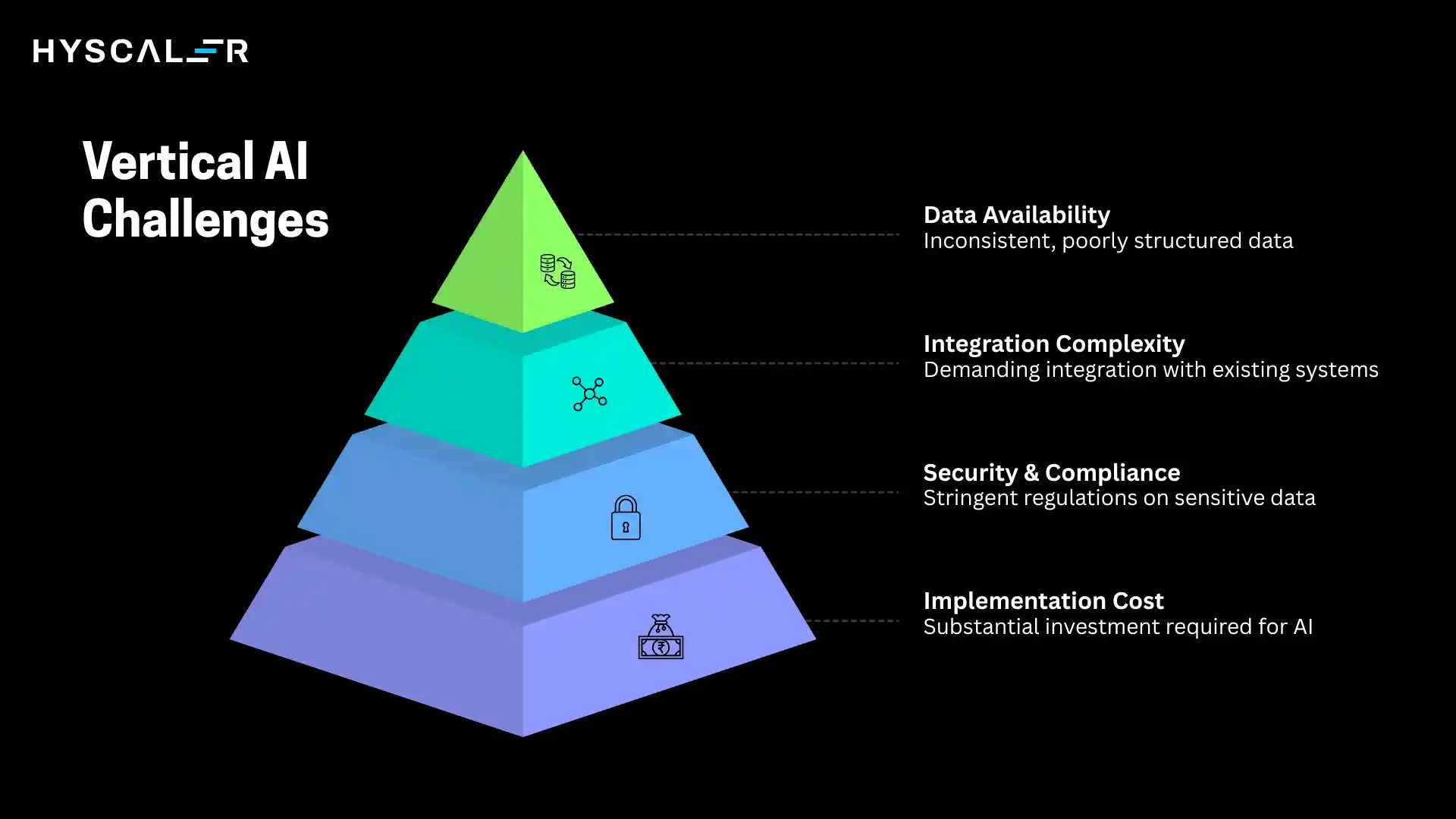
Data Availability and Quality
The performance of any Vertical AI system is fundamentally constrained by the quality and quantity of its training data.
Many organizations discover that while they have large volumes of data, it is inconsistent, poorly structured, incomplete, or not labeled in ways that support AI training.
Building robust data pipelines and governance practices is a prerequisite for effective Vertical AI, and often a more significant undertaking than organizations anticipate.
Integration Complexity
Integrating Vertical AI with existing enterprise systems, legacy ERP platforms, proprietary databases, and complex API ecosystems can be technically demanding.
Many enterprise environments were not designed with AI integration in mind, and bridging these systems requires careful engineering and ongoing maintenance.
Organizations should plan for integration complexity as a core part of their AI investment, not an afterthought.
Security and Compliance
Industries like healthcare, finance, and legal services operate under stringent data security and privacy regulations, HIPAA, GDPR, SOC 2, and others.
Vertical AI systems that process sensitive data must be designed with these requirements as first-order constraints, not retrofitted compliance.
This includes data residency considerations, access controls, audit logging, and model governance.
Working with an AI partner that has deep expertise in regulatory compliance within the target domain is essential.
Implementation Cost
High-quality Vertical AI is not a commodity purchase.
The investment required for domain-specific data curation, model development and fine-tuning, enterprise integration, and ongoing optimization is substantial.
Organizations should approach this as a strategic technology investment, one that requires executive sponsorship, realistic timelines, and clear success metrics, rather than a quick software deployment.
Future of Vertical AI
The trajectory of Vertical AI is clear: it is moving from early-adopter territory toward mainstream enterprise deployment, and its capabilities are expanding rapidly.
Several key trends are shaping where this technology is headed.
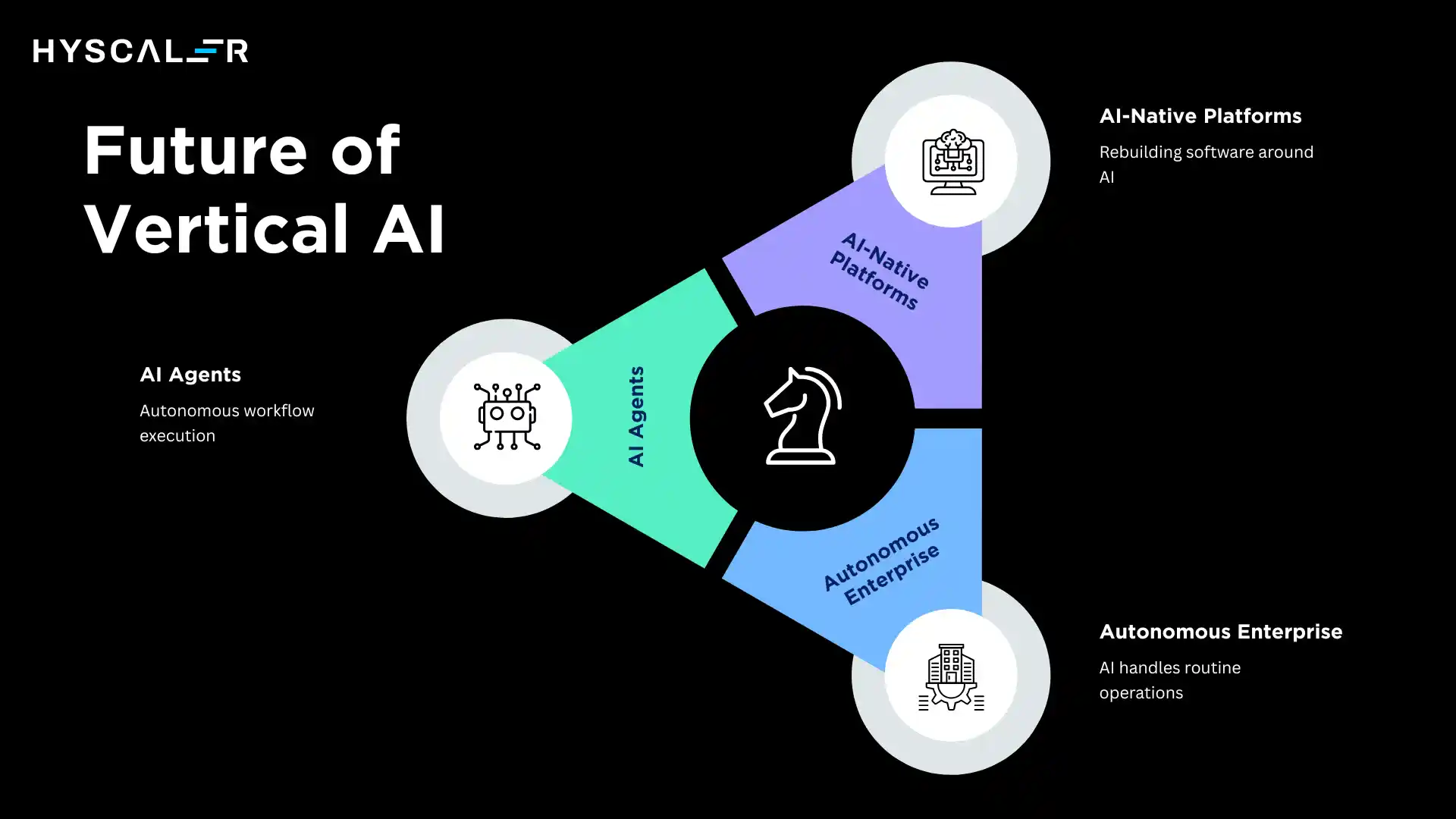
The Rise of AI Agents
The most significant near-term development in Vertical AI is the emergence of sophisticated AI agents.
These systems do not just respond to queries but autonomously pursue goals across multi-step, multi-system workflows.
In healthcare, an AI agent might schedule a follow-up appointment, send a patient reminder, update the care plan, and flag a medication interaction, all triggered by a single physician instruction.
In finance, an agent might monitor a portfolio, identify a rebalancing opportunity, execute trades within defined parameters, and generate a report for the portfolio manager.
These agents represent a qualitative leap from AI-as-tool to AI-as-colleague, a shift with profound implications for how enterprises organize work and allocate human capital.
Replacement of Traditional Software Categories
As Vertical AI systems mature, they will increasingly displace traditional software categories in their target domains.
AI-native platforms will replace conventional SaaS tools not by adding AI features on top, but by rebuilding the software category around AI-first architecture.
Organizations that resist this transition will find themselves at a growing cost and capability disadvantage relative to AI-native competitors.
The Autonomous Enterprise
Looking further ahead, the cumulative effect of Vertical AI deployment across departments and functions points toward what some analysts are calling the ‘autonomous enterprise’, an organization in which AI agents handle the vast majority of routine operational work, freeing human employees to focus almost entirely on strategy, creativity, relationship management, and complex judgment.
This is not a distant science-fiction scenario; early versions of this model are already operational in forward-leaning organizations across financial services, e-commerce, and professional services.
Enterprise adoption of Vertical AI is accelerating significantly.
Organizations that begin building their AI capabilities and data infrastructure today will be positioned to capture compounding advantages over the years ahead.
Those who wait will face increasingly difficult catch-up dynamics.
How Enterprises Can Implement Vertical AI
Successfully implementing Vertical AI requires a structured approach that balances ambition with pragmatism.
Here is a practical framework for organizations ready to move forward.
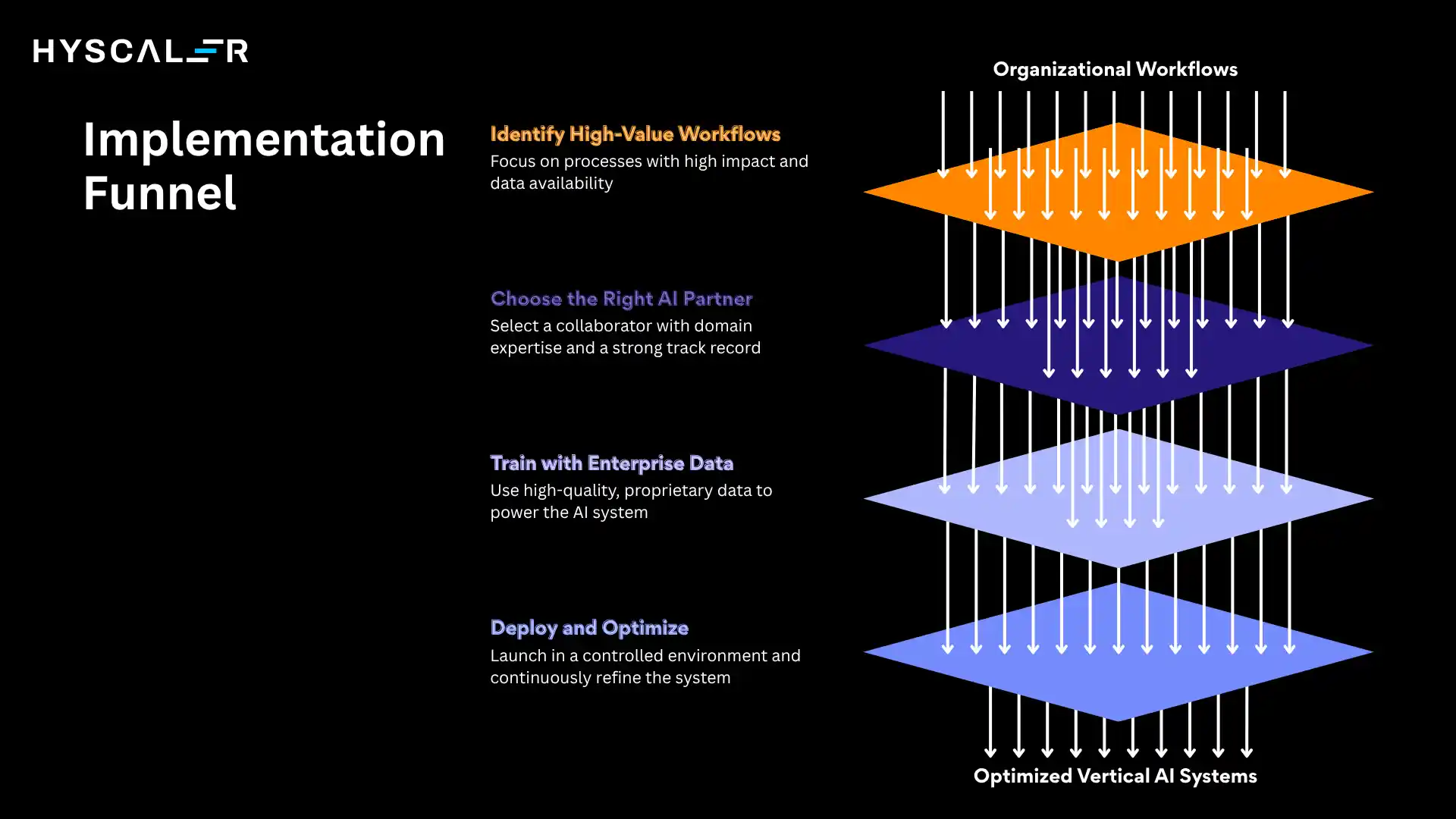
Step 1: Identify High-Value Workflows
Start by conducting a systematic audit of your organization’s workflows to identify where Vertical AI can deliver the greatest impact.
Look for processes that are high-volume, repetitive, and require domain expertise; these are the sweet spots where AI delivers disproportionate value.
Prioritize based on a combination of business impact, data availability, and feasibility.
Starting with a well-scoped use case allows you to demonstrate value quickly and build organizational confidence in AI.
Step 2: Choose the Right AI Partner
Building production-grade Vertical AI requires specialized expertise that most organizations do not have in-house.
Evaluate AI development partners based on their depth of experience in your target domain, their track record of enterprise deployments, their approach to data security and compliance, and their ability to support the full lifecycle from design through deployment and optimization.
The right partner is not just a technology vendor; they are a strategic collaborator in building a core business capability.
Step 3: Train with Enterprise Data
Work with your AI partner to identify, curate, and prepare the enterprise data that will power your Vertical AI system.
This includes historical transaction records, domain-specific documents, annotated examples, and any proprietary knowledge that represents your organization’s competitive insight.
The quality of this data investment directly determines the quality of the AI system you can build.
Invest in data governance infrastructure that will continue to feed and improve the system over time.
Step 4: Deploy and Optimize
Begin deployment in a controlled environment, with clear performance metrics established before launch.
Monitor outputs carefully, gather feedback from the human experts who work alongside the system, and plan for iterative refinement.
Vertical AI systems improve with operational experience; the more the system is used, the more data it generates to support ongoing optimization.
Build a continuous improvement process into your deployment plan from the start.
How HyScaler Helps Build Vertical AI Solutions
HyScaler is a technology engineering company specializing in the design, development, and deployment of advanced AI solutions for enterprises.
With deep expertise in AI engineering, enterprise integration, and domain-specific AI development, HyScaler serves as a strategic partner for organizations ready to move from AI experimentation to AI-driven transformation.
AI Agent Development
HyScaler’s engineering teams design and build sophisticated AI agents capable of autonomous multi-step workflows across complex enterprise environments.
From task-specific automation agents to full-scale agentic systems that operate across departments, HyScaler brings the technical depth and AI expertise required to build agents that perform reliably in production environments.
Enterprise Integration
HyScaler’s engineers have extensive experience integrating AI systems with the enterprise technology stacks that power modern businesses, including Salesforce, SAP, ServiceNow, Workday, custom-built legacy systems, and industry-specific platforms.
This integration expertise ensures that Vertical AI solutions connect seamlessly with your existing infrastructure, delivering value from day one without disrupting operations.
Custom Vertical AI Solutions
Rather than adapting general-purpose AI to your needs, HyScaler builds Vertical AI solutions purpose-designed for your domain and your organization.
This includes domain-specific model fine-tuning, knowledge base development, workflow design, and the user experience engineering required to make AI systems that your teams will actually adopt and rely on.
Deployment and Scaling
HyScaler manages the full deployment lifecycle, from initial proof of concept through production deployment and ongoing scaling.
This includes infrastructure design, security and compliance engineering, performance monitoring, and the continuous optimization processes that keep Vertical AI systems improving over time.
As your AI capabilities grow, HyScaler’s team grows with you, ensuring that your investment continues to deliver increasing returns.
Conclusion
Vertical AI represents the next major evolution in enterprise software and automation.
By combining the reasoning power of modern artificial intelligence with deep domain expertise, purpose-built training data, and seamless enterprise integration, Vertical AI delivers something that general-purpose AI cannot.
The enterprises that will define their industries over the next decade are those that recognize this shift early and begin building Vertical AI capabilities now.
The competitive advantages, higher accuracy, radical workflow automation, transformative productivity gains, and dramatically faster decision-making compound over time in ways that are extremely difficult for late movers to replicate.
Whether you are looking to automate complex operational workflows, build AI agents that work autonomously across your enterprise, or position your organization for the AI-driven future, the path begins with a clear strategy and the right technology partner.
FAQ
Can small and mid-sized businesses use Vertical AI?
Yes. Cloud-based and industry-specific solutions make Vertical AI accessible to SMBs, allowing adoption without large AI teams, making it scalable and cost-effective.
How does Vertical AI integrate with existing enterprise systems?
Vertical AI integrates via APIs or embedded interfaces into ERP, CRM, and databases, working within existing workflows to enhance productivity with minimal disruption.
Does Vertical AI require large amounts of data?
Not necessarily. While high-quality data is important, Vertical AI focuses more on relevant, domain-specific datasets rather than massive generic datasets. Even smaller, well-curated proprietary data can significantly improve performance.
What industries benefit the most from Vertical AI?
Industries with complex workflows and strict regulations, like healthcare, finance, insurance, manufacturing, and legal, benefit the most from Vertical AI.