Table of Contents
Artificial intelligence is no longer a concept confined to science fiction.
Today, AI models power everything from the search bar on your browser to complex medical diagnostics, real-time language translation, and self-driving vehicles.
But not all AI models are the same; each type is engineered for a specific class of tasks, using distinct architectures, training techniques, and data types.
Understanding the different types of AI models is essential for developers, researchers, business leaders, and curious learners alike.
Whether you are building a product powered by machine learning, choosing the right tool for your workflow, or simply trying to make sense of AI headlines, this guide has you covered.
In this comprehensive blog, we explore the major categories of AI models, what makes each unique, how they work at a high level, and where they are used in the real world.
Machine Learning Models
Machine learning (ML) is the foundation of modern AI.
An ML model learns patterns from data rather than being explicitly programmed with rules.
It improves its performance over time as it is exposed to more examples.
Supervised Learning Models
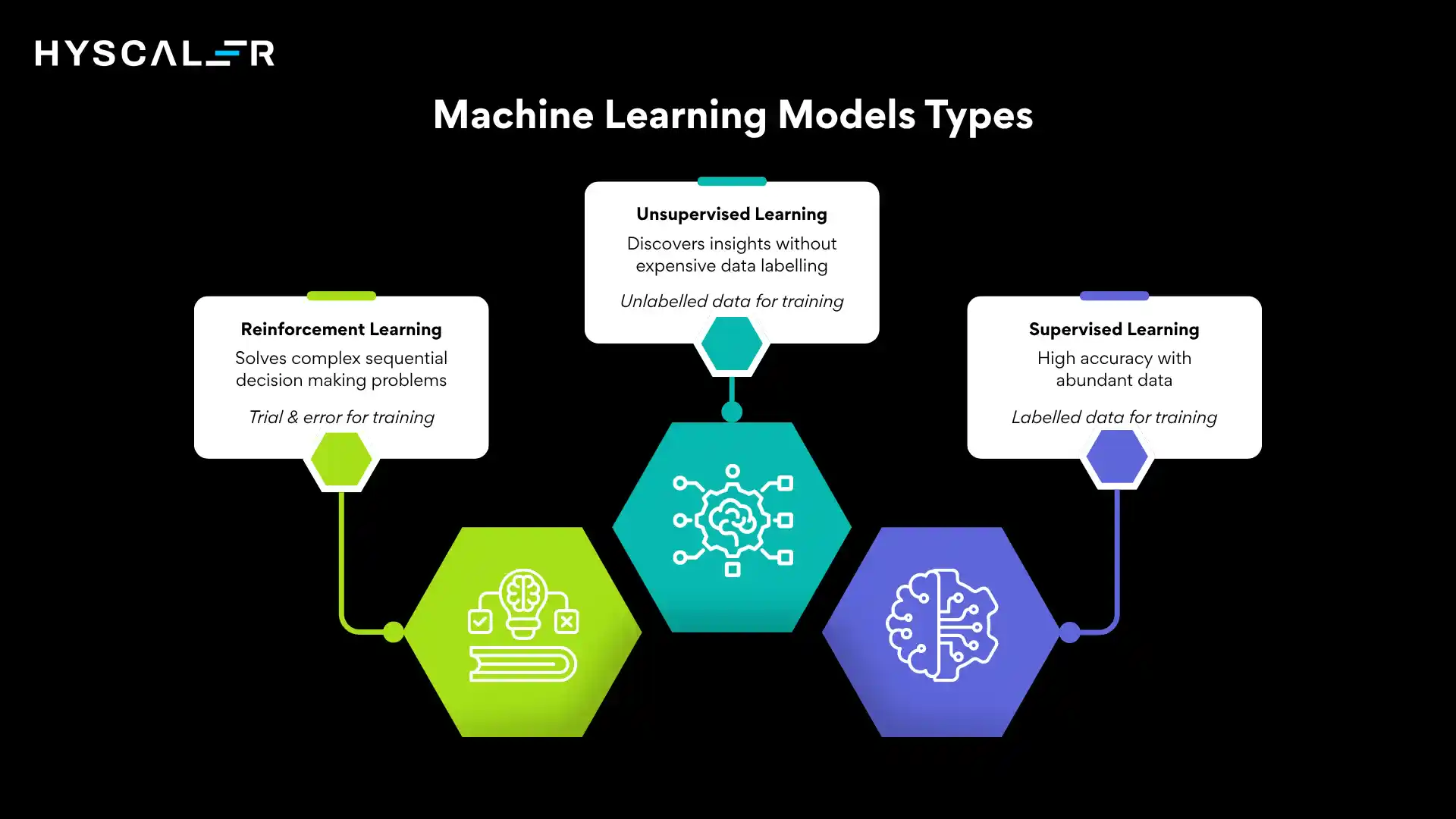
In supervised learning, the AI model is trained on a labelled dataset, meaning each input comes with a known correct output.
The model learns to map inputs to outputs and then applies that learning to new, unseen data.
- Examples: Linear Regression, Logistic Regression, Decision Trees, Support Vector Machines (SVM), Neural Networks
- Use Cases: Email spam detection, credit scoring, medical diagnosis, image classification
- Key Advantage: High accuracy when labelled data is abundant
Unsupervised Learning Models
Unsupervised learning models work without labelled data.
Instead, they look for hidden patterns, structures, or groupings within the data itself.
This makes them incredibly useful when you do not know what you are looking for in advance.
- Examples: K-Means Clustering, DBSCAN, Principal Component Analysis (PCA), Autoencoders
- Use Cases: Customer segmentation, anomaly detection, topic modelling, data compression
- Key Advantage: Discovers insights without needing expensive data labelling
Reinforcement Learning Models
Reinforcement learning (RL) models learn by trial and error.
An agent interacts with an environment, takes actions, and receives rewards or penalties depending on the outcome.
Over time, it learns a policy that maximises its cumulative reward.
- Examples: Q-Learning, Deep Q-Networks (DQN), Proximal Policy Optimisation (PPO), AlphaGo
- Use Cases: Game playing, robotic control, autonomous driving, recommendation engines
- Key Advantage: Solves complex sequential decision-making problems
Deep Learning Models
Deep learning is a subset of machine learning that uses neural networks with many layers, hence the term “deep.”
These multi-layered architectures can automatically learn hierarchical representations of data, making them exceptionally powerful for tasks involving images, audio, and text.
Convolutional Neural Networks (CNNs)
CNNs are specifically designed to process grid-like data, such as images and video.
They use a series of convolutional layers that apply filters to detect features like edges, textures, and shapes at increasing levels of abstraction.
- Use Cases: Image recognition, object detection, medical imaging, facial recognition, autonomous vehicles
- Notable Models: ResNet, VGG, EfficientNet, YOLO
Recurrent Neural Networks (RNNs) & LSTMs
RNNs process sequential data by maintaining a hidden state that carries information from previous time steps.
Long Short-Term Memory (LSTM) networks are a popular variant that solves the vanishing gradient problem, allowing models to learn long-range dependencies in data.
- Use Cases: Time-series forecasting, speech recognition, natural language processing, music generation
- Notable Models: LSTM, GRU (Gated Recurrent Unit), Bidirectional RNNs
Transformer Models
Introduced in the landmark 2017 paper “Attention is All You Need,” transformers revolutionised AI by replacing recurrence with a self-attention mechanism.
This allows the model to process all parts of a sequence simultaneously, making training far more efficient and scalable.
- Use Cases: Language translation, text generation, summarisation, code generation, question answering
- Notable Models: BERT, GPT series, T5, Claude, LLaMA, PaLM
Large Language Models (LLMs)
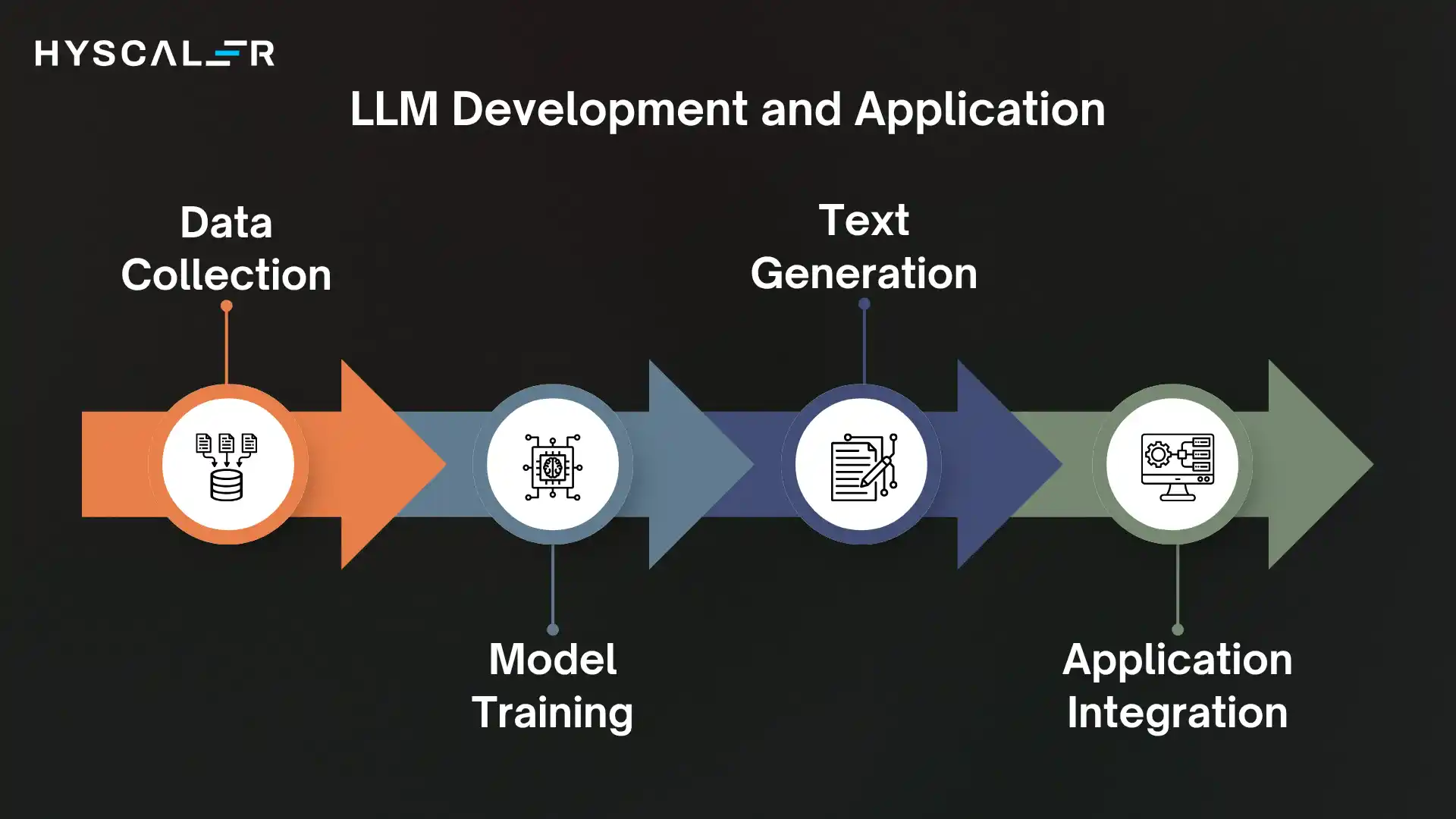
Large Language Models are a class of AI models trained on vast amounts of text data.
They learn statistical relationships between words, sentences, and concepts, enabling them to generate coherent, contextually relevant text across a wide range of domains.
LLMs have become the backbone of modern AI applications.
They power conversational AI assistants, code completion tools, search engines, and creative writing platforms.
Models like GPT-4, Claude, and Gemini represent the cutting edge of this category.
- Key Capabilities: Text generation, summarisation, translation, reasoning, question answering
- Training: Trained on terabytes of text from books, websites, and code repositories
- Notable Examples: GPT-4, Claude 3, Gemini, LLaMA 3, Mistral
- Limitation: Can hallucinate (generate plausible but incorrect information)
Generative AI Models
Generative AI models are designed to create new content, text, images, music, video, code, and more.
They learn the underlying distribution of training data and generate novel samples that resemble it.
Generative Adversarial Networks (GANs)
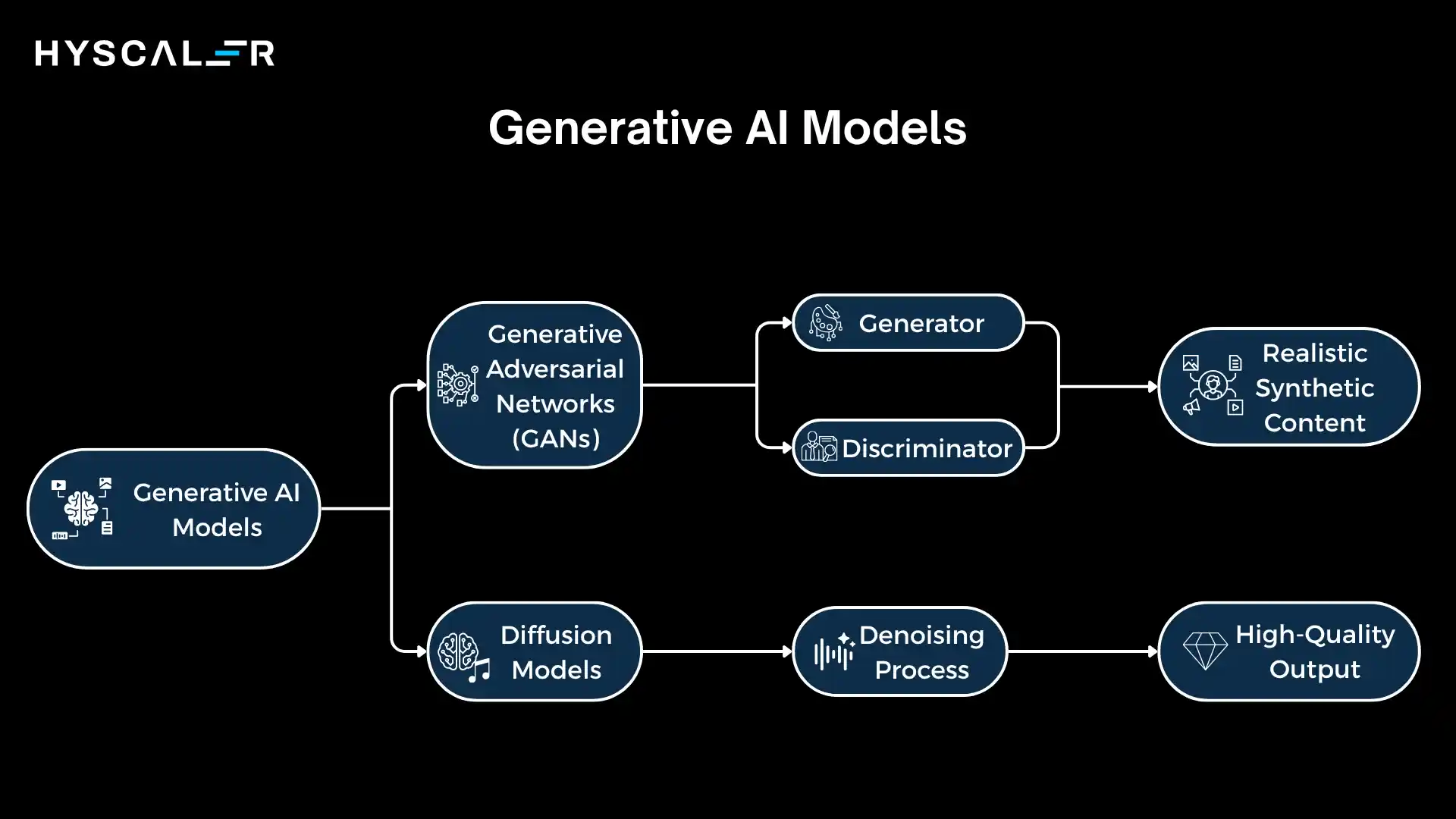
GANs consist of two neural networks, a Generator that creates fake data, and a Discriminator that tries to distinguish real data from fake.
The two networks train adversarially, pushing each other to improve.
The result is a generator capable of producing highly realistic synthetic content.
- Use Cases: Synthetic image generation, deepfakes, data augmentation, video generation
- Notable Models: StyleGAN, CycleGAN, BigGAN, Pix2Pix
Diffusion Models
Diffusion models work by gradually adding noise to training data and then learning to reverse this process, essentially learning how to denoise.
In inference, they start with pure noise and iteratively refine it into a high-quality image or other output.
- Use Cases: Text-to-image generation, image editing, video synthesis, audio generation
- Notable Models: DALL-E 3, Stable Diffusion, Midjourney, Imagen, Sora
Multimodal AI Models
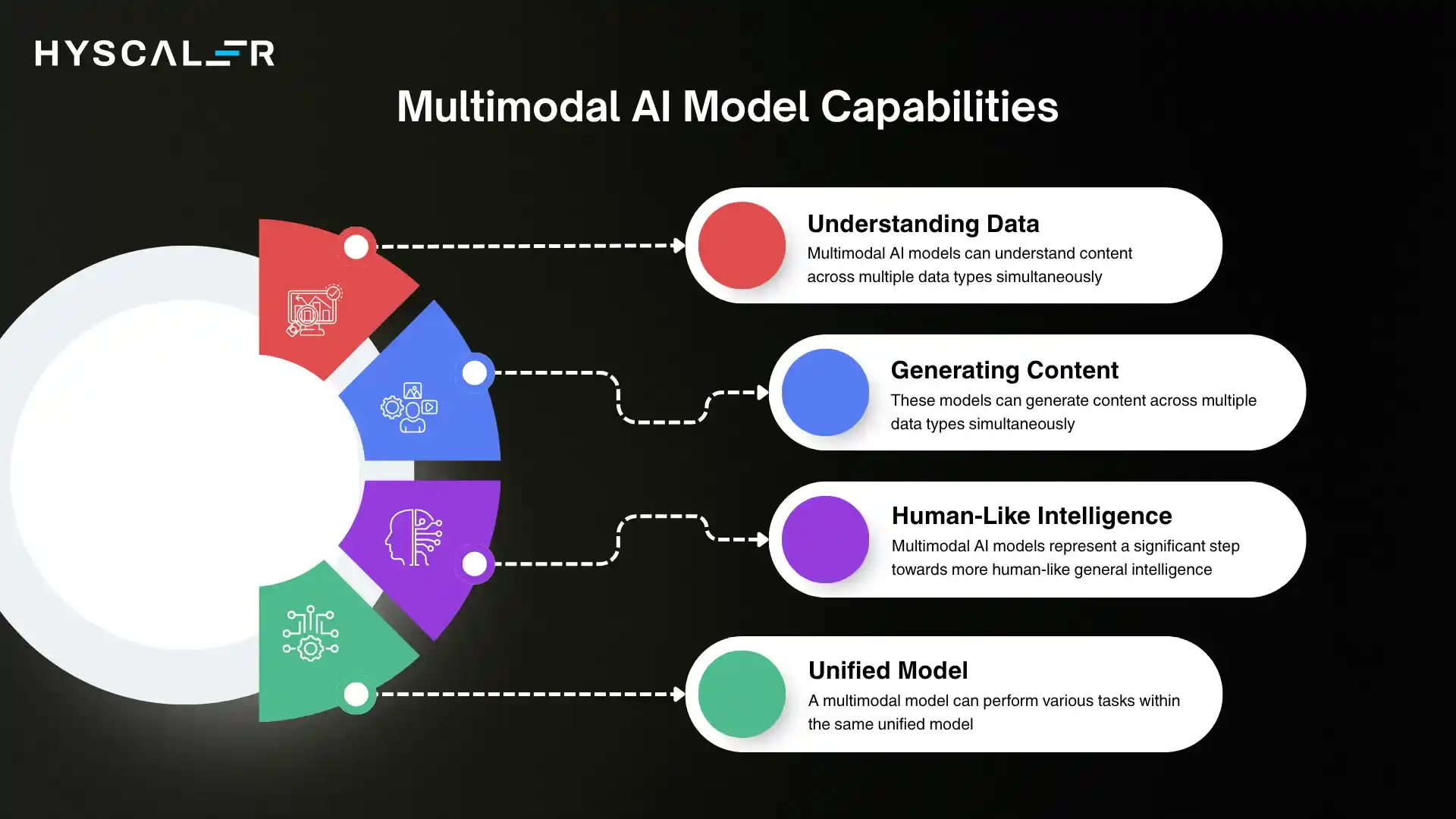
Multimodal AI models can understand and generate content across multiple types of data simultaneously, combining text, images, audio, and video.
These models represent a significant step towards more human-like general intelligence.
For example, a multimodal model can look at a photograph and describe it in natural language, answer questions about it, or generate a related image from a text prompt, all within the same unified model.
- Use Cases: Visual question answering, image captioning, video understanding, document intelligence
- Notable Models: GPT-4o, Gemini 1.5, Claude 3 Opus, Flamingo, CLIP, LLaVA
Foundation Models
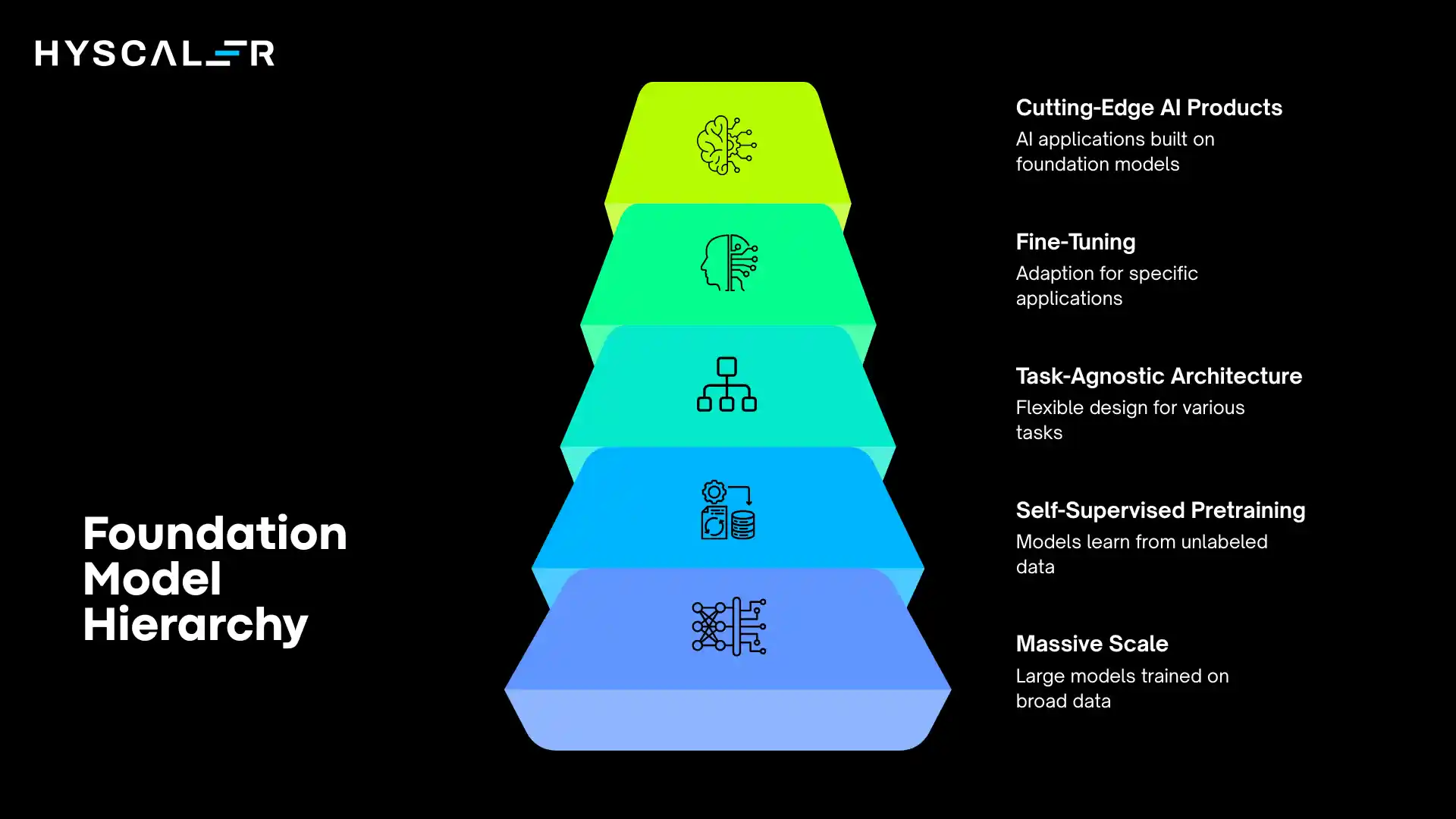
Foundation models are large-scale AI models trained on broad data and designed to be adapted to a wide range of downstream tasks.
Rather than training separate models for each task, a foundation model can be fine-tuned with minimal additional data to perform exceptionally well on specialised applications.
The concept was popularised by Stanford’s Institute for Human-Centered AI and has transformed how the AI industry thinks about model development.
Today, most cutting-edge AI products are built on top of foundation models.
- Characteristics: Massive scale, self-supervised pretraining, task-agnostic architecture
- Use Cases: NLP, computer vision, drug discovery, scientific research, code generation
- Notable Examples: BERT, GPT series, Claude, Gemini, SAM (Segment Anything Model)
Specialised AI Models
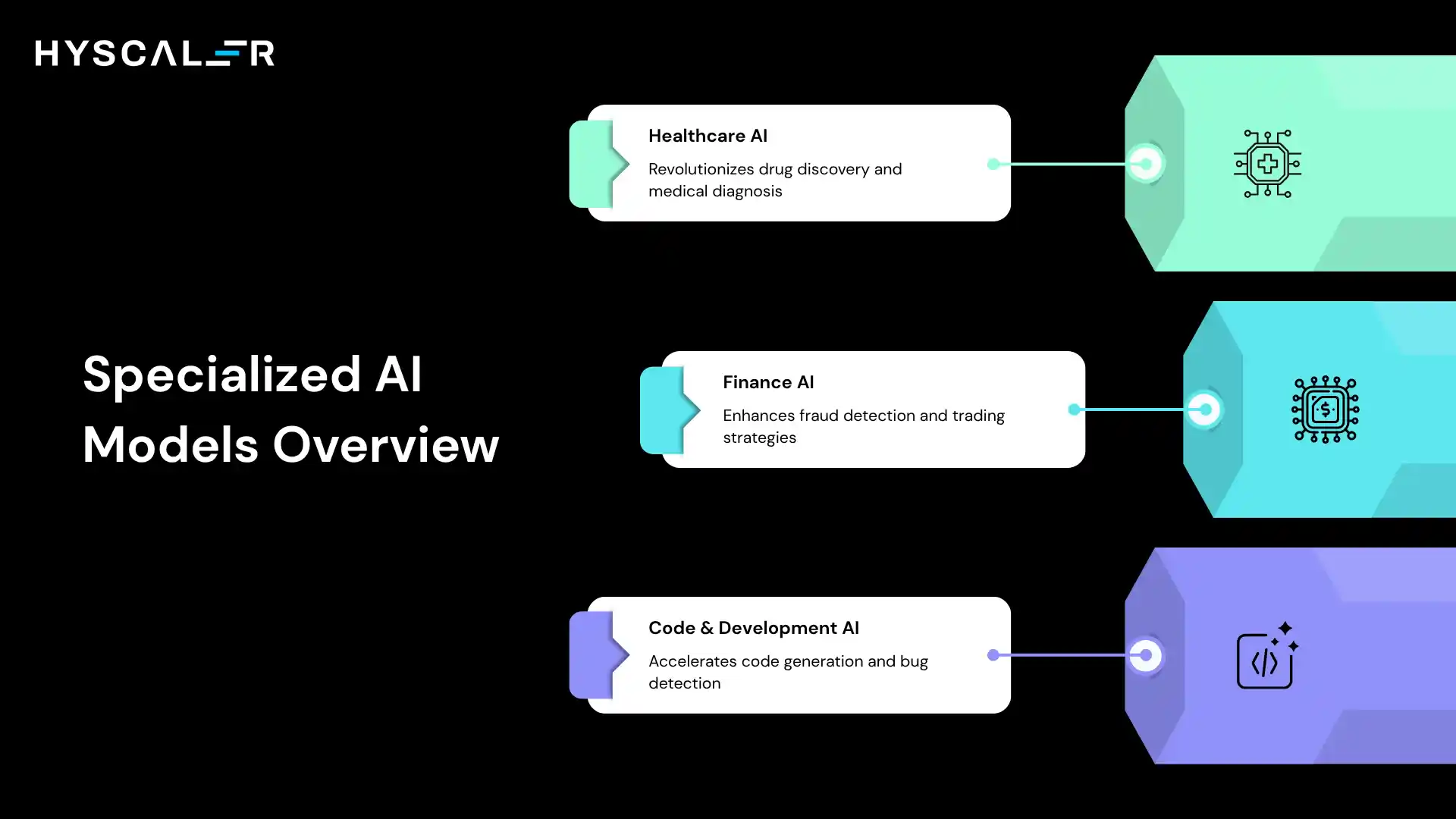
Beyond general-purpose models, there is a rich ecosystem of AI models purpose-built for specific domains.
These specialised models often outperform general ones in their respective fields by leveraging domain-specific data and architectures.
AI Models in Healthcare
- AlphaFold: Predicts protein structures with remarkable accuracy, revolutionising drug discovery
- MedPaLM 2: A medical LLM capable of passing medical licensing exams
- Radiology AI: CNN-based models that detect cancers, fractures, and abnormalities in X-rays and MRIs
AI Models in Finance
- Fraud Detection Models: Identify anomalous transactions in real-time using ensemble methods
- Algorithmic Trading Models: RL-based systems that execute trades based on market signals
- Credit Scoring: Gradient Boosting models (XGBoost, LightGBM) that assess lending risk
AI Models in Code & Development
- Code Generation: GitHub Copilot, CodeLlama, and DeepSeek Coder generate code from natural language prompts
- Bug Detection: AI models that statically analyse codebases to surface vulnerabilities and errors
Choosing the Right AI Model
With so many types of AI models available, choosing the right one depends on several key factors.
Here is a framework to guide your decision:
- Nature of your data: Structured (tabular) data typically suits classical ML; unstructured data (images, text, audio) benefits from deep learning or transformers
- Availability of labels: Labelled data → supervised learning; no labels → unsupervised; reward signal → reinforcement learning
- Task type: Classification, regression, generation, clustering, or decision-making, each maps to different model families
- Compute constraints: Large models require significant GPU resources; smaller, distilled models offer efficiency
- Domain requirements: Specialised domains may benefit from fine-tuned or purpose-built models
Conclusion
The landscape of AI models is vast, dynamic, and evolving rapidly.
From classical machine learning algorithms that have powered business intelligence for decades, to transformer-based large language models redefining what computers can do with language, each type of AI model has its place in the modern technological ecosystem.
Understanding the distinctions between these models, their strengths, limitations, and best-fit applications, is the first step towards using AI effectively and responsibly.
Whether you are a seasoned ML engineer or a business professional exploring AI adoption, a clear mental map of AI model types will help you make smarter decisions.
As AI advances, new architectures and hybrid models will emerge.
Stay curious, keep learning, and remember: the best AI model is always the one that best fits the problem at hand.
FAQ
What is the difference between machine learning and deep learning models?
Machine learning models use structured data and simpler algorithms, while deep learning models use neural networks with multiple layers to process complex data like images, audio, and text.
What are generative AI models used for?
Generative AI models are used to create content such as text, images, videos, and code. Examples include chatbots, AI art generators, and content creation tools.
What are predictive AI models?
Predictive AI models analyze historical data to forecast future outcomes, commonly used in finance, healthcare, and marketing for decision-making.
What is an NLP model in AI?
Natural Language Processing (NLP) models help machines understand, interpret, and generate human language, enabling applications like chatbots, translation, and sentiment analysis.
What is a computer vision model?
Computer vision models enable machines to interpret and analyze visual data such as images and videos, used in facial recognition, autonomous vehicles, and medical imaging.
What is reinforcement learning in AI?
Reinforcement learning is a type of AI where models learn by interacting with an environment and receiving rewards or penalties for their actions.
What are embodied AI models?
Embodied AI models integrate AI with physical systems like robots, allowing them to perceive, interact, and act in the real world.
Which AI model is best for businesses?
The best AI model depends on the use case:
Generative AI → Content creation
Predictive AI → Forecasting
NLP → Customer support
Computer Vision → Image/video analysis
How do AI models learn from data?
AI models learn through training processes where they analyze large datasets, identify patterns, and adjust their parameters to improve accuracy over time.
Are AI models safe and reliable?
AI models can be highly effective but require proper training, monitoring, and ethical guidelines to ensure accuracy, fairness, and security.