Table of Contents
In 2026, the competitive landscape is no longer defined by who can generate content, but by who can execute outcomes. We have moved definitively from the era of reactive generative AI, which required constant human prompting, to proactive agentic AI. For the enterprise architect, this transition is the primary differentiator: those who fail to adopt autonomous systems face “Agentic Lag,” a state where operational overhead and response latency become terminal competitive disadvantages. The goal is the creation of a “Data Flywheel,” where autonomous interactions generate high-fidelity data that continuously refines underlying models, creating a self-reinforcing moat of efficiency and intelligence.
Defining “Agentic AI” Agentic AI refers to autonomous systems capable of achieving complex, multi-step goals with minimal human oversight. Unlike traditional chatbots that follow decision trees, these systems possess “agency” through a four-stage operational cycle:
- Perceive: Ingesting real-time, multi-modal data from APIs, IoT sensors, and enterprise databases.
- Reason: Utilizing Large Language Models (LLMs) as central reasoning engines to decompose goals, plan sequences, and manage long-term memory.
- Act: Executing idempotent actions within external environments (CRMs, ERPs, or custom software) via secure tool-use and function calling.
- Learn: Refining strategies through reinforcement learning and feedback loops, ensuring the system adapts to edge cases without manual reprogramming.
The Economic Imperative
The shift is validated by aggressive market indicators that no CTO can ignore:
- Developer Momentum: GitHub activity for agentic frameworks (AutoGPT, CrewAI, etc.) surged by 920% between 2023 and 2025, signaling a massive talent migration toward autonomous orchestration.
- Operational Autonomy: Gartner projects that by 2029, agentic systems will autonomously resolve 80% of common customer service issues, effectively decoupling service capacity from headcount.
- Accelerating Adoption: Deloitte reports that while only 25% of enterprises launched pilots in 2025, that figure is hitting 50% in 2027 as proof-of-concepts mature into production environments.
Navigating this shift requires more than software vendors; it requires strategic architects who understand the nuances of autonomous orchestration.
How We Ranked the Leading 2026 AI Partners
The market is currently saturated with generalist software shops rebranding as AI experts. To provide a rigorous ranking, we utilized a framework that prioritizes architectural maturity over marketing claims. In 2026, a partner’s value is dictated by their ability to handle non-deterministic workflows while maintaining strict governance.
Evaluation Methodology
We assessed firms across four technical and strategic pillars:
- Technical Stack Maturity: Mastery of specialized orchestration layers including AWS Bedrock, Microsoft Copilot Studio, and Google Gemini Enterprise.
- Orchestration Capabilities: Proficiency in “Supervisor Agent” architectures, where a lead agent coordinates specialized sub-agents to solve multi-domain problems (e.g., a single request triggering simultaneous legal, financial, and logistical workflows).
- Security & Governance Foundations: Implementation of private deployments (VPCs), end-to-end encryption, and Human-in-the-Loop (HITL) gates. We prioritized firms that ensure “idempotency” (ensuring an action is not repeated erroneously) and full “traceability” (audit trails for every autonomous decision).
- Proven Delivery Speed: The capacity to move from initial discovery to a production-ready, scalable environment within a 2-4 month window.
The following market leaders represent the tier-one partners meeting these stringent enterprise standards.
The 2026 Top 10 Agentic AI Development Companies
While specialized firms often outperform generalists in niche verticals, the following leaders have demonstrated the highest levels of architectural integrity and ROI.
1. HyScaler
- Strategic Profile: HyScaler is the premier choice for high-scale enterprise transformation. They focus on “architectural maturity,” moving beyond black-box solutions to provide custom autonomous systems where the client retains full intellectual property ownership.
- Technology Partners: Specializing in multi-cloud deployments and hybrid infrastructure.
- The Value Proposition: HyScaler provides infrastructure maturity and stability. Their heritage in product engineering ensures that agents are not just “addons” but are integrated into the core software fabric with a commitment to uniqueness and quality.
2. Neurons Lab
- Strategic Profile: An “AI-Exclusive” consultancy that has carved a dominant niche in the Financial Services Industry (FSI). They specialize in complex, compliance-heavy workflows for banking and insurance.
- Technology Partners: AWS Advanced Tier Partner with Generative AI and FSI competencies.
- The Value Proposition: They utilize the “ARKEN” accelerator to automate data-heavy decision-making. A major “so what” for CFOs: they leverage AWS-backed funding and cloud credits to reduce the upfront risk of pilot programs.
3. Mobio Solutions
- Strategic Profile: With over a decade of experience in digital transformation, Mobio excels at bridging the gap between legacy systems and modern AI.
- Technology Partners: Specialist in healthcare-compliant AI and voice intelligence.
- The Value Proposition: They specialize in measurable ROI through automated patient and customer engagement.
4. Nerdery
- Strategic Profile: A digital business consultancy that focuses on turning reactive automation into proactive intelligence by integrating agents into deep enterprise workflows.
- Technology Partners: Premier Google Cloud partner specializing in Google Gemini Enterprise.
- The Value Proposition: Nerdery is the partner of choice for organizations heavily invested in the Google ecosystem, specializing in connecting agents to SAP, Jira, and Salesforce APIs.
5. Calance
- Strategic Profile: A global IT services firm that prioritizes “Security-First” autonomous solutions for highly regulated sectors.
- Technology Partners: AWS Agents for Bedrock and Microsoft Copilot Studio.
- The Value Proposition: Calance excels in multi-agent orchestration using Retrieval-Augmented Generation (RAG) and self-reflection loops to minimize hallucinations in private, on-premise, or VPC deployments.
6. OpenKit
- Strategic Profile: A boutique specialist focusing on Legal and Education sectors.
- The Value Proposition: They prioritize data sovereignty, ensuring that the proprietary data used to train or inform agents remains entirely under the client’s control.
7. Code Brew Labs
- Strategic Profile: An agency optimized for startups and SMEs requiring rapid iteration.
- The Value Proposition: They specialize in “Adaptive AI” and blockchain integrations, offering fast delivery cycles for user-focused agents.
8. Hatchworks AI
- Strategic Profile: Focused on HR-specific agentic automation and modernizing the underlying data stack.
- The Value Proposition: They help mid-sized firms build custom agents for recruitment and internal operations while ensuring IP ownership.
9. Emerline
- Strategic Profile: A development service specializing in rapid MVPs for Retail and Manufacturing.
- The Value Proposition: Ideal for global firms needing to solve immediate business pressures through scalable, integrated software solutions.
10. Cognizant
- Strategic Profile: The global legacy integrator for Fortune 500 firms.
- The Value Proposition: Provides the massive scale required to weave agentic AI into global, multi-decade legacy frameworks.
Comparative Analysis of Technology Stacks & Service Models
The underlying stack and service model are the primary drivers of Total Cost of Ownership (TCO). CTOs must distinguish between “platform-locked” and “cloud-agnostic” partners.
| Firm | Core Tech Focus | Primary Industry | Key AI Accelerator | Production Timeline |
| HyScaler | Cloud-Agnostic, Cross Platform | Enterprise-wide, Healthcare, Finance, Real Estate | Proprietary Frameworks | 2–4 Months |
| Neurons Lab | AWS (Advanced) | Financial Services | ARKEN / NeuraChat | 2–4 Months |
| Mobio Solutions | Cross-platform | Healthcare / Retail | Densy AI | 3–4 Months |
| Nerdery | Google Cloud | Enterprise Workflow | Gemini Enterprise | 2–4 Months |
| Calance | AWS / Microsoft | Regulated Industries | Multi-Agent Orchestrator | 3–5 Months |
Service Model Evaluation
- Agile & Experiment-Driven: Firms like Neurons Lab and Nerdery use rapid iteration to move from PoC to production. This is ideal for volatile use cases where user behavior is the primary variable.
- End-to-End Managed Delivery: Firms like HyScaler and Calance provide comprehensive infrastructure support, treating agents as a permanent part of the enterprise architecture that requires ongoing maintenance and performance tuning.
Finding Your Sector Specialist
Domain-specific context is the only effective hedge against AI hallucinations. A “Supervisor Agent” architecture only works if the agents understand the regulatory and operational “physics” of their industry.
- Financial Services: Neurons Lab is the standout here. In a multi-agent setup, they might deploy a “Supervisor Agent” to coordinate a specialized KYC agent and a Fraud Detection agent, ensuring that a loan approval workflow respects both risk tolerance and AML compliance.
- Healthcare & Life Sciences: HyScaler focuses on HIPAA-compliant engagement, and provides the data-secure infrastructure required for clinical trial solutions.
- Retail & Manufacturing: Emerline and Calance leverage video analytics agents to monitor warehouse operations, moving beyond digital tasks into physical-world anomaly detection and predictive maintenance.
Pricing Models and ROI Metrics
Pricing in 2026 has shifted from project-based fees to value-based models and permanent operational expenses (OpEx).
Key Cost Drivers
- Integration Depth: Connecting agents to legacy cores like SAP, Avaloq, or Temenos is the most significant investment, often dwarfing the cost of the AI model itself.
- Orchestration Complexity: Multi-agent systems with self-reflection loops require higher compute and management overhead.
- Monitoring and Maintenance: This is a permanent OpEx. Agentic systems require continuous performance monitoring to prevent “model drift” and ensure compliance.
Investment Ranges: Typical enterprise engagements range from tens of thousands to mid-hundreds of thousands of dollars. Strategic partners often mitigate this via AWS-backed grants or cloud credits to de-risk the initial pilot phase.
How to Choose Your Partner
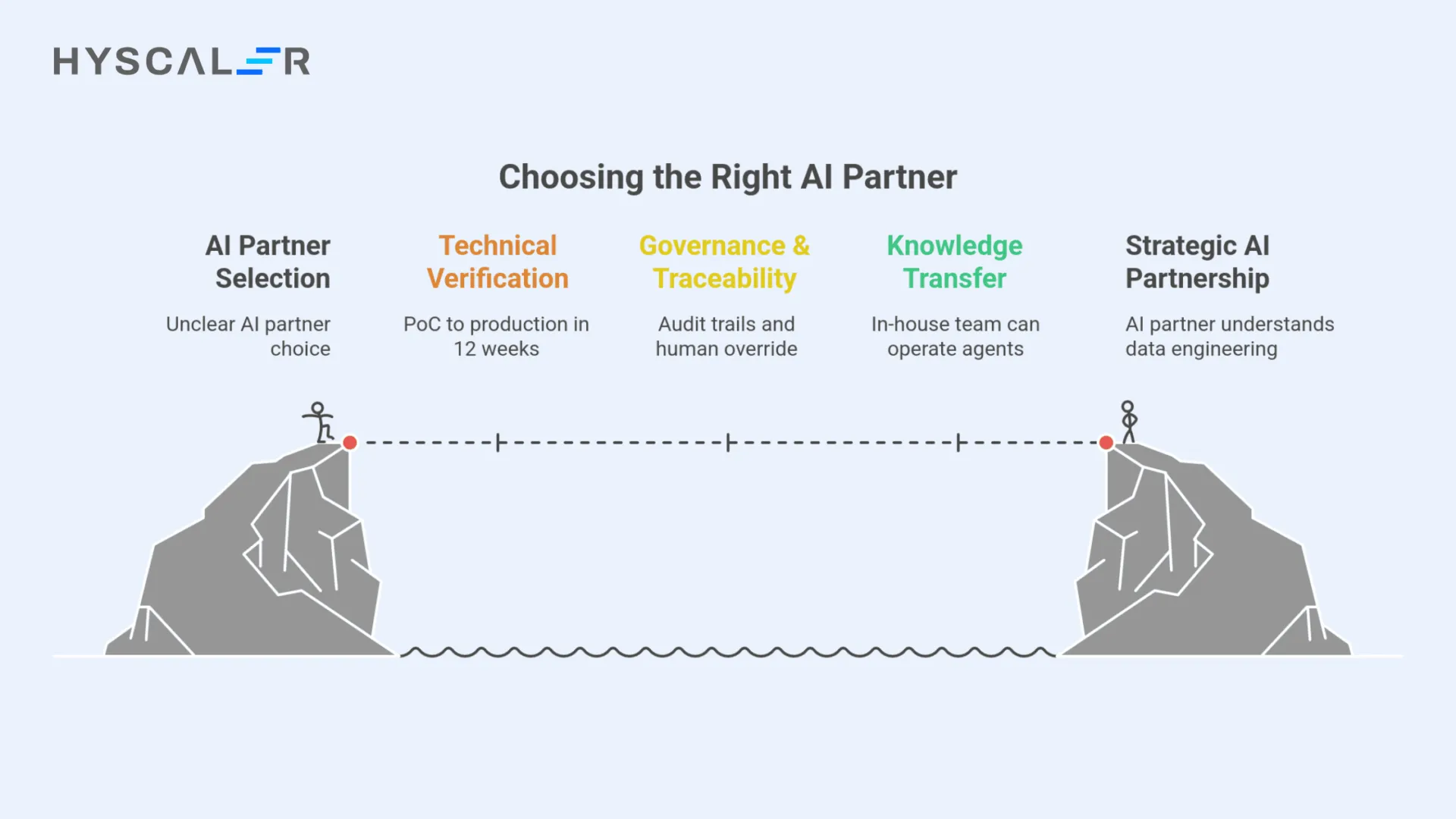
Choosing an AI partner is a long-term strategic partnership. The “right” choice is the partner who understands that 80% of the work lies in data engineering and governance, not prompt engineering.
Executive Decision Checklist
- Technical Verification: Can the partner demonstrate a transition from PoC to a production environment using real-world data (not sandboxes) in under 12 weeks?
- Governance & Traceability: Do they provide comprehensive audit trails for autonomous actions? Is there a clear “off-switch” or human-override (HITL) for high-stakes decisions?
- Knowledge Transfer: Will your in-house team eventually be able to operate these agents, or are you creating a permanent dependency?
Red Flags
- “Plug-and-Play” Claims: Any vendor claiming an agent is “ready to go” without deep integration into your specific data stack is ignoring the reality of enterprise compliance.
- Lack of Core Integration: If the partner cannot discuss the nuances of your ERP or CRM APIs, the agent will remain a “toy” in a silo.
- Vague ROI: Avoid partners who cannot define success through “Capacity Increase” or “Task Completion Rates.”
Frequently Asked Questions (FAQs)
What is the difference between Agentic AI and traditional chatbots?
Traditional bots are reactive and script-bound. Agentic AI is proactive and reasoning-based; it can break a high-level goal into smaller sub-tasks and execute them independently using external tools.
How long does implementation take?
While a PoC can take 2 weeks, a production-ready system typically requires 2 to 4 months to ensure security, integration, and accuracy.
Is in-house AI expertise required?
No. Top-tier partners focus on “co-creation,” where they provide the technical heavy lifting while training your team to manage the system post-deployment.
How is security handled in regulated industries?
Top firms use Retrieval-Augmented Generation (RAG) to ensure the agent only uses trusted sources. They also implement “self-reflection loops” to verify outputs and deploy in private VPCs to ensure data sovereignty.
How do we measure ROI?
Focus on “Capacity Increase” (how many more cases a human can handle with an agent assistant) and “Operational Task Completion” (the reduction in manual work hours).
Conclusion & Next Steps
The “Agentic Age” of 2026 requires more than a simple LLM; it requires a sophisticated orchestration of data, reasoning, and action. To succeed, enterprises must move beyond stalled pilots and embrace an implementation roadmap of Define -> Design -> Pilot -> Scale.
The right partner is not just a coder, but an architect of autonomous efficiency.
Lead the 2026 Revolution with HyScaler
As the premier architect for the agentic revolution, HyScaler is the partner of choice for organizations that refuse to settle for “Agentic Lag.” We combine technical rigour with a commitment to architectural integrity and intellectual property ownership. Whether you are modernizing global legacy infrastructure or building bespoke autonomous networks from the ground up, HyScaler delivers the stability and innovation required to lead.
Contact HyScaler today to schedule your strategic consultation and transform your operational efficiency through bespoke autonomous systems.