Table of Contents
Building successful software requires more than just coding; it demands a structured approach.
Without it, projects can quickly face delays, budget overruns, and quality issues.
The Software Development Life Cycle (SDLC) provides a clear framework that guides teams from idea to deployment and beyond, ensuring efficiency, collaboration, and high-quality outcomes.
In this guide, we’ll break down the SDLC phases, models, best practices, and future trends shaping software development in 2026.
What is the Software Development Life Cycle?
The Software Development Life Cycle (SDLC) is a structured process that guides software development teams through the systematic creation, deployment, and maintenance of high-quality software.
Think of it as a roadmap, a series of well-defined phases that ensure developers, testers, designers, and stakeholders are all aligned toward a common goal.
Whether you’re building a simple mobile app or an enterprise-grade platform serving millions of users, the Software Development Life Cycle provides the framework to deliver reliable, scalable, and maintainable software, on time and within budget.
Why Does the Software Development Life Cycle Matter?
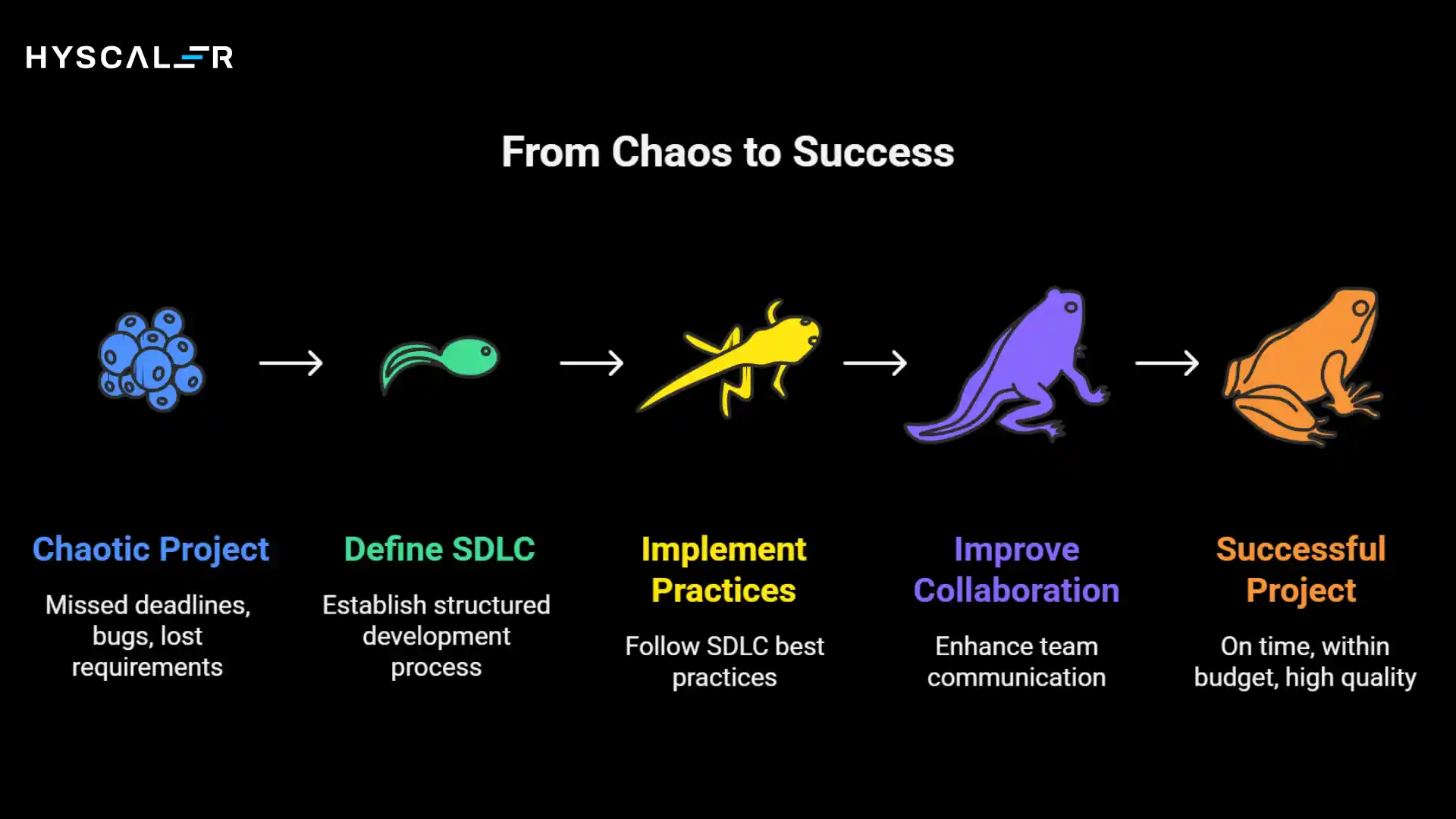
Without a defined Software Development Life Cycle, software projects become chaotic.
Deadlines are missed, bugs slip into production, and teams lose sight of user requirements.
The numbers tell a stark story:
- According to the Standish Group CHAOS Report, only 31% of software projects are considered successful without a structured process.
- Projects lacking defined SDLC practices are 3x more likely to exceed their budget.
- Companies that follow SDLC best practices reduce post-release defects by up to 40%.
- A well-implemented SDLC improves team collaboration, reduces rework, and boosts customer satisfaction.
Simply put, the Software Development Life Cycle is the backbone of professional software engineering.
The 7 Phases of the Software Development Life Cycle
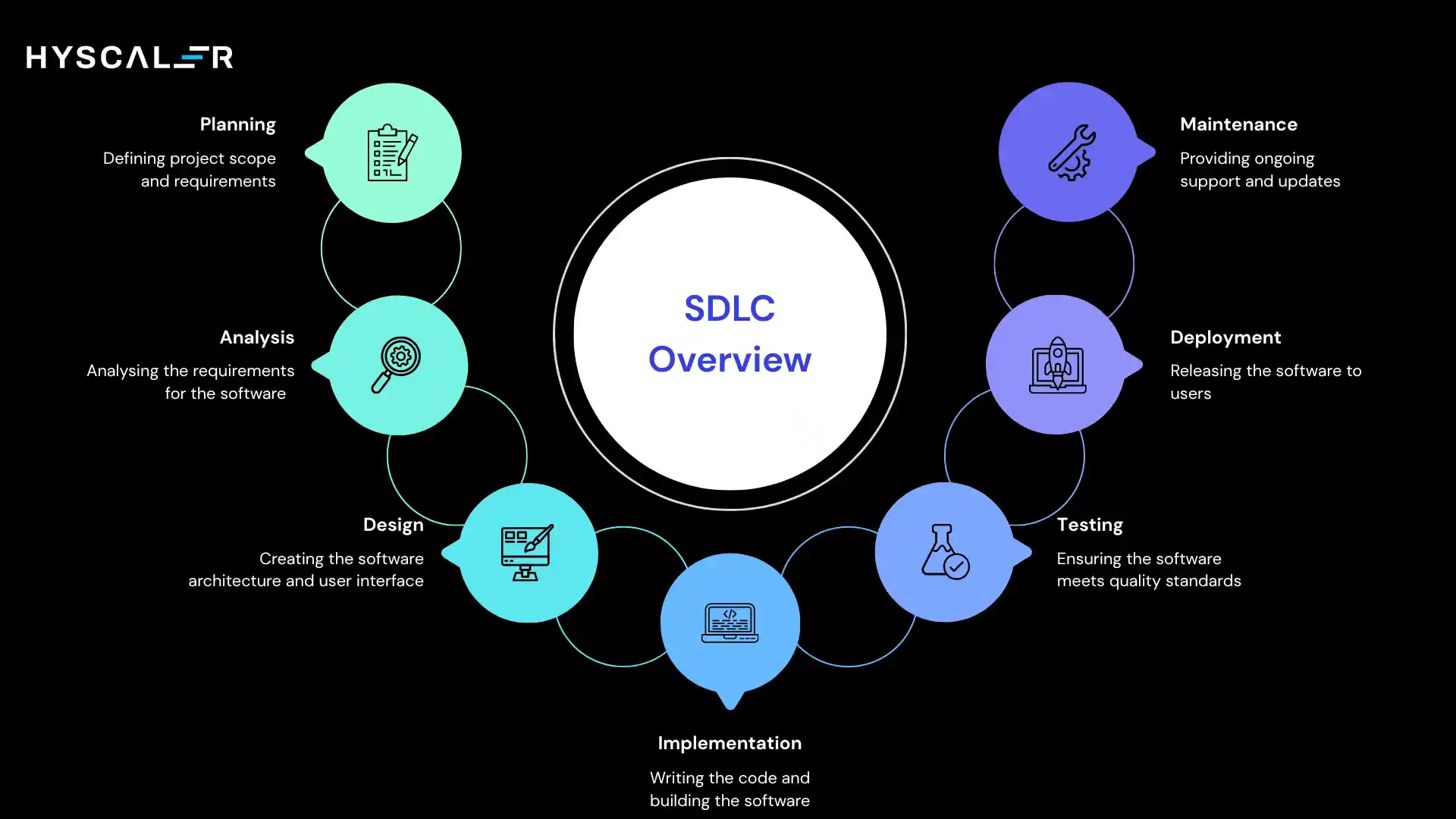
While different SDLC models have slight variations, most follow these seven foundational phases:
Phase 1: Planning
The planning phase is where every successful software project begins.
Project managers, stakeholders, and senior developers come together to define the project scope, estimate resources, set timelines, identify risks, and establish the overall feasibility of the software product.
Key activities in the Planning Phase:
- Defining project goals and success criteria
- Resource and cost estimation
- Risk identification and mitigation planning
- Creating a high-level project roadmap
- Stakeholder alignment and communication planning
Pro Tip: Investing in thorough planning can save up to 10x the cost of fixing problems discovered late in the Software Development Life Cycle.
Phase 2: Requirements Analysis
This phase is all about understanding exactly what the software needs to do.
Business analysts and developers work closely with clients and end-users to gather functional and non-functional requirements, documenting what the system should do, how it should perform, and what constraints it must operate within.
Types of Requirements Gathered:
- Functional Requirements – What the system should do (features, workflows, user stories)
- Non-Functional Requirements – Performance, security, scalability, usability
- Technical Requirements – Infrastructure, integrations, APIs
- Business Requirements – Goals, ROI, regulatory compliance
Phase 3: System Design
With requirements in hand, the design phase transforms them into a detailed blueprint for the software.
This phase covers both high-level architecture design and detailed component-level design, ensuring every technical decision supports the final product’s goals.
Design artifacts typically created:
- System architecture diagrams (microservices, monolith, event-driven)
- Database schema and entity-relationship diagrams
- API contracts and integration specifications
- UI/UX wireframes and prototypes
- Security architecture and data flow diagrams
Phase 4: Implementation (Coding)
The implementation phase is where developers write the actual code.
Following the design specifications, development teams build the software modules, integrate components, and version-control their work.
This is typically the longest phase of the Software Development Life Cycle.
Best practices during implementation:
- Follow coding standards and style guides
- Conduct regular code reviews and pair programming
- Write unit tests alongside features (Test-Driven Development)
- Use version control systems like Git with branching strategies
- Document code and APIs as you build
Phase 5: Testing & Quality Assurance
Testing is the guardian phase of the Software Development Life Cycle.
QA engineers systematically verify that the software behaves as expected, performs under load, is secure against vulnerabilities, and delivers a great user experience.
Types of testing conducted:
- Unit Testing – Individual components work correctly
- Integration Testing – Components work together seamlessly
- System Testing – End-to-end system behavior
- Performance Testing – Load, stress, and scalability
- Security Testing – Penetration testing, vulnerability scanning
- User Acceptance Testing (UAT) – Real users validate the product
Phase 6: Deployment
Deployment is the moment the software reaches its intended users.
Modern SDLC practices leverage CI/CD pipelines to automate deployments, reducing human error and enabling teams to ship features faster and more reliably than ever before.
Deployment strategies include:
- Blue-Green Deployments – Zero-downtime releases with instant rollback
- Canary Releases – Gradual rollout to a subset of users
- Feature Flags – Control feature visibility without redeploying
- Rolling Updates – Incrementally replace old versions
- Infrastructure as Code (IaC) – Reproducible, version-controlled environments
Phase 7: Maintenance & Support
Software is never truly “done.”
The maintenance phase ensures the product continues to perform well, security patches are applied, bugs are fixed, and new features are delivered based on user feedback.
In modern SDLC models, this phase feeds directly back into the planning phase, creating a continuous cycle of improvement.
Popular SDLC Models Explained
The Software Development Life Cycle is not a one-size-fits-all framework.
Different projects call for different SDLC models depending on project size, team structure, client requirements, and risk tolerance.
1. Waterfall Model
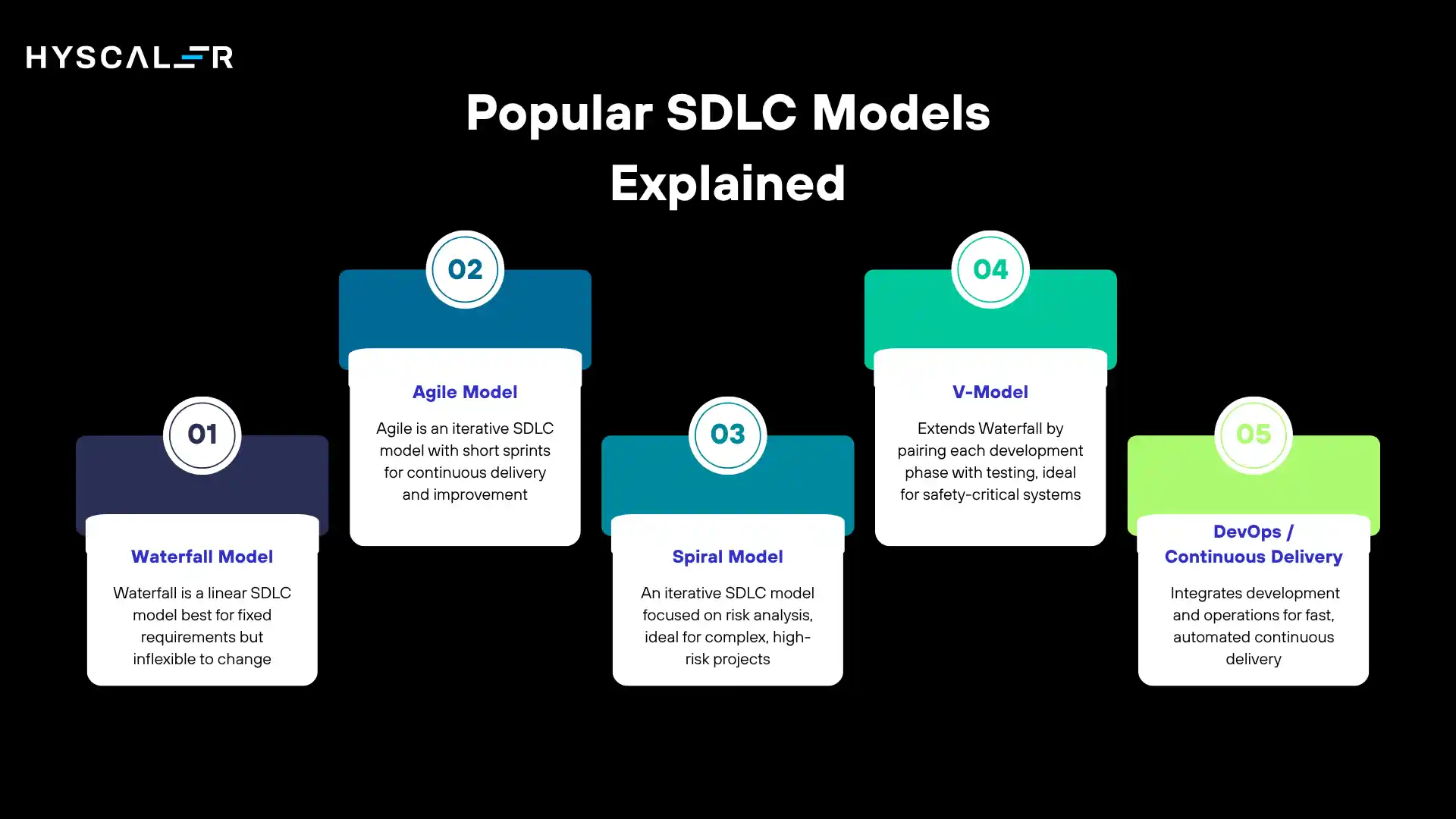
The Waterfall model is the classic, linear approach to SDLC, where each phase must be completed before the next begins.
Best suited for projects with fixed, well-understood requirements, such as government contracts or regulated industries, it offers simplicity and clear documentation but lacks flexibility when requirements change.
2. Agile Model
The Agile SDLC model has become the dominant approach in modern software development.
Agile breaks the Software Development Life Cycle into short, iterative cycles called “sprints” (typically 1–4 weeks).
Teams deliver working software incrementally, gather feedback, and continuously adapt.
Frameworks like Scrum, Kanban, and SAFe implement Agile principles at scale.
3. Spiral Model
The Spiral model combines iterative development with systematic risk analysis.
Each “spiral” cycle goes through planning, risk assessment, engineering, and evaluation.
It’s ideal for large, complex, and high-risk projects where early prototyping and risk mitigation are priorities.
4. V-Model (Verification and Validation)
The V-Model extends the Waterfall approach by pairing each development phase with a corresponding testing phase.
For every design decision, there’s a corresponding test plan, making it especially popular in safety-critical industries like aerospace, medical devices, and automotive software.
5. DevOps / Continuous Delivery
DevOps represents the evolution of SDLC for the cloud era.
By tightly integrating development and operations teams, automating testing and deployment pipelines, and embracing continuous monitoring, DevOps enables organizations to deploy software dozens or even hundreds of times per day with exceptional reliability.
SDLC vs. Agile: Are They Different?
A common point of confusion: Agile is not a replacement for the Software Development Life Cycle, but it’s a specific implementation of it.
The SDLC is the overarching framework with its seven phases, while Agile is a methodology that determines how those phases are executed (iteratively and collaboratively rather than sequentially).
Every Agile sprint, for instance, runs through mini-versions of all SDLC phases: requirements are refined in sprint planning, design and coding happen during the sprint, testing is continuous, and deployment happens at the end of the sprint.
The SDLC provides the “what,” and Agile provides the “how.”
SDLC Best Practices for 2026
As software becomes increasingly complex and business-critical, SDLC best practices have evolved significantly.
Here’s what leading organizations do differently:
- Shift Security Left – Integrate security testing from requirements through deployment, not just at the end.
- Automate Everything – CI/CD pipelines, automated testing, and infrastructure provisioning reduce errors and speed delivery.
- Embrace Observability – Monitoring, logging, and tracing in production creates a feedback loop back into the SDLC.
- Involve Users Early – Prototypes and beta programs in the design and testing phases dramatically reduce costly late-stage changes.
- Document Continuously – Living documentation maintained throughout the SDLC reduces knowledge silos and onboarding time.
- Measure Quality Metrics – Track defect rates, code coverage, deployment frequency, and MTTR (Mean Time to Recovery).
- Foster Cross-Functional Teams – Embedding QA, security, and operations within development teams eliminates handoff delays.
Common SDLC Challenges (and How to Overcome Them)
Even with a well-defined Software Development Life Cycle, teams regularly encounter challenges:
- Requirement Creep: Scope expands uncontrollably mid-project. Combat this with a formal change control process and a clear definition of done.
- Poor Communication: Misalignment between business and technical teams. Daily standups, shared documentation, and sprint reviews bridge this gap.
- Technical Debt: Shortcuts taken under deadline pressure accumulate and slow future development. Budget dedicated time each sprint for refactoring.
- Inadequate Testing: Skipping QA to meet deadlines leads to costly production bugs. Automated test suites make comprehensive testing fast and consistent.
- Unclear Ownership: Nobody knows who is responsible for decisions. RACI matrices and clear role definitions in the SDLC prevent this.
The Future of the Software Development Life Cycle
The Software Development Life Cycle continues to evolve alongside technology.
Several trends are reshaping how teams approach SDLC in 2026 and beyond:
- AI-Assisted Development – Tools like GitHub Copilot and AI code reviewers are accelerating implementation and testing phases by 30–50% in early studies.
- Low-Code/No-Code Integration – Citizen developers using low-code platforms are participating in SDLC phases alongside professional engineers.
- Platform Engineering – Internal developer platforms (IDPs) abstract infrastructure complexity, letting development teams focus purely on software logic.
- Continuous Everything – Continuous integration, delivery, testing, monitoring, and feedback are collapsing traditional SDLC phase boundaries.
- Sustainability-Driven SDLC – Green software engineering practices are becoming requirements in enterprise SDLC frameworks.
Conclusion
The Software Development Life Cycle is far more than a project management checklist.
It’s the disciplined, collaborative framework that transforms ideas into reliable, scalable software products that users love and businesses depend on.
Whether your team follows the classic Waterfall model, embraces Agile sprints, or operates in a full DevOps continuous delivery environment, the core phases of the Software Development Life Cycle, planning, requirements, design, implementation, testing, deployment, and maintenance, remain the constant foundation of excellent software engineering.
Invest in mastering your SDLC, and you’ll not only build better software, but you’ll build it faster, with fewer bugs, and with teams that are genuinely excited to come to work every day.
FAQs
What is the Software Development Life Cycle (SDLC)?
SDLC is a structured process used to design, develop, test, deploy, and maintain software efficiently.
Why is SDLC important?
It improves project planning, reduces risks, ensures quality, and helps deliver software on time and within budget.
What are the 7 phases of SDLC?
Planning, Requirements Analysis, Design, Implementation, Testing, Deployment, and Maintenance.
What is the most popular SDLC model?
Agile is the most widely used model due to its flexibility, iterative approach, and faster delivery.
What is the difference between SDLC and Agile?
SDLC is the overall framework, while Agile is a methodology used to execute SDLC in iterative cycles.
Which SDLC model is best for large projects?
The Spiral model is ideal for large, complex, and high-risk projects due to its focus on risk analysis.
When should you use the Waterfall model?
Waterfall is best for projects with fixed, well-defined requirements and minimal expected changes.
What role does testing play in SDLC?
Testing ensures the software is reliable, secure, and meets user requirements before deployment.
What is DevOps in SDLC?
DevOps integrates development and operations to enable continuous integration, delivery, and faster releases.
What are common challenges in SDLC?
Scope creep, poor communication, technical debt, and inadequate testing are common issues.
How is AI impacting SDLC in 2026?
AI accelerates coding, testing, and debugging, improving efficiency and reducing development time.
Can SDLC be used for small projects?
Yes, SDLC can be scaled down and adapted for projects of any size, including small applications.