Table of Contents
Network Operations is no longer just an IT function; it is the operational backbone that ensures uptime, performance, security, and business continuity.
Whether you’re running AI workloads, cloud-native applications, or global SaaS platforms, your network determines reliability, scalability, and customer experience.
This guide breaks down everything you need to know about Network Operations in 2026, including architecture, roles, tools, best practices, and future trends.
What is Network Operations?
Network Operations (NetOps) refers to the continuous management, monitoring, optimization, and security of an organization’s network infrastructure.
It encompasses a wide range of activities that keep your digital infrastructure running smoothly:
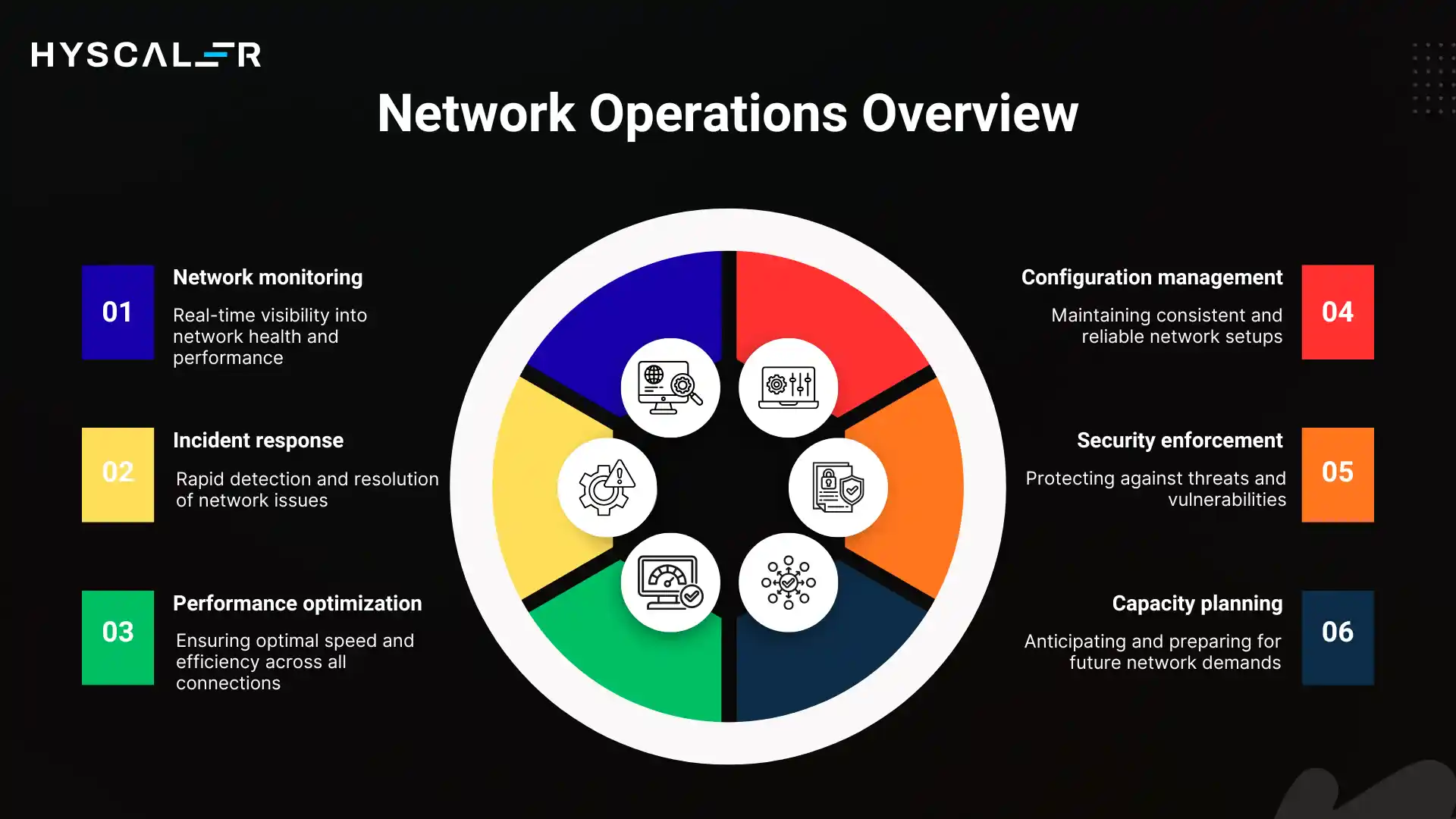
- Network monitoring: Real-time visibility into network health and performance
- Incident response: Rapid detection and resolution of network issues
- Performance optimization: Ensuring optimal speed and efficiency across all connections
- Configuration management: Maintaining consistent and reliable network setups
- Security enforcement: Protecting against threats and vulnerabilities
- Capacity planning: Anticipating and preparing for future network demands
Network operations are typically handled by a Network Operations Center (NOC), a centralized team responsible for maintaining network health 24/7.
Think of the NOC as mission control for your entire digital infrastructure.
Core Components of Network Operations
Network Infrastructure Management
At the foundation of network operations lies the physical and virtual infrastructure that enables connectivity across your organization.
This infrastructure includes critical components that work together to route, secure, and optimize data traffic.
Key infrastructure elements:
- Routers: Direct traffic between different networks
- Switches: Connect devices within the same network
- Firewalls: Protect against unauthorized access and threats
- Load balancers: Distribute traffic evenly across servers
- Cloud networking components: Virtual networks, VPCs, and cloud-native routing
- SD-WAN systems: Software-defined wide area networks for optimized connectivity
Modern enterprises operate hybrid environments that combine on-premises data centers with cloud providers like Amazon Web Services, Microsoft Azure, and Google Cloud Platform.
This hybrid approach provides flexibility, scalability, and resilience that traditional single-environment setups simply cannot match.
The challenge? Managing infrastructure across multiple environments requires sophisticated orchestration, consistent policies, and unified visibility.
Network Monitoring & Observability
You can’t manage what you can’t measure.
Modern network operations rely on comprehensive monitoring and observability to maintain performance and prevent issues before they impact users.
Modern monitoring capabilities include:
- Real-time telemetry: Continuous data streams from network devices
- SNMP monitoring: Standard protocol for collecting device information
- Flow analysis: Understanding traffic patterns and bandwidth usage
- Packet inspection: Deep visibility into network communications
- AI-driven anomaly detection: Identifying unusual patterns that signal potential problems
Popular monitoring tools in 2026:
- SolarWinds Network Performance Monitor
- Datadog
- Cisco ThousandEyes
- Prometheus with Grafana
- Splunk
Here’s a sobering statistic: Without deep observability, 80% of outages go undetected until customers report them.
By that point, the damage to user experience and reputation is already done.
Proactive monitoring shifts the equation from reactive firefighting to preventive maintenance.
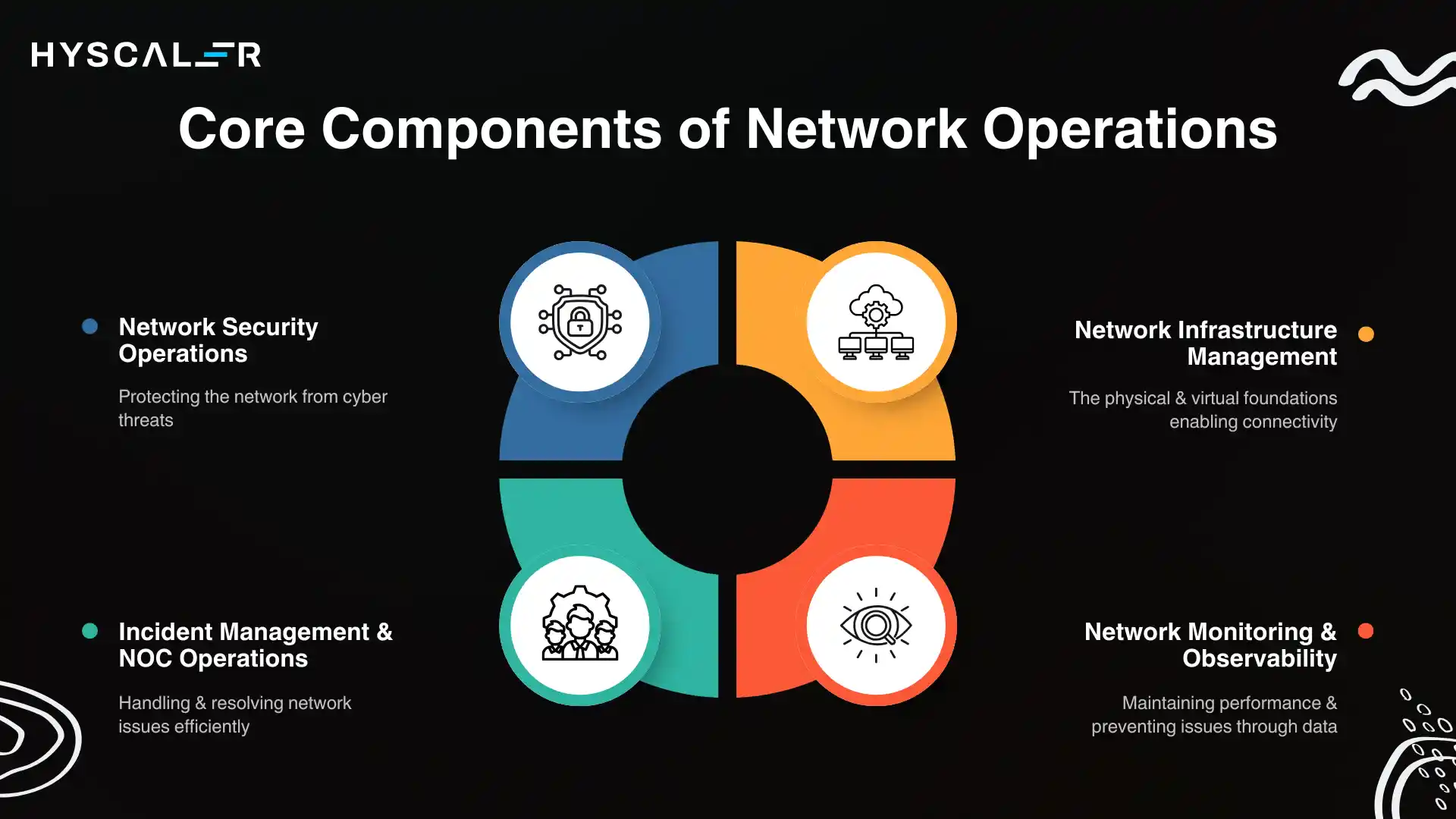
Incident Management & NOC Operations
When issues occur, and they will, having a well-organized incident management process is what separates industry leaders from the rest.
A Network Operations Center (NOC) handles:
- 24/7 monitoring: Round-the-clock vigilance over network health
- Alert triage: Filtering and prioritizing notifications to focus on real issues
- Root cause analysis: Identifying the underlying source of problems
- Escalation management: Routing complex issues to specialized teams
- SLA tracking: Ensuring service level agreements are met
Many organizations adopt frameworks like ITIL (Information Technology Infrastructure Library) to standardize their incident management processes.
ITIL provides proven methodologies for:
- Incident classification and prioritization
- Problem management
- Change management
- Service continuity
The goal is simple: minimize Mean Time to Resolution (MTTR) and maximize Mean Time Between Failures (MTBF).
Every minute of downtime costs money, damages customer trust, and impacts productivity.
Network Security Operations
In 2026, security isn’t an afterthought; it’s woven into the fabric of network operations.
With cyber threats evolving daily and regulatory requirements tightening, network security operations have become impossible to ignore.
Security within network operations includes:
- Firewall policy enforcement: Controlling traffic flow based on security rules
- Intrusion detection and prevention: Identifying and blocking malicious activity
- DDoS mitigation: Protecting against distributed denial-of-service attacks
- Zero Trust segmentation: Assuming no implicit trust and verifying everything
- Secure remote access: Enabling safe connectivity for distributed workforces
Leading security platforms integrate seamlessly with network operations:
- Palo Alto Networks
- Fortinet
- Cisco Security
- CrowdStrike
- Zscaler
The shift to Zero Trust architecture means that network operations teams must continuously verify every connection, user, and device, not just at the perimeter, but throughout the entire network.
This approach dramatically reduces the attack surface and limits the potential damage from breaches.
Traditional vs Modern Network Operations
The evolution of network operations over the past decade has been nothing short of transformative.
Here’s how the landscape has changed:
| Traditional NetOps | Modern NetOps (2026) |
| Reactive monitoring | Proactive AI-driven detection |
| Manual configuration | Infrastructure as Code (IaC) |
| Hardware-centric | Cloud-native & hybrid |
| Static capacity planning | Predictive scaling |
| Ticket-based workflows | Automated remediation |
| Siloed operations | Integrated with CloudOps, DevOps, and MLOps |
Modern network operations are increasingly integrated with broader operational disciplines.
The lines between network operations, cloud operations, and application operations continue to blur as organizations adopt holistic approaches to infrastructure management.
Key modern practices:
- AIOps integration: Artificial intelligence for IT operations enhances decision-making
- GitOps workflows: Version-controlled infrastructure changes
- Observability-first design: Building systems with monitoring built in from day one
- Chaos engineering: Deliberately introducing failures to test resilience
Network Operations Architecture (High-Level Flow)
Understanding how modern network operations function requires looking at the end-to-end workflow:
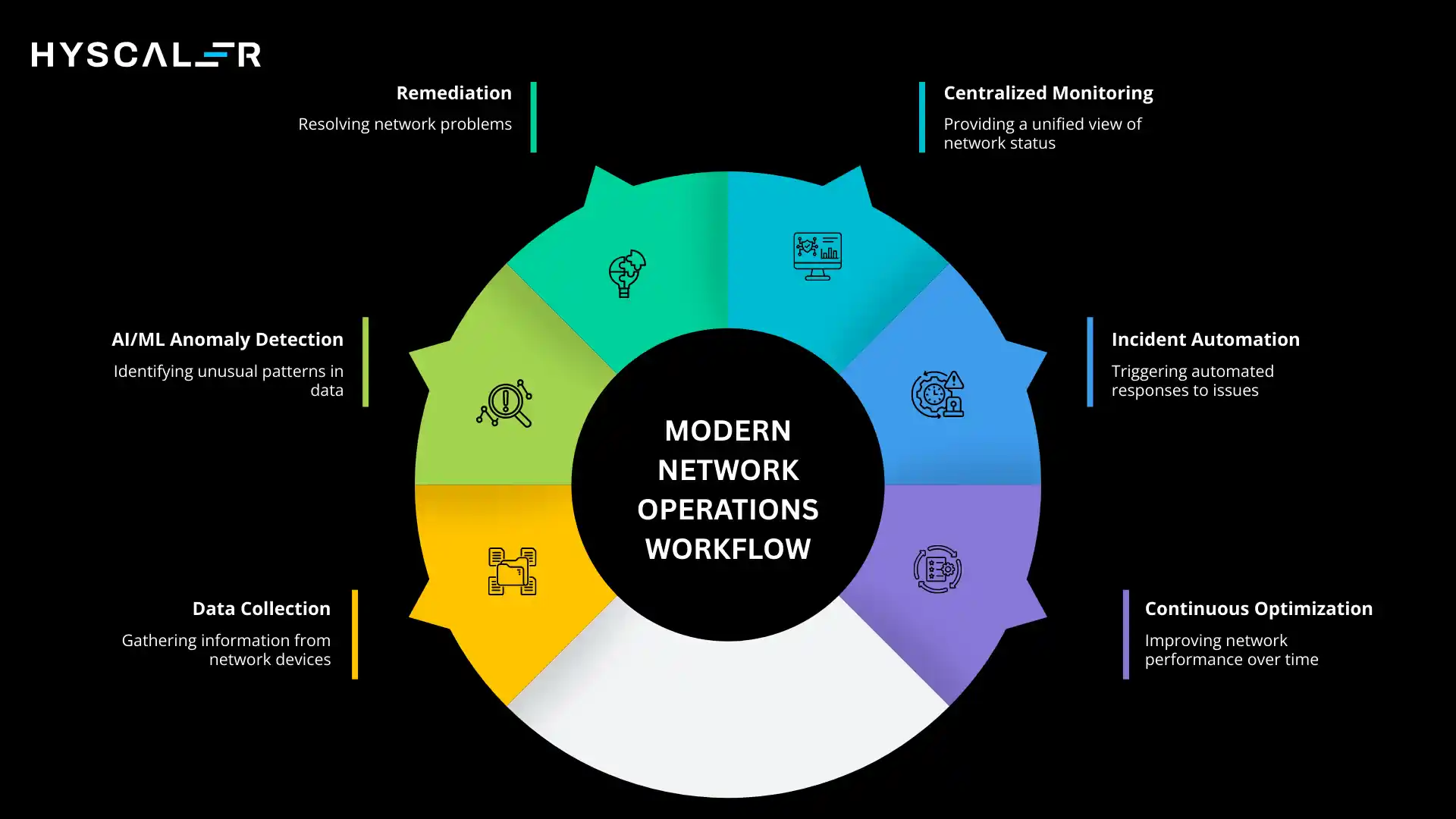
1. Data Collection (Telemetry, Logs, Flows) Network devices, applications, and systems continuously generate data about their state and performance.
2. Centralized Monitoring Platform All telemetry flows into a unified platform that provides a single pane of glass for network visibility.
3. AI/ML-Based Anomaly Detection Machine learning models analyze patterns and identify deviations that might indicate problems.
4. Incident Automation When issues are detected, automated workflows trigger appropriate responses based on severity and type.
5. Remediation (Manual or Automated) Depending on the issue, remediation might be fully automated or require human intervention.
6. Continuous Optimization Post-incident analysis feeds back into the system to improve future performance and prevent recurrence.
This layered approach ensures reliability across distributed systems while reducing the burden on operations teams.
The goal is to automate the routine and reserve human expertise for complex problem-solving.
Key Metrics in Network Operations
What gets measured gets managed.
Network operations teams track specific metrics that directly correlate with business outcomes:
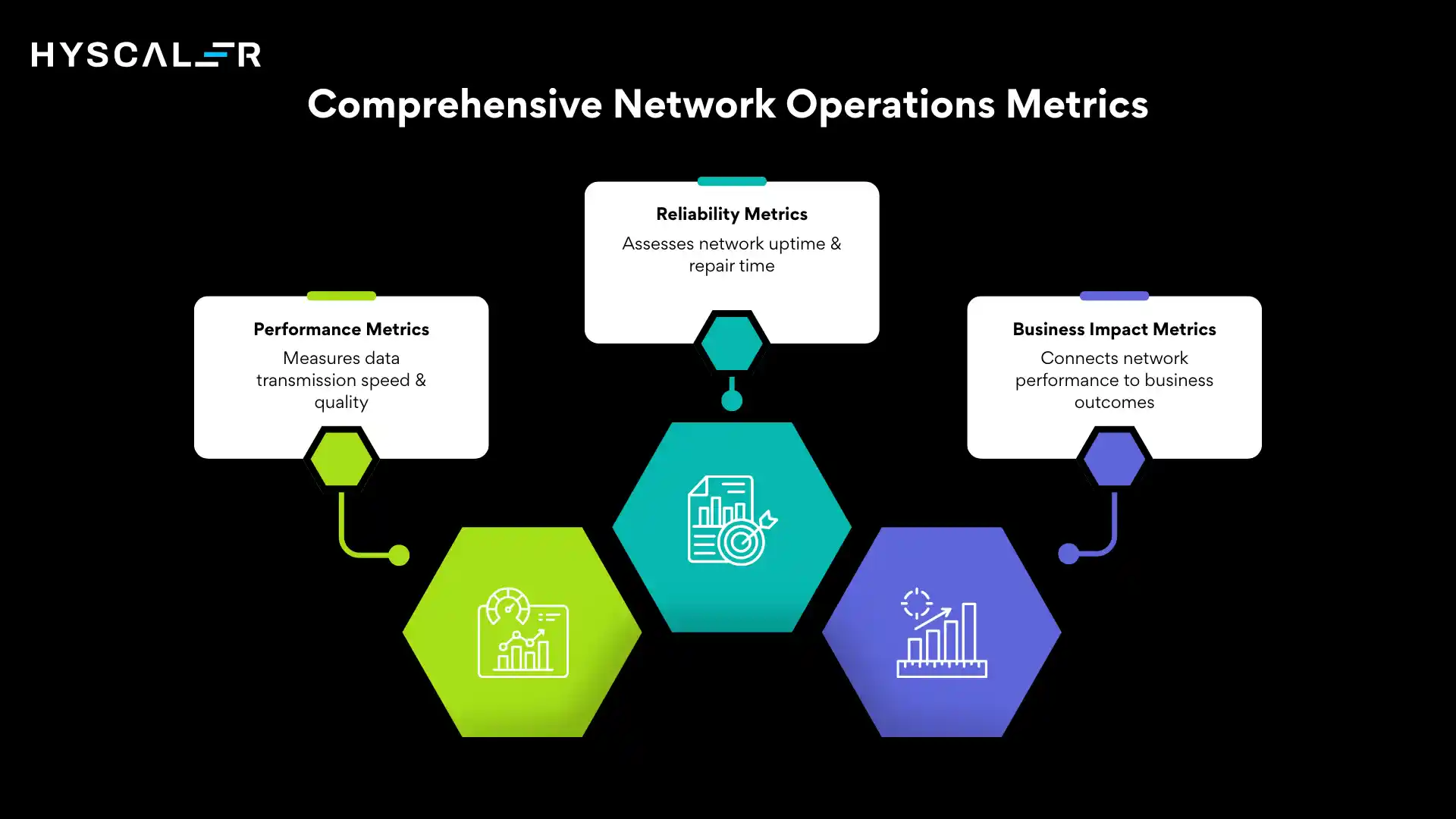
Performance metrics:
- Latency: How long it takes data to travel from source to destination
- Packet loss: Percentage of data packets that fail to reach their destination
- Throughput: Volume of data successfully transmitted over time
- Jitter: Variation in packet arrival times
Reliability metrics:
- Availability (SLA %): Percentage of time the network is operational
- MTTR (Mean Time to Resolution): Average time to fix issues
- MTBF (Mean Time Between Failures): Average time between system failures
Business impact metrics:
- Customer satisfaction scores
- Revenue impact of outages
- Productivity metrics
Tracking these metrics directly affects business KPIs such as uptime and customer satisfaction.
Modern dashboards make these metrics visible to both technical teams and business stakeholders, creating alignment around network performance.
Why Network Operations is Business-Critical
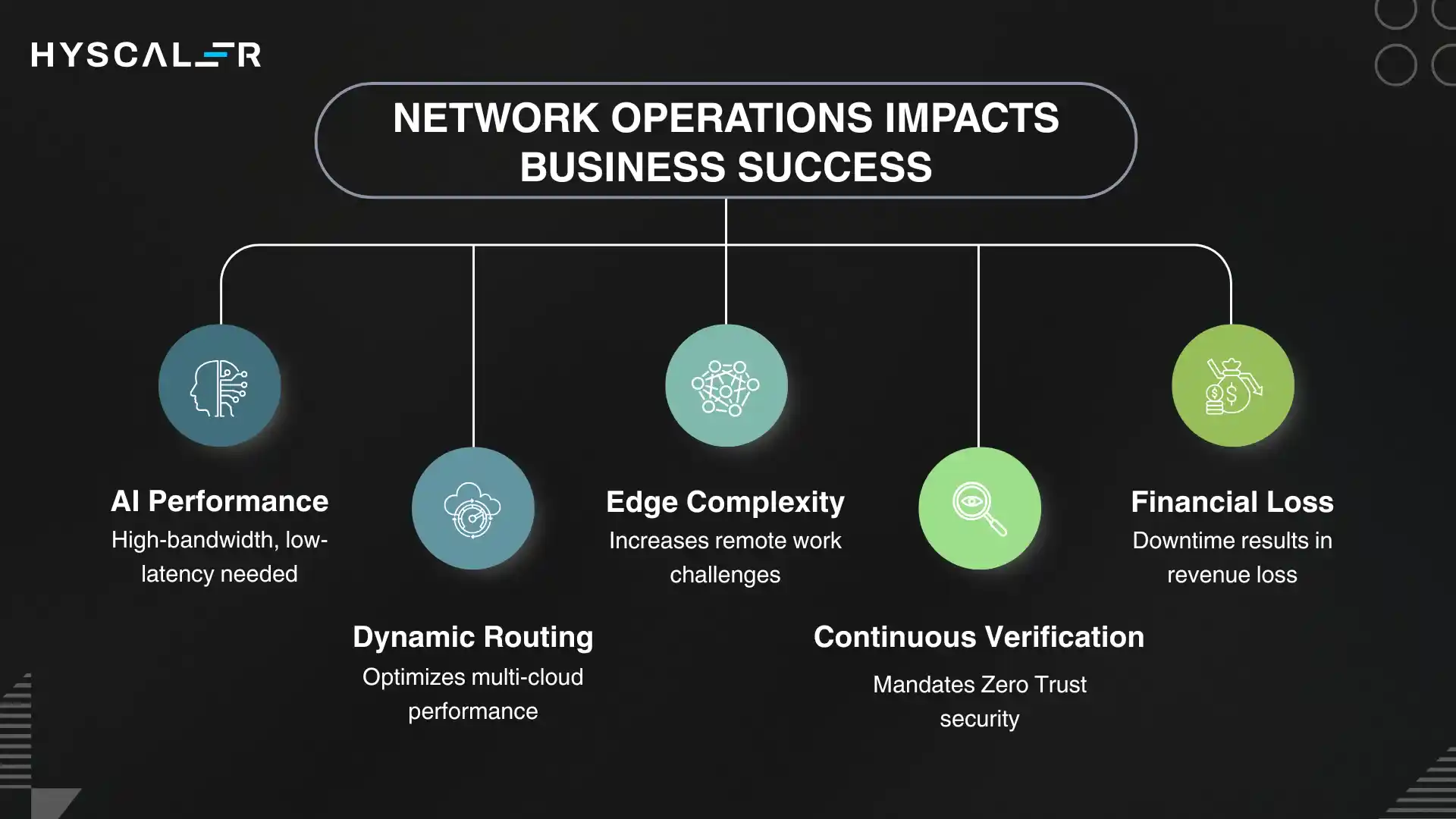
In 2026, the importance of network operations extends far beyond keeping systems running.
Here’s why it’s become a strategic business function:
AI systems depend on high-bandwidth, low-latency networking: Machine learning workloads require massive data transfers and real-time processing. Network bottlenecks directly impact AI performance and business value.
Multi-cloud architectures require dynamic routing: Organizations using multiple cloud providers need intelligent routing that optimizes for performance, cost, and compliance.
Remote work increases edge complexity: With distributed workforces, the network edge extends to homes, coffee shops, and co-working spaces worldwide.
Zero Trust mandates continuous verification: Security requirements demand that networks continuously authenticate and authorize every connection.
Downtime is no longer technical; it’s financial.
Even a few minutes of network outage can result in:
- Revenue loss: E-commerce sites lose thousands per minute of downtime
- Brand damage: Customer trust erodes with each outage
- Compliance violations: Regulatory penalties for service disruptions
- Productivity loss: Employees unable to work impact the entire organization
For cloud-native SaaS companies, network availability IS product availability.
There’s no distinction between your network and your business.
Future of Network Operations (2026–2030)
The next four years will bring significant advances in how networks are operated and managed.
Here are the trends shaping the future:
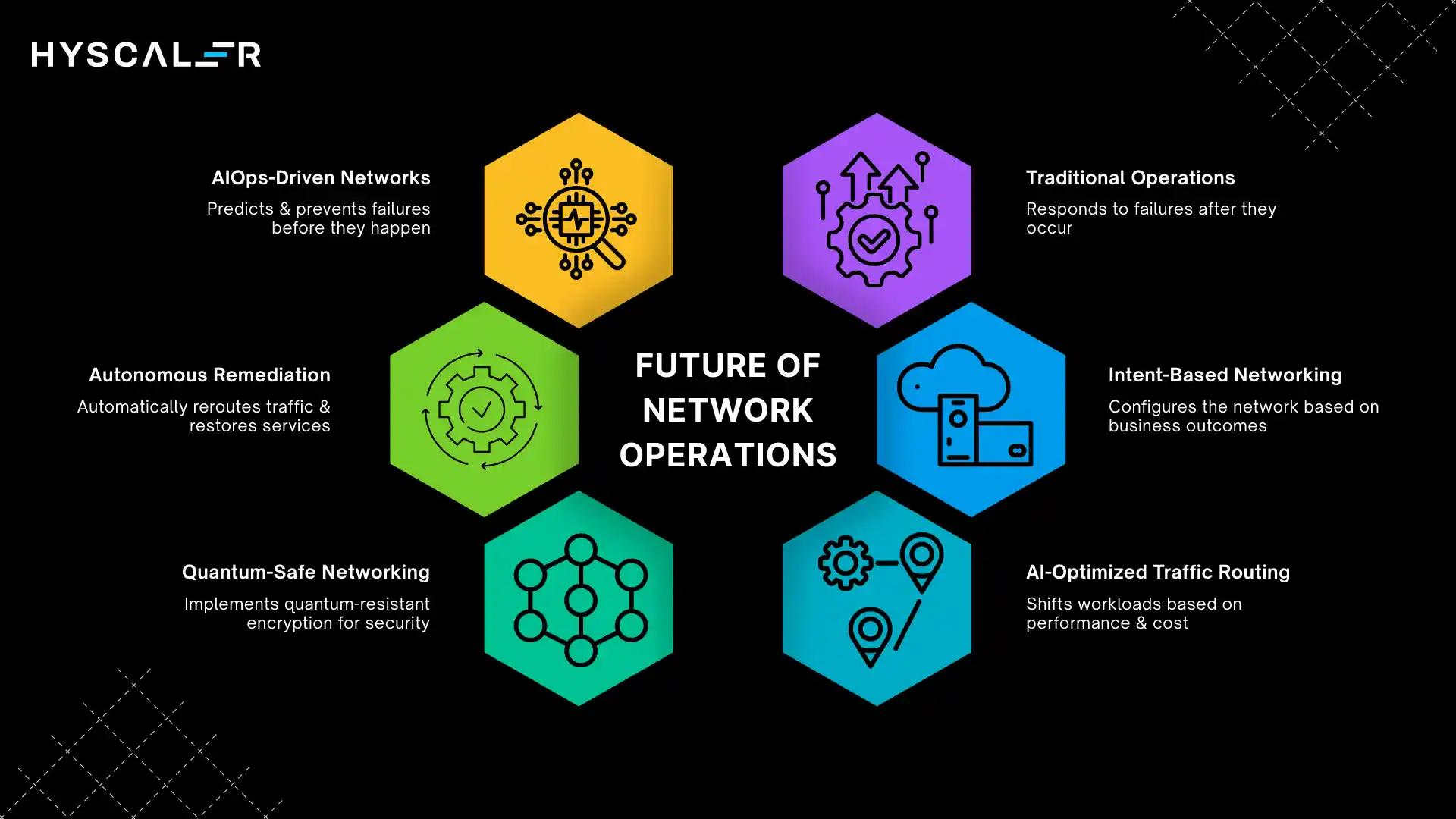
AIOps-Driven Networks
Predictive analytics will prevent failures before they happen.
By analyzing historical patterns and current conditions, AI systems will identify and remediate issues before they impact users.
Expect to see:
- Predictive capacity planning that anticipates needs months in advance
- Automated root cause analysis that diagnoses issues in seconds
- Self-optimizing networks that continuously tune themselves for performance
Intent-Based Networking
Networks will automatically configure themselves based on business intent rather than manual commands.
Operations teams will declare desired outcomes (“ensure sub-10ms latency for trading applications”), and the network will figure out how to achieve them.
Autonomous Remediation
Self-healing infrastructure will reduce MTTR dramatically.
When failures occur, networks will automatically:
- Reroute traffic around failed components
- Spin up replacement resources
- Restore services without human intervention
- Document what happened for post-incident review
AI-Optimized Traffic Routing
Workloads will dynamically shift based on performance and cost.
Traffic routing decisions will consider:
- Real-time latency measurements
- Cloud provider pricing
- Compliance and data residency requirements
- Predicted traffic patterns
Quantum-Safe Networking
As quantum computing advances, networks will need to implement quantum-resistant encryption protocols to maintain security.
Network Operations Best Practices
Whether you’re building network operations from scratch or modernizing an existing function, these best practices will set you up for success:
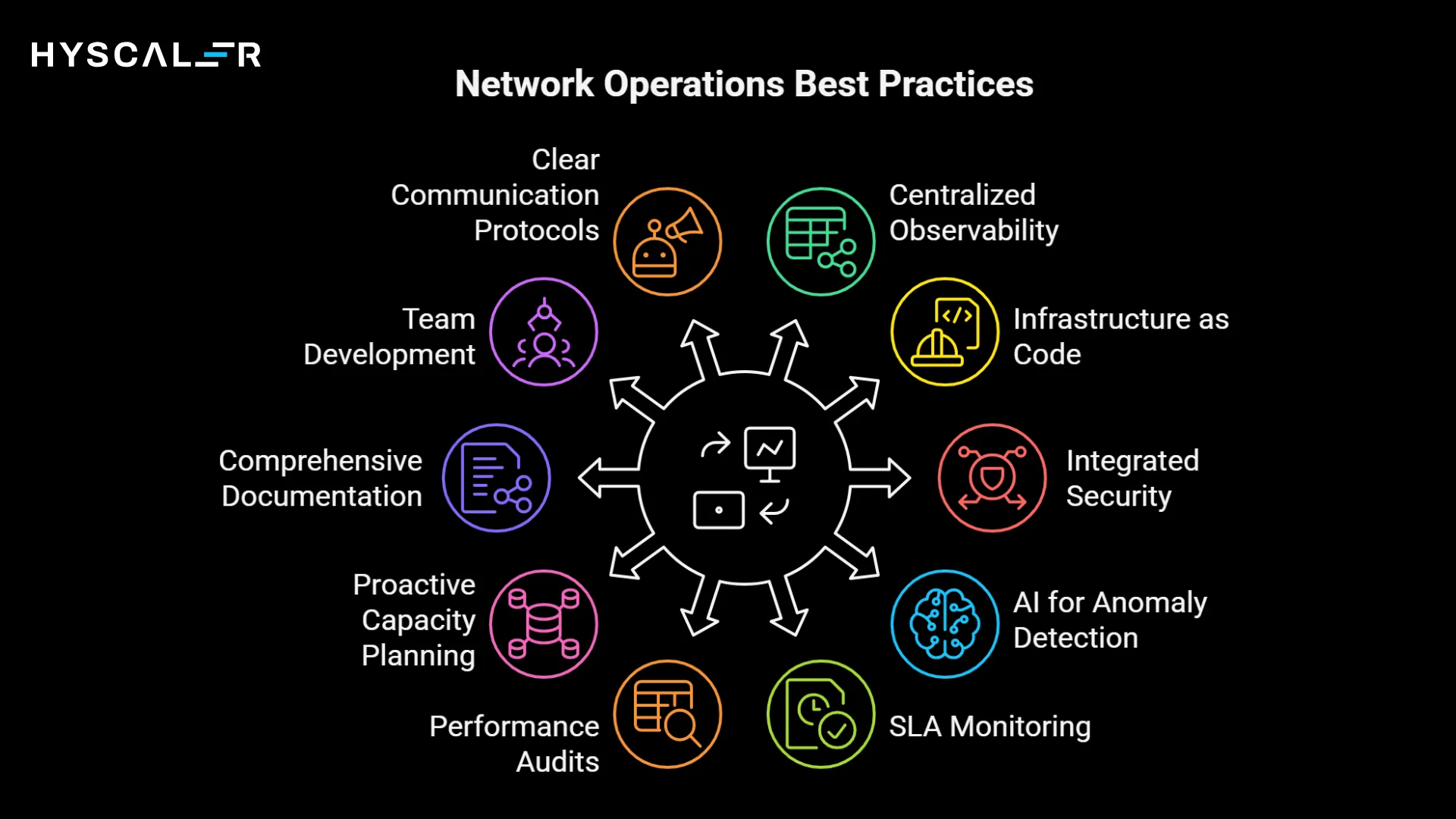
Implement centralized observability: consolidate monitoring data into a single platform for comprehensive visibility across your entire network infrastructure.
Adopt Infrastructure as Code: Manage network configurations through version-controlled code rather than manual changes. This ensures consistency, enables rollbacks, and provides an audit trail.
Integrate security into network workflows: Security should be part of every network decision, not a separate consideration. Build security checks into your automation and change management processes.
Use AI for anomaly detection: Human operators can’t monitor thousands of metrics simultaneously. AI excels at identifying unusual patterns that warrant investigation.
Maintain strong SLA monitoring: consistently track and report on service level agreements. Make SLA data visible to stakeholders so everyone understands performance.
Conduct regular performance audits: Periodically review network performance, identify optimization opportunities, and ensure your infrastructure keeps pace with business needs.
Plan capacity proactively: Don’t wait until you hit limits. Use predictive analytics to anticipate capacity needs and provision resources ahead of demand.
Document everything: Network configurations, runbooks, and incident reports. Comprehensive documentation accelerates troubleshooting and knowledge transfer.
Invest in team development: Network operations require specialized skills. Provide ongoing training and certification opportunities for your team.
Establish clear communication protocols: When incidents occur, clear communication with stakeholders is critical. Define who communicates what, when, and through which channels.
Final Thoughts
Network Operations is no longer a back-office function; it is a strategic capability that powers digital transformation, AI innovation, and enterprise resilience.
The organizations that will thrive in the coming years are those that recognize network operations as a competitive differentiator, not just a cost center.
They invest in modern tools, embrace automation, adopt AI-driven approaches, and integrate network operations with broader business objectives.
The transformation is underway:
- Traditional reactive monitoring is giving way to predictive analytics
- Infrastructure is replacing manual configuration as Code
- Siloed operations are evolving into integrated CloudOps/DevOps/NetOps teams
- Static networks are becoming dynamic, self-optimizing systems
Organizations that modernize their network operations with automation, AI, and cloud-native architectures will gain a measurable competitive advantage. They’ll experience:
- Faster time to market for new services
- Higher reliability and customer satisfaction
- Lower operational costs through automation
- Better security posture through continuous verification
- Greater agility to respond to changing business needs
If you’re building AI-driven infrastructure or scaling cloud workloads, strengthening Network Operations should be your priority.
The network is the foundation upon which everything else is built.
Ready to modernize your network operations?
Start by assessing your current state:
- How proactive vs. reactive is your monitoring?
- What percentage of incidents are detected by monitoring vs. user reports?
- How long does it take to resolve typical network issues?
- Are your network configurations managed as code?
- Do you have comprehensive observability across hybrid environments?
The answers to these questions will reveal where to focus your modernization efforts.
The future of network operations is autonomous, intelligent, and seamlessly integrated with business objectives.
The question isn’t whether to transform, it’s how quickly you can get there.
FAQs
What is Network Operations (NetOps)?
Network Operations (NetOps) refers to the processes, tools, and teams responsible for monitoring, managing, and maintaining enterprise network infrastructure to ensure performance, reliability, and security.
Why is Network Operations important for digital enterprises?
It ensures network availability, minimizes downtime, supports application performance, and enables seamless digital services across cloud, data centers, and edge environments.
What are the main responsibilities of a Network Operations team?
Key responsibilities include network monitoring, performance optimization, configuration management, troubleshooting, and incident response.
What is a Network Operations Center (NOC)?
A Network Operations Center is a centralized location where engineers monitor network health, detect issues, and manage infrastructure in real time.
How does NetOps differ from traditional network management?
Modern NetOps emphasizes automation, orchestration, and integration with DevOps practices to improve agility and deployment speed.
What technologies are commonly used in Network Operations?
Common tools include network monitoring platforms, automation tools, configuration management systems, and observability solutions.
How does automation improve Network Operations?
Automation reduces manual configuration errors, accelerates network changes, and enables faster troubleshooting and recovery.
What role does AI play in modern NetOps?
AI and analytics help detect anomalies, predict network failures, and automate incident response in complex enterprise environments.
How does NetOps support cloud and microservices architectures?
NetOps ensures reliable connectivity, traffic management, and performance across hybrid cloud, containerized, and distributed environments.
What are the future trends in Network Operations?
Key trends include AI-driven operations (AIOps), intent-based networking, zero-trust security integration, and fully automated network management.