Table of Contents
Modern enterprises rely on complex digital infrastructures where applications, networks, and security systems must work seamlessly together.
As AI, cloud-native systems, and distributed infrastructure scale, enterprises must align Network Operations (NetOps), Development Operations (DevOps), and Security Operations (SecOps) into a unified operating model.
With organizations accelerating cloud adoption, microservices architectures, and AI-driven platforms, operational responsibilities have evolved into specialized disciplines.
This has led to the emergence of NetOps, DevOps, and SecOps, three operational models that ensure reliability, speed, and security across modern IT environments.
While these terms are often mentioned together, they serve different purposes.
DevOps focuses on accelerating software development and delivery, NetOps manages and optimizes network infrastructure, and SecOps ensures security is integrated into every stage of operations.
Together, they form the operational backbone of modern enterprises, enabling organizations to deploy applications faster, maintain resilient networks, and protect critical systems from cyber threats.
In this guide, we will explore the key differences in NetOps vs DevOps vs SecOps, their roles in modern enterprises, and how organizations can build an integrated operational strategy for 2026 and beyond.
What is NetOps?
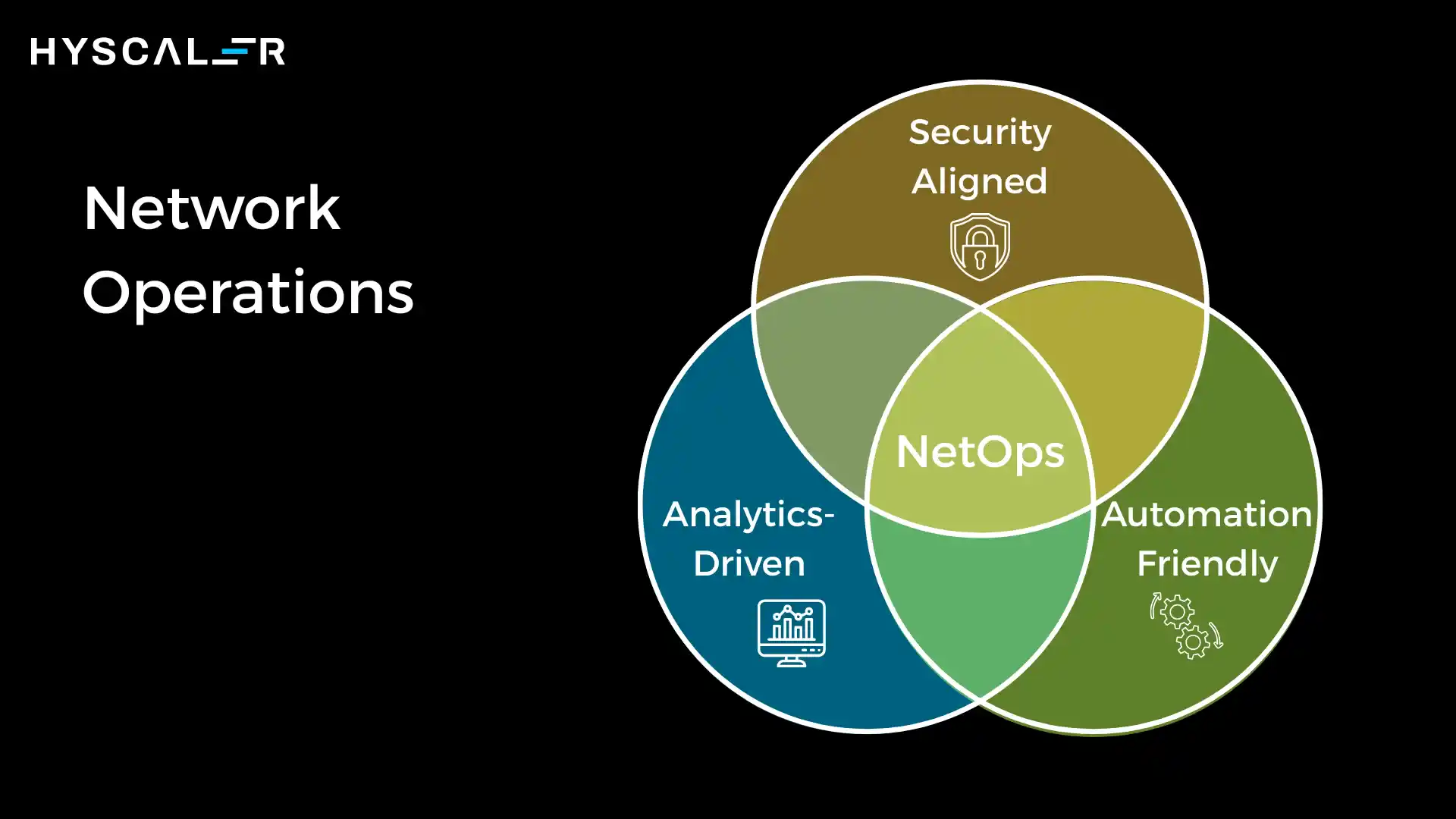
NetOps (Network Operations) focuses on managing and maintaining network infrastructure to ensure reliable connectivity and performance.
Core Responsibilities:
Network monitoring and uptime management form the foundation of NetOps work.
Teams configure routers, switches, and firewalls while optimizing traffic flow and reducing latency.
When outages occur, NetOps engineers respond immediately to restore service.
They also plan network capacity to accommodate growing demands across on-premises, hybrid, and cloud environments.
Primary Goal: Ensure stable, high-performance connectivity across all infrastructure layers.
What is DevOps?
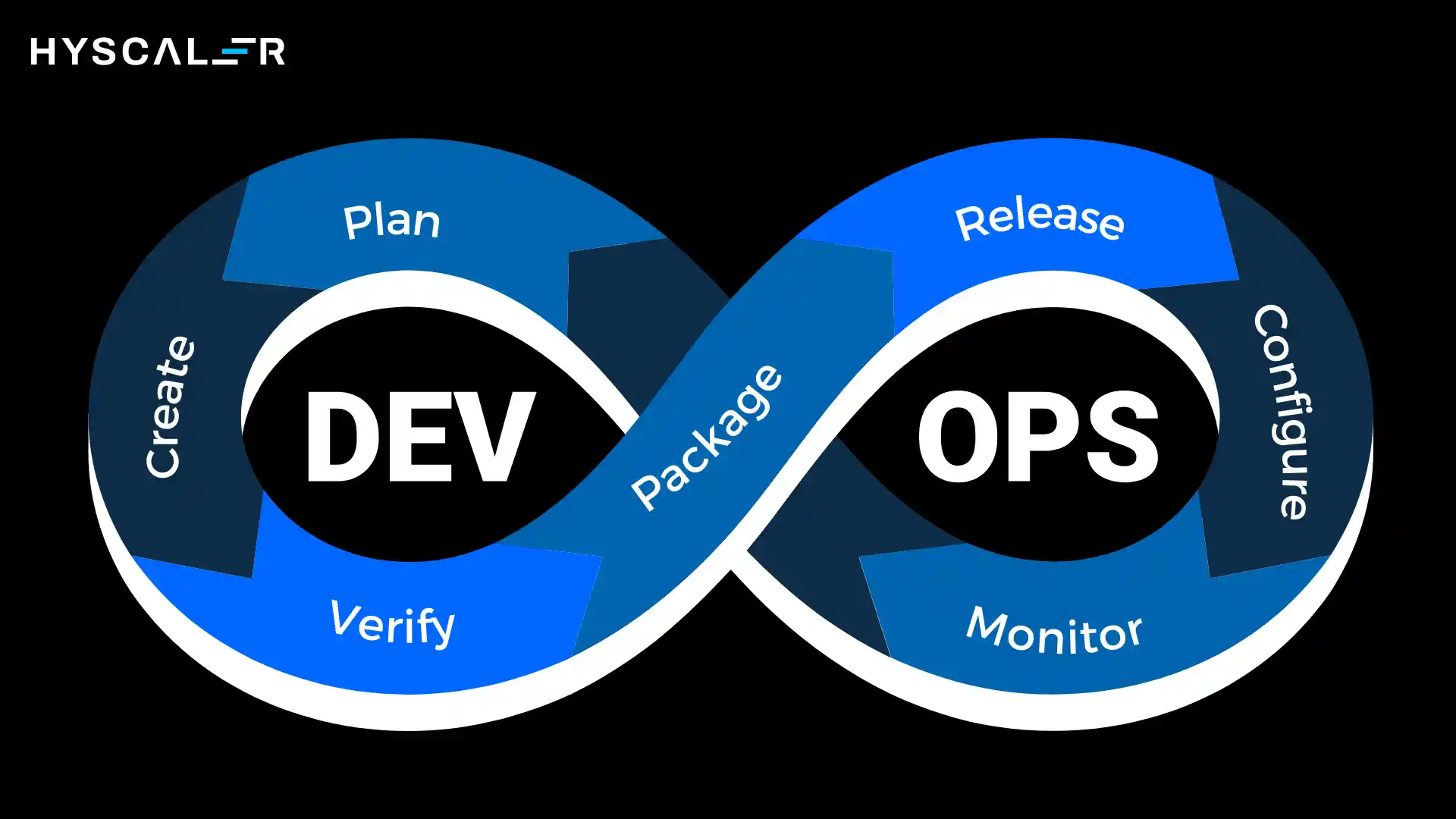
DevOps is a culture and engineering practice that integrates development and operations to enable faster, automated software delivery.
Core Responsibilities:
DevOps teams build and maintain CI/CD pipelines that automate code integration and deployment.
They treat Infrastructure as Code (IaC), using tools like Terraform and Ansible to provision resources programmatically.
Containerization with Docker and orchestration through Kubernetes enables consistent deployments across environments.
Automated testing catches bugs early, while continuous deployment practices push updates to production rapidly and safely.
Primary Goal: Deliver software faster, reliably, and at scale.
What is SecOps?
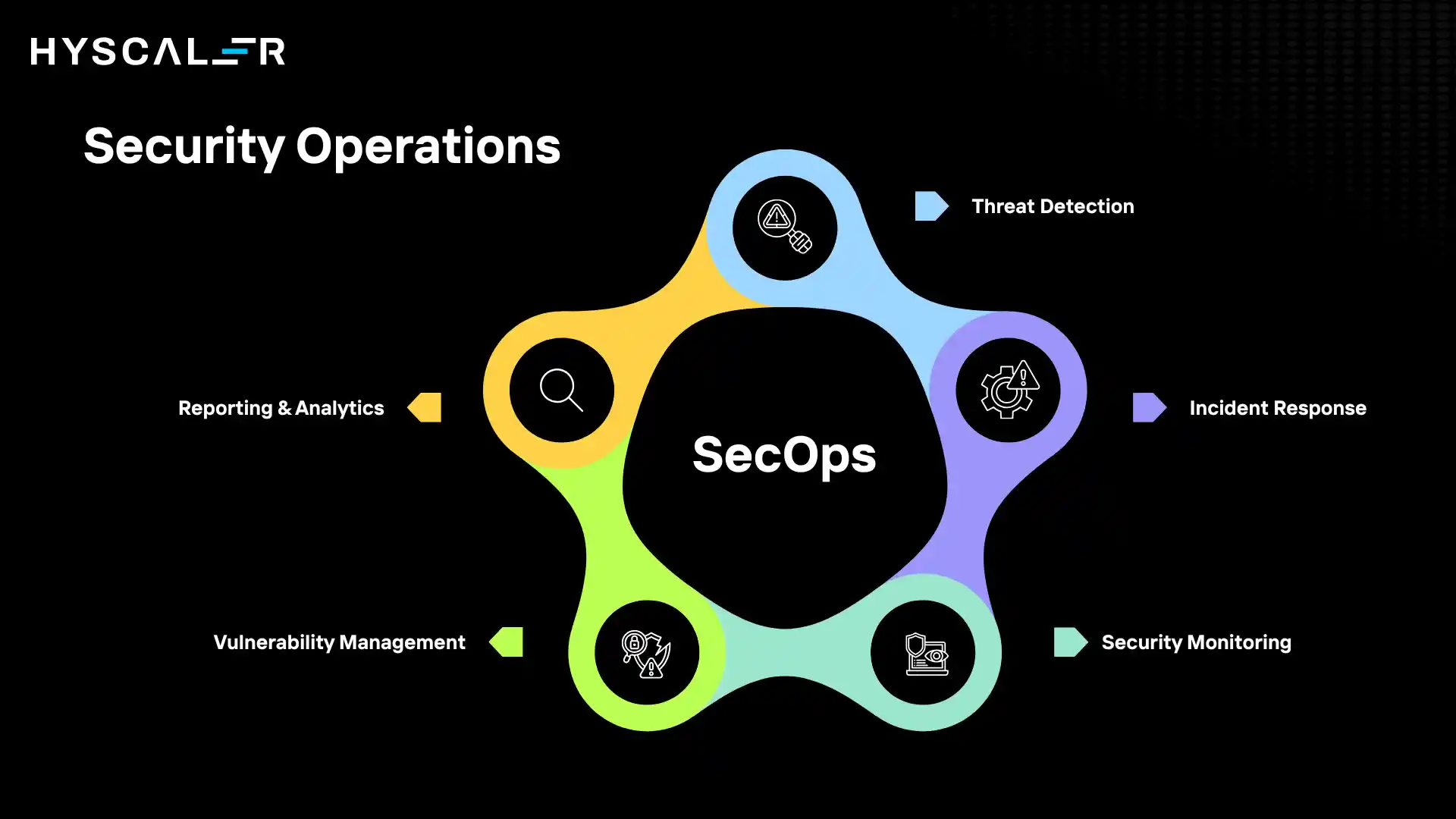
SecOps (Security Operations) integrates security into IT operations to detect, prevent, and respond to threats in real time.
Core Responsibilities:
Security Operations Centers (SOCs) monitor systems continuously for suspicious activity and emerging threats.
When incidents occur, SecOps teams investigate, contain, and remediate breaches.
Vulnerability management programs identify and patch weaknesses before attackers exploit them.
Compliance teams ensure adherence to regulatory requirements like GDPR, HIPAA, and SOC 2.
Zero Trust architectures verify every access request, regardless of network location.
Primary Goal: Protect infrastructure and applications from cyber threats and breaches.
NetOps vs DevOps vs SecOps – In Short
NetOps manages network infrastructure, DevOps accelerates software delivery, and SecOps protects systems from cyber threats.
Together, they ensure performance, agility, and security across enterprise IT environments.
NetOps vs DevOps vs SecOps – Comparison Table
| Dimension | NetOps | DevOps | SecOps |
|---|---|---|---|
| Primary Focus | Network Infrastructure | Application Delivery | Cybersecurity |
| Key KPI | Uptime, Latency | Deployment Speed, MTTR | Threat Detection Time |
| Core Tools | Cisco DNA Center, SolarWinds, PRTG | Jenkins, GitLab, Kubernetes, Terraform | Splunk, CrowdStrike, Palo Alto Networks |
| Risk Type | Network Downtime | Release Failure | Security Breach |
| Automation Level | Increasing (NetDevOps) | High | High |
How They Overlap in Modern Enterprises
In 2026, organizational silos are breaking down as enterprises recognize that isolated operations create vulnerabilities and inefficiencies.
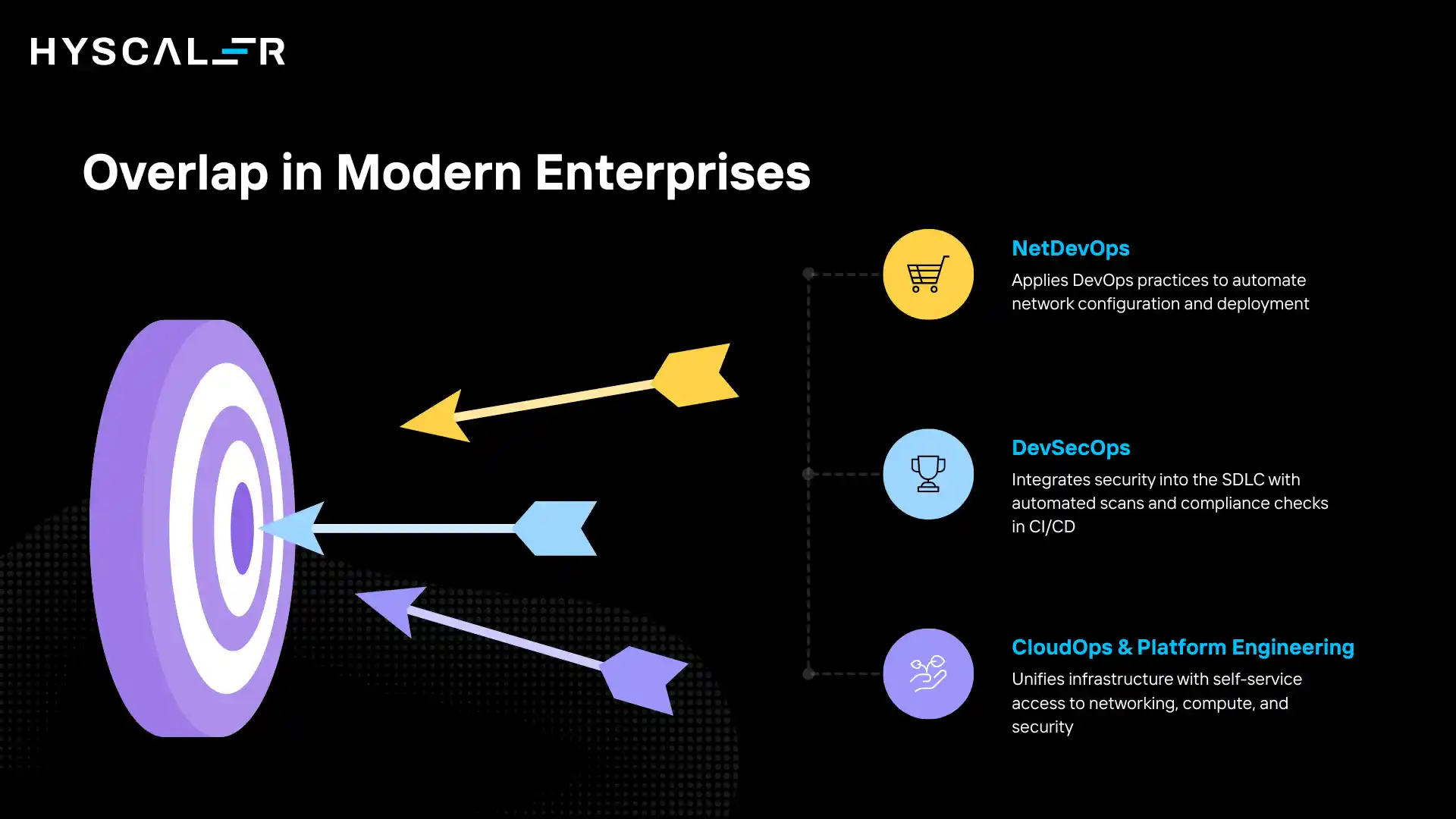
NetDevOps
Applies DevOps principles to network management.
Teams use automation tools to configure network devices, implement version control for network policies, and deploy infrastructure changes through CI/CD pipelines.
This approach reduces manual errors and accelerates network provisioning.
DevSecOps
Embeds security throughout the software development lifecycle rather than treating it as a final gate.
Security scanning runs in CI/CD pipelines to catch vulnerabilities during development.
Automated compliance checks verify that code meets security standards before deployment.
CloudOps and Platform Engineering
Create unified infrastructure management across teams.
Platform teams build internal developer platforms that provide self-service access to networking, compute, and security resources while maintaining governance and compliance.
For AI-native companies, this integration is critical because AI workloads create unique operational challenges.
Machine learning models stress network bandwidth during training and inference.
Model deployment requires sophisticated CI/CD pipelines that handle large artifacts and complex dependencies.
AI systems expand the attack surface, introducing risks such as model poisoning, data exfiltration, and adversarial attacks.
Real-World Enterprise Scenario
Consider deploying an AI-powered fraud detection platform for a financial services company.
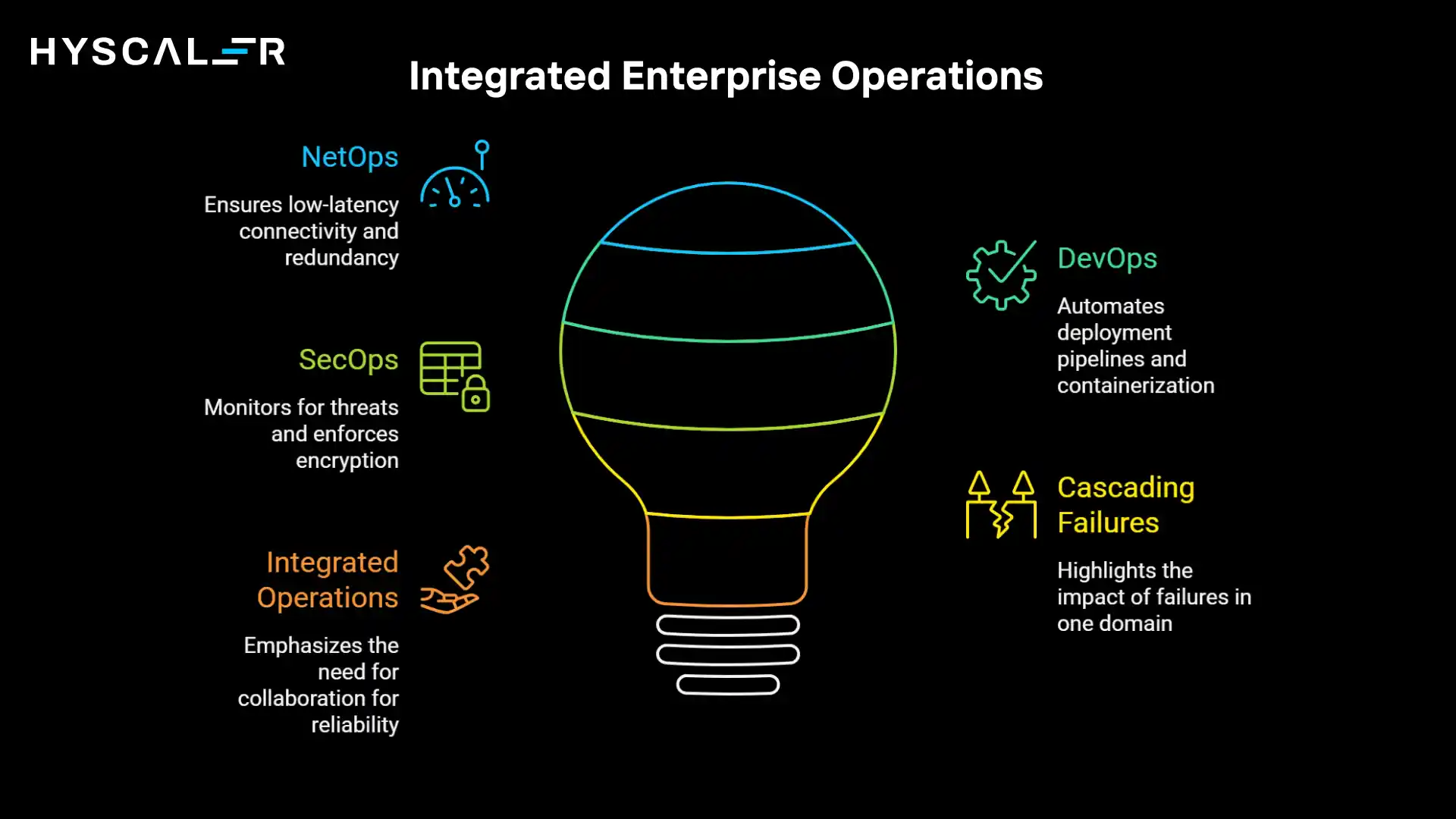
NetOps engineers ensure low-latency connectivity between edge transaction systems and cloud-based ML infrastructure.
They configure software-defined networking to prioritize real-time fraud detection traffic and implement redundant paths to prevent downtime during peak transaction volumes.
DevOps teams automate the deployment pipeline for updated fraud detection models.
They containerize the ML inference service, orchestrate deployments across multiple regions using Kubernetes, and implement blue-green deployments to roll out updates without service interruption.
SecOps monitors the entire system for threats.
They detect anomalous API access patterns that might indicate credential theft, scan container images for vulnerabilities before deployment, and enforce data encryption for sensitive financial information in transit and at rest.
Failure in any domain cascades across the system.
Network latency degrades model performance, impacting fraud detection accuracy. Insecure deployment practices expose customer data.
Delayed software releases leave known vulnerabilities exploitable.
Only integrated operations ensure the platform functions reliably and securely.
Common Challenges
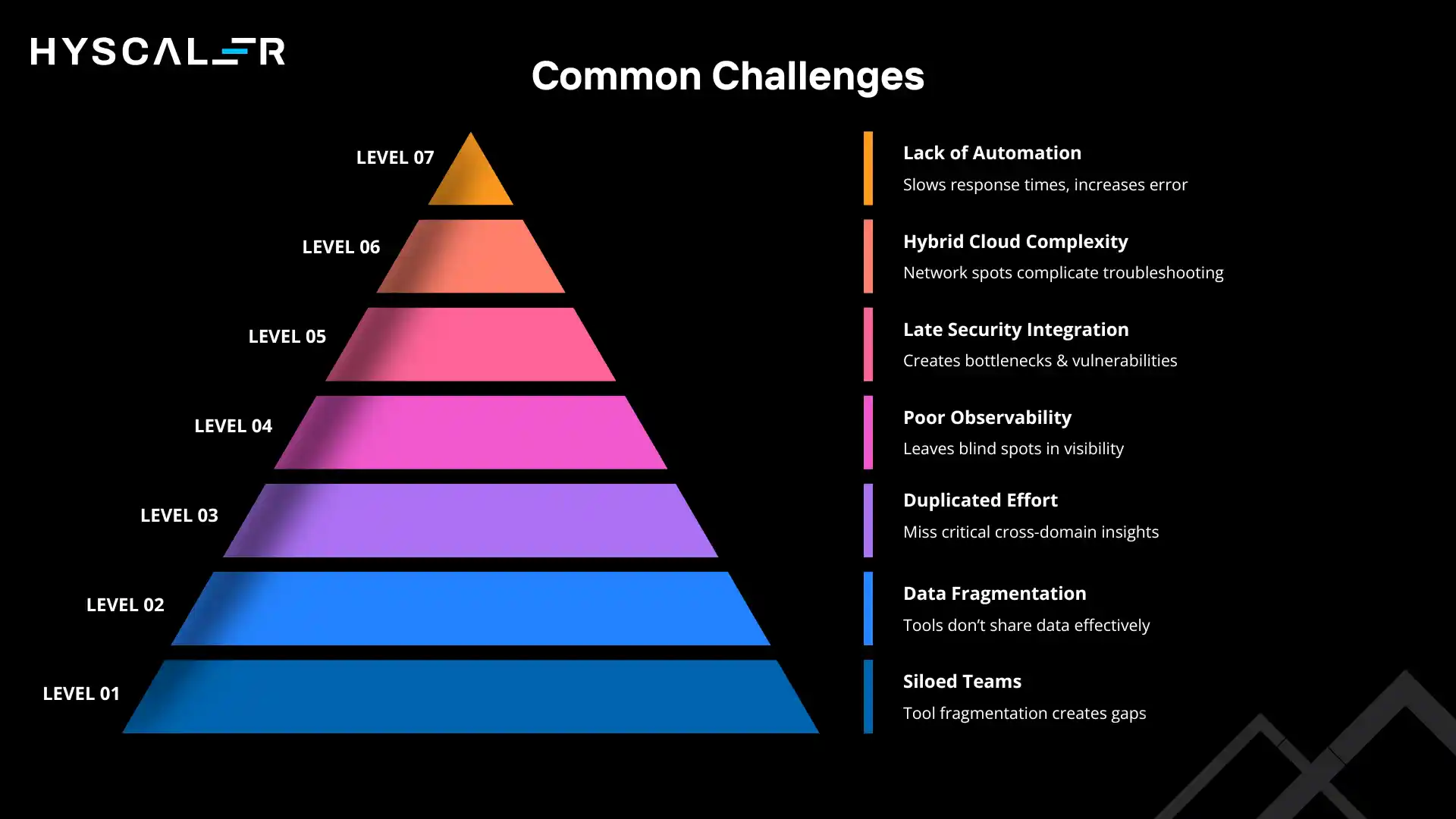
Enterprises face several obstacles when coordinating NetOps, DevOps, and SecOps:
Siloed teams and tool fragmentation create communication gaps and inefficiencies.
NetOps uses network monitoring platforms, DevOps relies on CI/CD tools, and SecOps depends on SIEM systems that don’t share data effectively.
Teams duplicate effort and miss critical insights that emerge from correlating data across domains.
Poor cross-team observability leaves blind spots.
When an application slows down, is it a network issue, code problem, or security incident?
Without unified visibility, teams waste time troubleshooting in isolation rather than collaborating on root cause analysis.
Security added too late in the pipeline creates bottlenecks and vulnerabilities.
When security reviews happen at the end of development cycles, teams rush to remediate issues or deploy insecure code to meet deadlines.
Network blind spots in hybrid cloud environments complicate troubleshooting.
Traffic flows across on-premises data centers, multiple cloud providers, and edge locations.
Traditional network monitoring tools struggle with this complexity, leaving performance issues undiagnosed.
Lack of automation maturity slows response times and increases human error.
Manual network configurations, deployment processes, and security audits can’t scale with modern infrastructure demands.
Future Trend: Unified Ops Model
Modern enterprises are moving toward integrated operations that break down traditional boundaries:
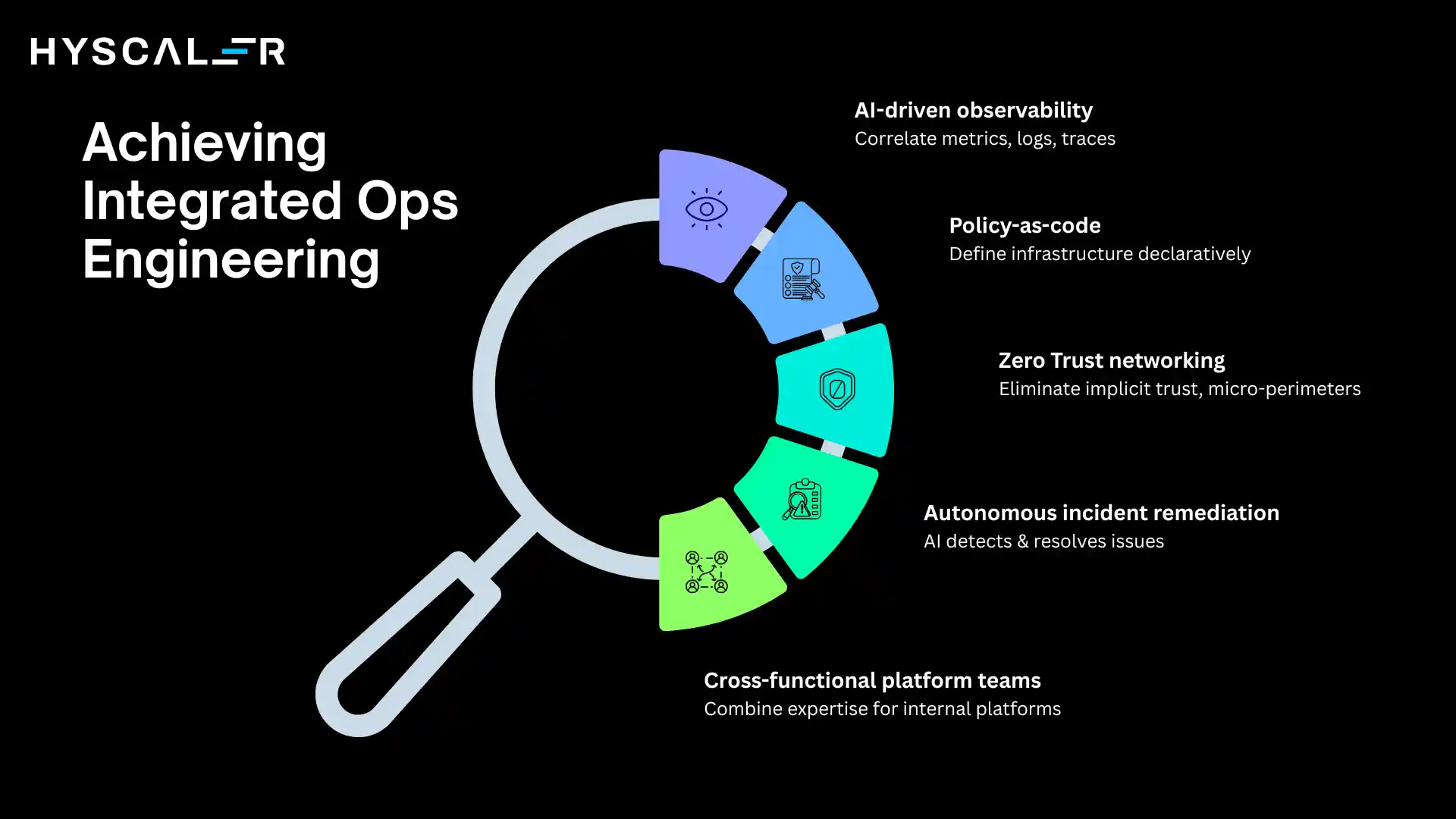
AI-driven observability
These platforms correlate metrics, logs, and traces across network, application, and security layers.
Machine learning detects anomalies that span domains, like a DDoS attack that manifests as both network congestion and application performance degradation.
Policy-as-code
It defines infrastructure requirements declaratively.
Network segmentation rules, deployment approval workflows, and security policies become versioned code that teams test and deploy automatically.
This approach ensures consistency and enables auditable compliance.
Zero Trust networking
It eliminates implicit trust based on network location.
Every user, device, and service authenticates and authorizes individually, creating micro-perimeters around resources.
This architecture requires tight integration between network access controls, application authentication, and security monitoring.
Autonomous incident remediation
It uses AI to detect and resolve common issues without human intervention.
When a containerized service crashes, the system automatically restarts it, analyzes logs to identify the root cause, and creates alerts only if the issue recurs or requires escalation.
Cross-functional platform teams
Combine networking, development, and security expertise.
These teams build and maintain internal platforms that abstract infrastructure complexity while maintaining security and performance standards.
Developers get self-service capabilities without compromising governance.
The future is not NetOps vs DevOps vs SecOps.
It’s Integrated Ops Engineering where teams share responsibility for reliability, velocity, and security outcomes.
Conclusion
NetOps ensures connectivity. DevOps ensures delivery. SecOps ensures protection.
Together, they form the operational backbone of digital enterprises.
As infrastructure grows more complex and threats evolve, successful organizations integrate these disciplines into cohesive operational models.
Teams that break down silos, automate workflows, and share visibility across domains will deliver the performance, agility, and security that modern business demands.
FAQ
What is NetOps?
NetOps (Network Operations) focuses on managing, monitoring, and automating enterprise network infrastructure to ensure performance, availability, and reliability.
What is DevOps?
DevOps is a culture and set of practices that combine software development and IT operations to enable faster, automated, and continuous software delivery.
What is SecOps?
SecOps (Security Operations) integrates security practices into IT operations to continuously monitor, detect, and respond to security threats.
How is NetOps different from DevOps?
NetOps focuses on network infrastructure management, while DevOps focuses on software development, deployment automation, and CI/CD pipelines.
How is SecOps different from DevOps?
SecOps prioritizes security monitoring and threat response, while DevOps focuses on application delivery speed and operational efficiency.
Why are NetOps, DevOps, and SecOps important for enterprises?
Together, they ensure reliable networks, faster software delivery, and strong security, enabling organizations to run modern digital infrastructure efficiently.
What tools are commonly used in NetOps?
Common NetOps tools include network monitoring platforms, configuration management tools, and automation frameworks.
What tools are commonly used in DevOps?
DevOps teams often use CI/CD tools, container platforms, infrastructure-as-code tools, and observability platforms.
What tools are used in SecOps?
SecOps teams rely on SIEM platforms, security monitoring tools, vulnerability scanners, and incident response systems.
How do NetOps, DevOps, and SecOps work together?
They collaborate to build secure, automated, and reliable infrastructure, ensuring applications run smoothly while maintaining strong security and network performance.
What is the role of automation in NetOps, DevOps, and SecOps?
Automation helps reduce manual tasks, improve reliability, accelerate deployments, and strengthen security monitoring across all three operations models.
What is the future of NetOps, DevOps, and SecOps?
The future is platform engineering and unified operations, where networking, development, and security are integrated through automation and AI-driven infrastructure.