Table of Contents
Software architecture is the backbone of every digital product.
It dictates how your application grows, how your teams collaborate, how quickly you ship features, and ultimately, how reliably your system serves its users.
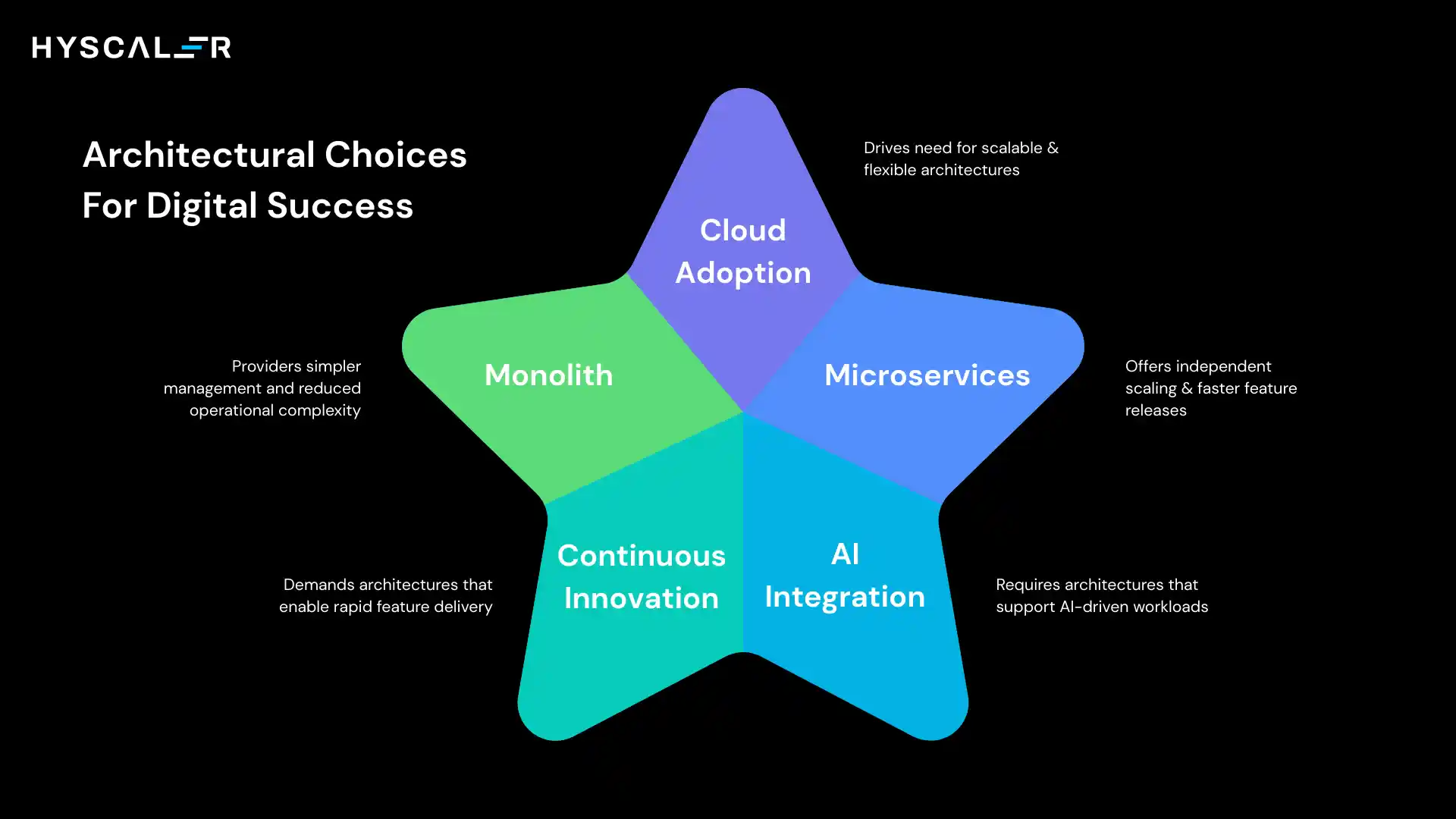
As enterprises accelerate their cloud adoption, integrate AI-powered capabilities, and compete in markets that demand continuous innovation, the foundational choice of architecture has never mattered more.
At the heart of this conversation lies a long-standing and increasingly urgent debate: Microservices vs Monolith.
What was once a clear-cut argument for modernity has become far more nuanced.
Engineering leaders at enterprises of all sizes are re-evaluating their assumptions, and in 2026, both architectural styles will remain relevant, but for very different reasons and contexts.
Cloud-native platforms, AI-driven workloads, and the rise of platform engineering have all shifted the calculus.
The pressure to scale independently, ship faster, and isolate failures has pushed many organizations toward microservices.
Yet the operational complexity, DevOps overhead, and distributed system challenges have caused others to pause, or even migrate back toward a well-structured monolith.
This guide will help you cut through the noise.
We will explore how each architecture works, compare its trade-offs, analyze real-world examples from companies like Amazon, Netflix, and Uber, and give you a practical decision framework to choose the right architecture for your enterprise in 2026.
What is Monolithic Architecture?
Definition
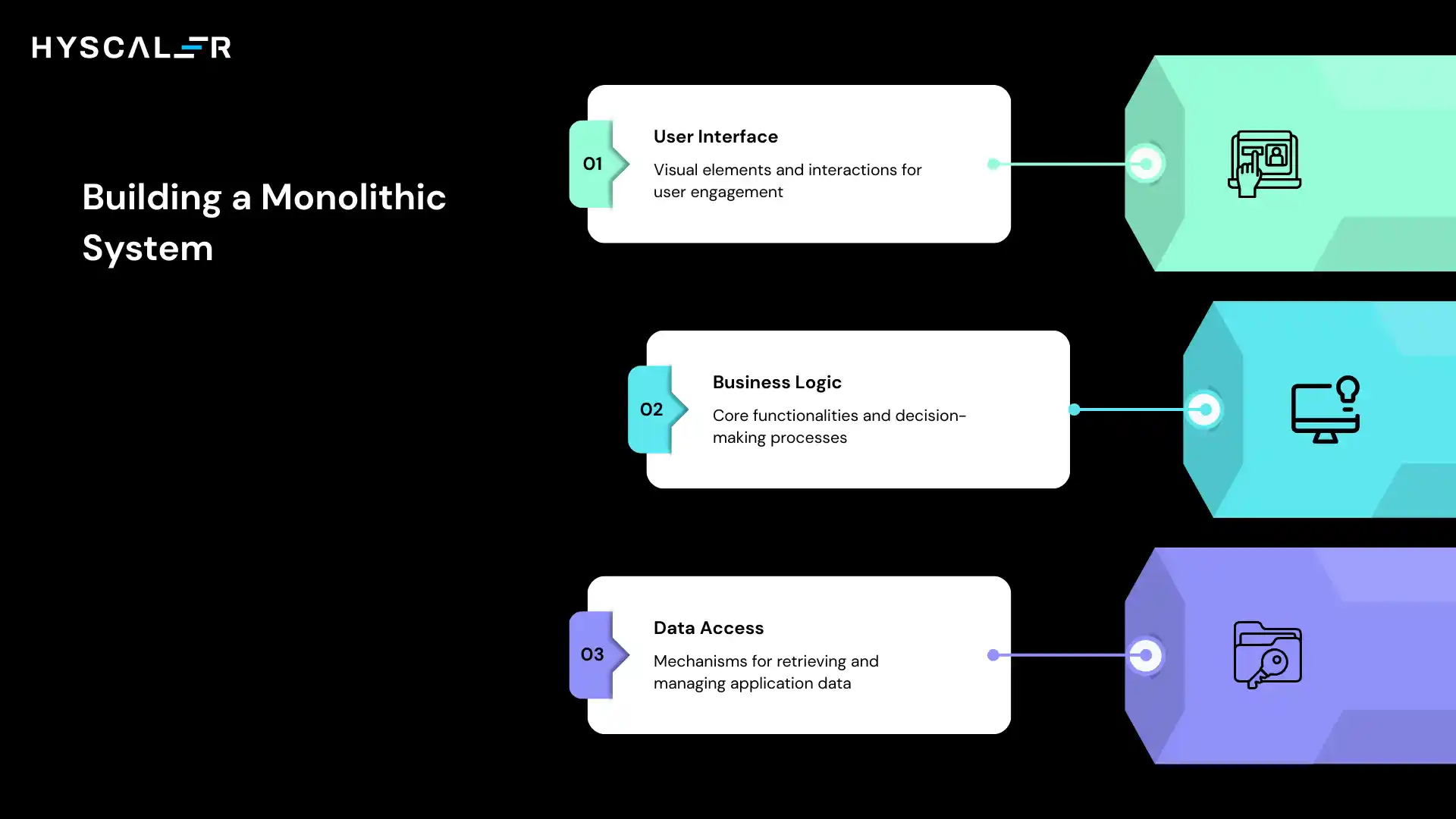
A monolithic architecture is a software design pattern where all components of an application, the user interface, business logic, and data access layer, are bundled together into a single, unified codebase and deployed as one unit.
Think of it as a single, tightly coupled system where everything lives and runs together.
How Monolith Works
In a monolithic application, developers work within a single codebase.
All modules, from authentication to payments to notifications, share the same runtime environment.
Changes to any part of the application require rebuilding and redeploying the entire system.
- Single Codebase: All application logic resides in one repository.
- Shared Database: All modules access a single, centralized database.
- Single Deployment: The entire application is deployed as one artifact.
- Tightly Coupled: Components are interdependent and communicate through function calls.
Real-World Example
Consider a traditional e-commerce application built in 2012.
The product catalog, shopping cart, checkout, user authentication, and order management are all part of a single Spring Boot or Django application.
To add a new payment gateway, the entire application must be tested and redeployed, even the parts completely unrelated to payments.
Key Characteristics
- Simple to develop and test in early stages
- Lower initial infrastructure cost
- Easy local development with a single running process
- Harder to scale specific components independently
- Deployment risk increases with application size
What is Microservices Architecture?
Definition
Microservices architecture is an approach where an application is decomposed into a collection of small, independently deployable services.
Each service is focused on a specific business capability, communicates over well-defined APIs, and can be developed, deployed, and scaled independently of the others.
How Microservices Work
Rather than one large application, you have dozens or hundreds of small services.
A user request might pass through an API gateway, hit an authentication service, then a product service, then a recommendation service, all in milliseconds.
These services communicate via REST APIs, gRPC, or message queues like Kafka.
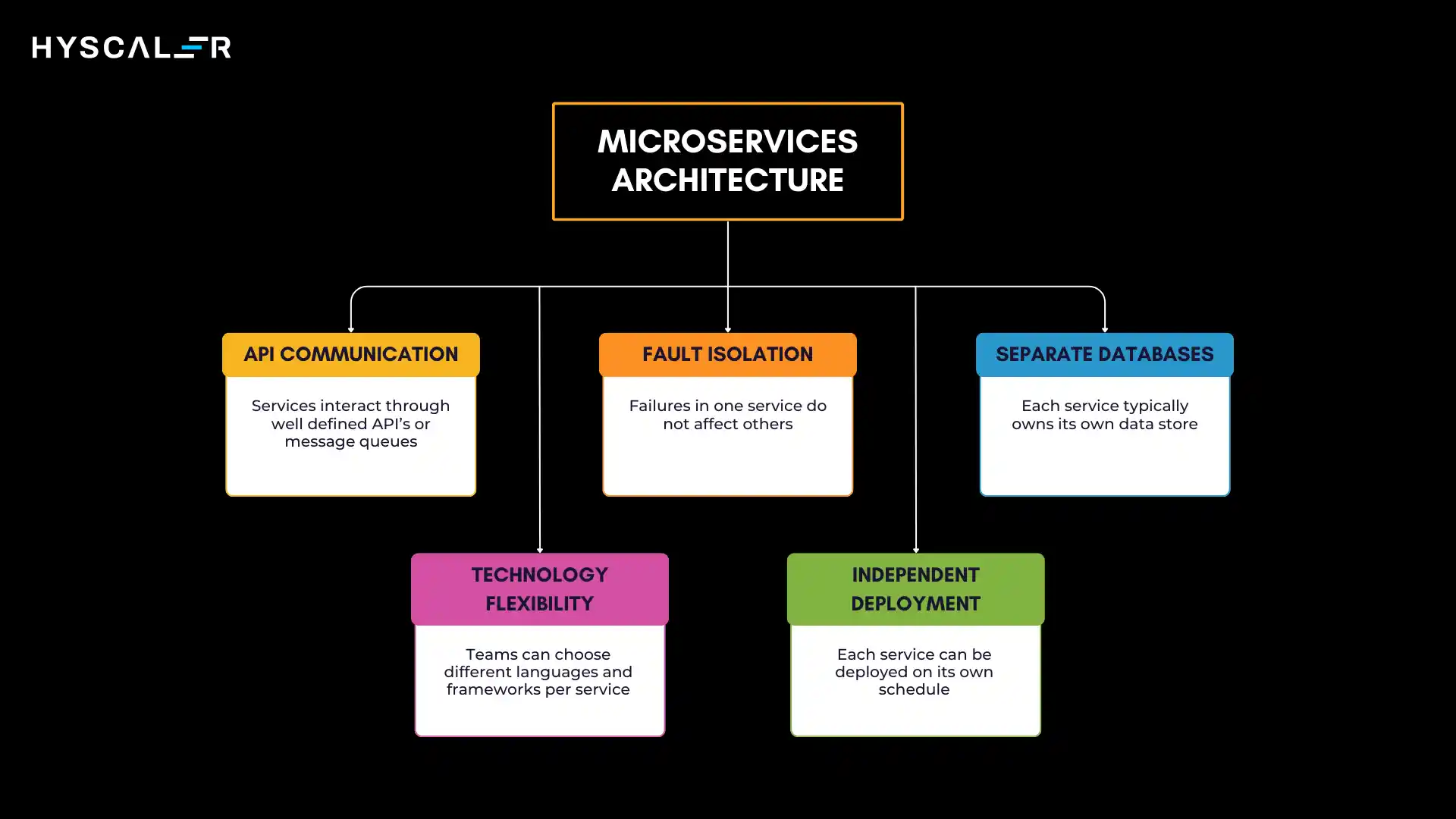
- API communication: Services talk to each other via APIs or async messaging.
- Independent deployment: Each service can be deployed on its own schedule.
- Separate databases: Each service typically owns its own data store.
- Technology flexibility: Teams can choose different languages and frameworks per service.
Real-World Example
Netflix is perhaps the most famous microservices success story.
Their platform is composed of hundreds of independent services, each handling a specific function such as user profiles, streaming quality, recommendation algorithms, or billing.
If their recommendation engine goes down, users can still browse and stream content.
This fault isolation is a defining advantage of microservices at scale.
Amazon similarly decomposed its monolithic retail platform into microservices in the early 2000s, enabling its famously fast innovation cycles and independent team autonomy.
Key Characteristics
- Loosely coupled, highly cohesive services
- Independent scaling per service
- Resilient: failures are isolated
- Requires robust DevOps, CI/CD pipelines, and service mesh infrastructure
- Higher operational complexity
Microservices vs Monolith: Key Differences
The table below summarizes the core differences between these two architectural paradigms across the dimensions that matter most for enterprise decision-making:
| Factor | Monolith | Microservices | Winner | Notes |
|---|---|---|---|---|
| Scalability | Limited (vertical) | Excellent (horizontal) | Microservices | Scale individual services independently |
| Deployment | Single unit | Independent per service | Microservices | Faster, targeted releases |
| Complexity | Low initially | High | Monolith | Simpler for small teams |
| Flexibility | Low | High | Microservices | Mix languages/frameworks |
| Fault Isolation | Poor | Excellent | Microservices | One failure won’t crash all |
| Dev Speed (early) | Fast | Slower initially | Monolith | Less setup required |
| Maintenance | Hard at scale | Easier per service | Microservices | Modular code is cleaner |
Advantages of Monolithic Architecture
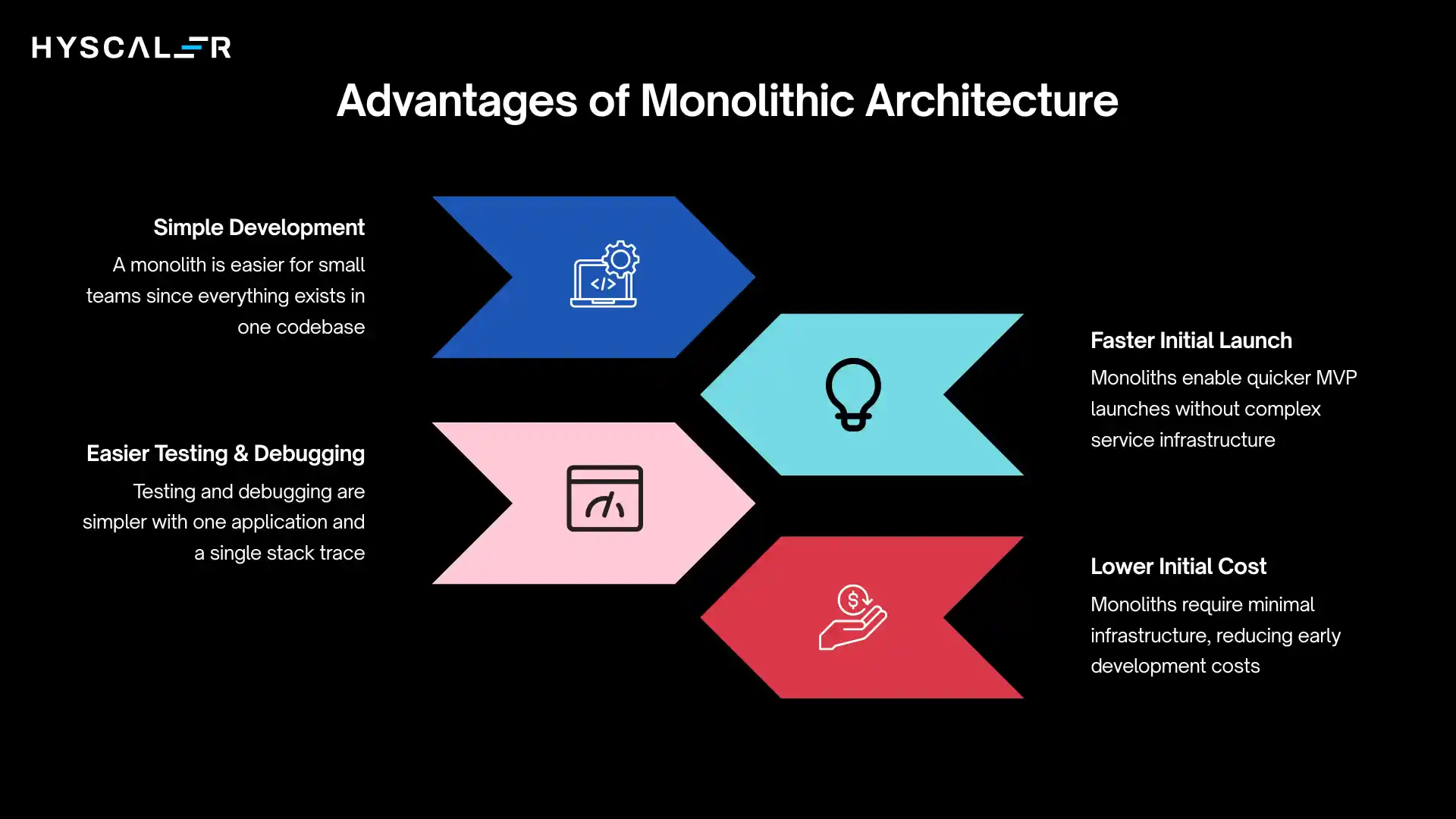
Simple Development
For small teams and early-stage products, a monolith is simply easier to build.
There is no need to reason about distributed systems, network latency between services, or API contracts between teams.
Developers can navigate the entire codebase in a single IDE window, making onboarding faster and collaboration more natural.
Faster Initial Launch
When speed to market matters most, as it almost always does for MVPs and startups, a monolith removes significant friction.
There is no service infrastructure to set up, no API gateway to configure, and no distributed tracing to instrument.
You write code, run it, and ship it.
Easier Testing and Debugging
End-to-end testing is simpler in a monolith.
You spin up one application, run your test suite, and observe the results.
There is no need to mock dozens of downstream services or orchestrate multi-service test environments.
When a bug occurs, you have a single stack trace to follow rather than a distributed log across five services.
Lower Initial Cost
Infrastructure costs are lower for monoliths.
A single server, a single database, one CI/CD pipeline.
This makes monoliths ideal for budget-constrained projects, internal tools, or applications that do not need to scale to millions of users.
Disadvantages of Monolithic Architecture
- Hard to scale: You must scale the entire application even if only one feature needs more resources, leading to inefficient resource utilization.
- Slower innovation: As the codebase grows, it becomes harder to make changes quickly. Developer productivity drops, build times increase, and the risk of regressions grows.
- Risk of full system failure: A critical bug in one module can bring down the entire application. There is no fault isolation.
- Difficult to maintain at scale: Large monolithic codebases become increasingly difficult to understand, test, and extend. Technical debt accumulates rapidly.
- Technology lock-in: The entire application must use the same language, framework, and runtime, limiting the ability to adopt new technologies.
Advantages of Microservices Architecture
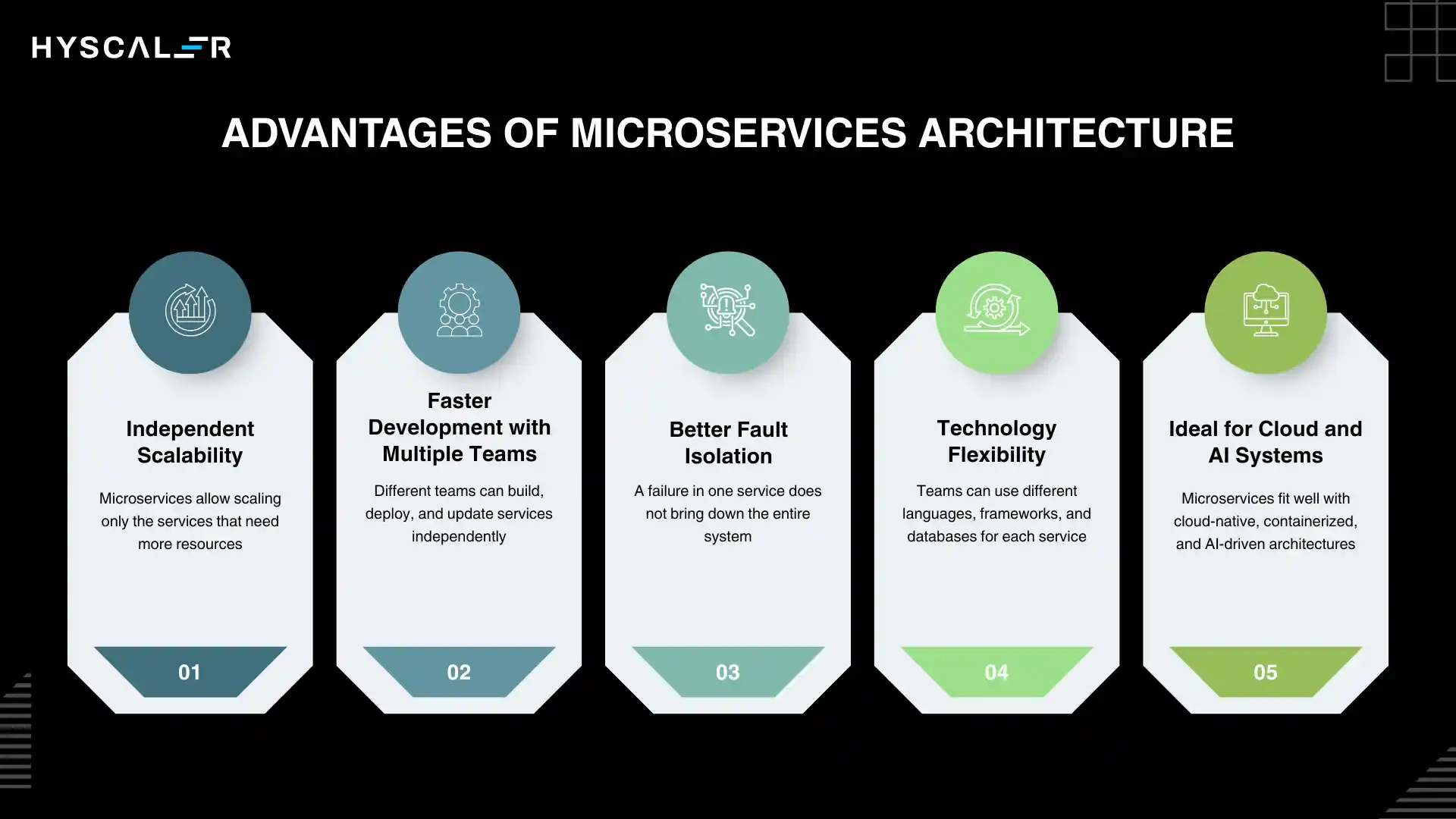
Independent Scalability
One of the most powerful benefits of microservices is the ability to scale only the services that need it.
If your recommendation engine needs 10x more compute during peak hours, you scale just that service, not your entire platform.
This results in significant cost efficiency at enterprise scale.
Faster Development with Multiple Teams
Microservices enable true organizational agility.
Multiple teams can work on different services simultaneously with minimal coordination overhead.
Each team owns its service, chooses its deployment schedule, and can release independently.
This maps directly to Conway’s Law: your architecture mirrors your organizational structure.
Better Fault Isolation
When a microservice fails, only that service is affected; the rest of the system continues to operate.
This resilience is critical for high-availability enterprise systems where downtime translates directly into revenue loss and user trust.
Technology Flexibility
Different services can be written in different languages and use different databases.
Your machine learning inference service can be in Python with a Redis cache, while your billing service is in Java with PostgreSQL.
This polyglot architecture allows teams to use the best tool for each job.
Ideal for Cloud and AI Systems
Microservices align naturally with cloud-native principles, containerization via Docker, orchestration via Kubernetes, and serverless execution.
In 2026, with AI workloads requiring GPU compute and specialized infrastructure, the ability to deploy AI services independently is a significant architectural advantage.
Disadvantages of Microservices
- Higher Complexity: Distributed systems are inherently harder to reason about. Network failures, partial outages, and eventual consistency add significant complexity.
- Infrastructure Overhead: You need container orchestration (Kubernetes), service discovery, API gateways, distributed tracing, and centralized logging, all of which require significant investment.
- Requires DevOps Maturity: Microservices assume a high level of automation. Without mature CI/CD pipelines, monitoring, and deployment automation, microservices become an operational nightmare.
- Harder Monitoring and Debugging: Tracing a single request across 10 services requires sophisticated tooling like Jaeger, Zipkin, or Datadog APM. Debugging distributed failures is significantly more complex than in a monolith.
- Data Management Complexity: Distributed data ownership means managing data consistency across services, handling eventual consistency, and implementing sagas for distributed transactions.
When Should You Choose Monolith?
Despite the industry buzz around microservices, there are scenarios where a monolith is genuinely the right choice:
Best Use Cases for Monolithic Architecture
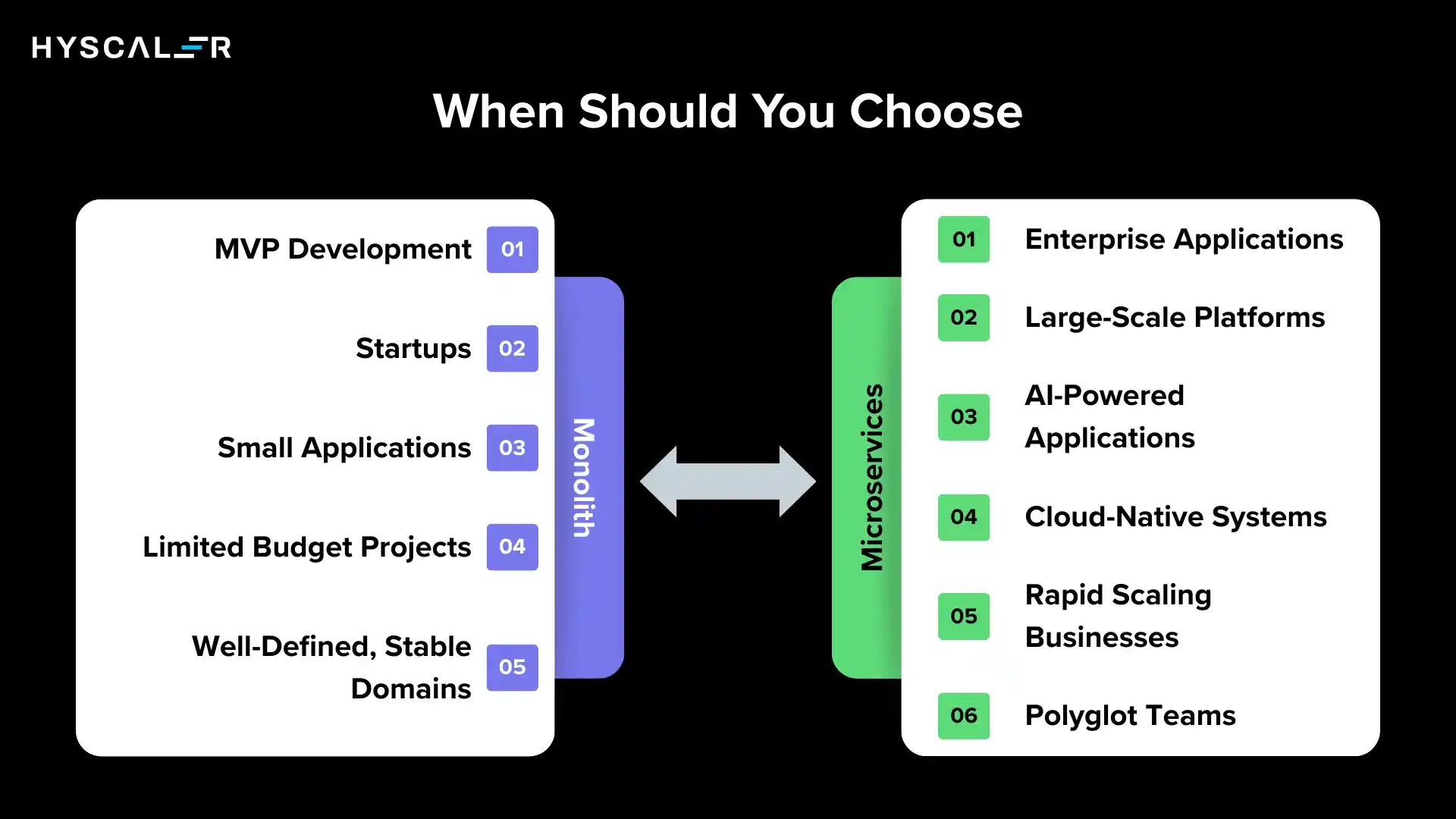
- MVP Development: When validating a business idea, a monolith lets you move fast without infrastructure distractions.
- Startups (0–50 engineers): Small teams benefit enormously from the simplicity and speed of a monolith.
- Small Applications: Internal tools, admin dashboards, and low-traffic applications rarely justify microservices complexity.
- Limited Budget Projects: Organizations without dedicated DevOps engineers should avoid the infrastructure overhead of microservices.
- Well-Defined, Stable Domains: If your application’s domain is simple and unlikely to grow substantially, a monolith is easier to maintain.
The modular monolith, a monolith with clear internal module boundaries, is emerging as a popular middle ground in 2026, offering the simplicity of a monolith with some organizational clarity of microservices.
When Should You Choose Microservices?
Microservices shine in high-scale, high-complexity environments where the investment in infrastructure pays significant dividends:
Best Use Cases for Microservices Architecture
- Enterprise Applications: Large organizations with multiple teams benefit from service ownership and independent deployment.
- Large-Scale Platforms: Applications serving millions of concurrent users need the independent scalability that microservices provide.
- AI-Powered Applications: AI inference services, model training pipelines, and data processing systems often require specialized compute that must be scaled and managed independently.
- Cloud-Native Systems: Applications built for Kubernetes and cloud platforms align naturally with microservices.
- Rapid Scaling Businesses: When you need to scale from 100,000 to 10 million users in months, microservices make targeted scaling possible.
- Polyglot Teams: Organizations where different teams have deep expertise in different technology stacks benefit from technology flexibility.
Monolith to Microservices Migration
Why Companies Migrate
Most microservice architectures did not start that way.
Amazon, Netflix, Uber, and eBay all began with monoliths and migrated as their scale and organizational complexity demanded it.
The typical triggers for migration include: deployment bottlenecks, scaling limitations, team coordination overhead, and the desire to adopt cloud-native infrastructure.
Migration Challenges
- Identifying service boundaries is harder than it appears; poor decomposition leads to ‘distributed monoliths’ with the worst of both worlds.
- Data decoupling is the hardest technical challenge. Splitting a shared database into service-owned databases requires careful planning and often temporary data duplication.
- Team restructuring must accompany architectural restructuring; Conway’s Law is unavoidable.
- Maintaining two architectures simultaneously during migration increases risk and slows delivery.
Migration Strategy Overview
The most successful migration strategy is the Strangler Fig Pattern, coined by Martin Fowler.
Rather than a risky big-bang rewrite, new functionality is built as microservices, and existing monolith functionality is gradually extracted and replaced.
The key steps are:
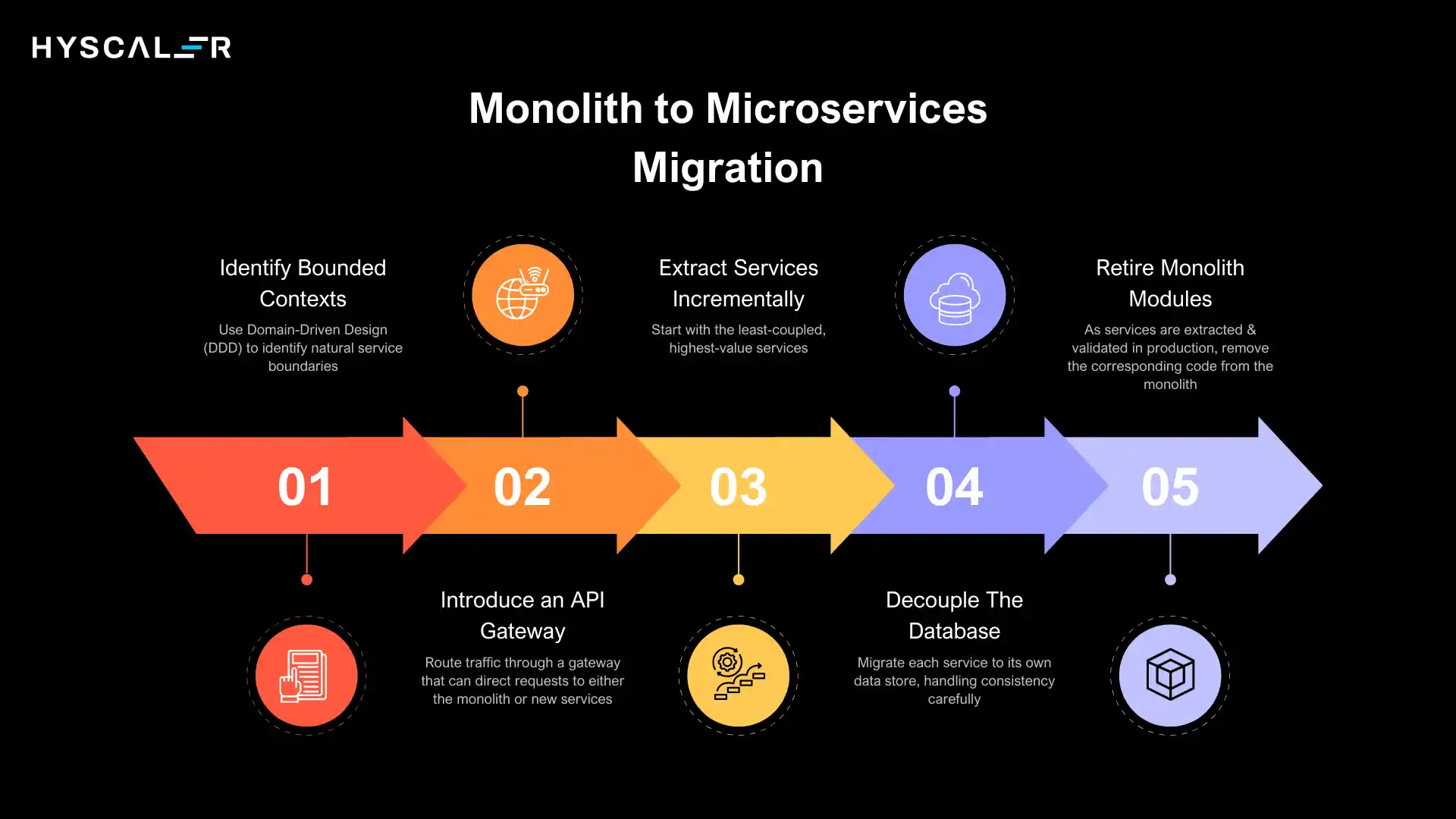
- Step 1 – Identify bounded contexts: Use Domain-Driven Design (DDD) to identify natural service boundaries.
- Step 2 – Introduce an API Gateway: Route traffic through a gateway that can direct requests to either the monolith or new services.
- Step 3 – Extract services incrementally: Start with the least-coupled, highest-value services. Authentication, notifications, and file storage are common first targets.
- Step 4 – Decouple the database: Migrate each service to its own data store, handling consistency carefully.
- Step 5 – Retire monolith modules: As services are extracted and validated in production, remove the corresponding code from the monolith.
Enterprise Decision Framework
Use this checklist to guide your architectural decision:
Team & Organization
- Team size < 20 engineers → Lean toward Monolith
- Multiple independent teams → Lean toward Microservices
- Limited DevOps maturity → Start with Monolith
Budget & Timeline
- Limited infrastructure budget → Monolith
- Fast time-to-market required → Monolith for v1
- Long-term enterprise investment → Microservices
Scalability & Growth
- Expected rapid growth (10x–100x) → Microservices
- Predictable, moderate growth → Modular Monolith or Microservices
- Small, stable user base → Monolith
Technical Requirements
- AI/ML workloads with specialized compute → Microservices.
- Multiple technology stacks required → Microservices
- Simple domain, single technology stack → Monolith
Real-World Examples
Amazon
Amazon began as a monolithic Perl application in 1994.
By the early 2000s, their monolith had become a significant barrier to innovation.
Jeff Bezos issued the famous ‘API mandate’ requiring all teams to expose their data through service interfaces.
This architectural shift enabled Amazon to build AWS, Prime, Marketplace, and dozens of other products independently, and ultimately gave birth to the cloud computing industry.
Netflix
Netflix migrated from a monolithic DVD-rental application to a cloud-native microservices architecture between 2008 and 2012 following a major database corruption incident.
Today, their platform runs on hundreds of microservices on AWS, processing billions of API calls daily.
Netflix open-sourced many of the tools they built for microservices management, including Hystrix for fault tolerance and Eureka for service discovery.
Uber
Uber’s original architecture was a single Python monolith called ‘ubercarpool.’
As Uber expanded internationally to hundreds of cities, the monolith became a serious impediment to scaling and team autonomy.
Their migration to microservices enabled independent teams in different cities to build location-specific features without stepping on each other’s code.
Startups Using Monolith Successfully
Not all successful companies are microservices companies.
Basecamp, Stack Overflow, and Shopify (at least through most of their growth) built substantial businesses on well-structured monoliths.
The key insight: a well-organized monolith with good engineering practices can scale further than most companies will ever need.
Future Trends in Software Architecture (2026 and Beyond)
Cloud-Native Architecture
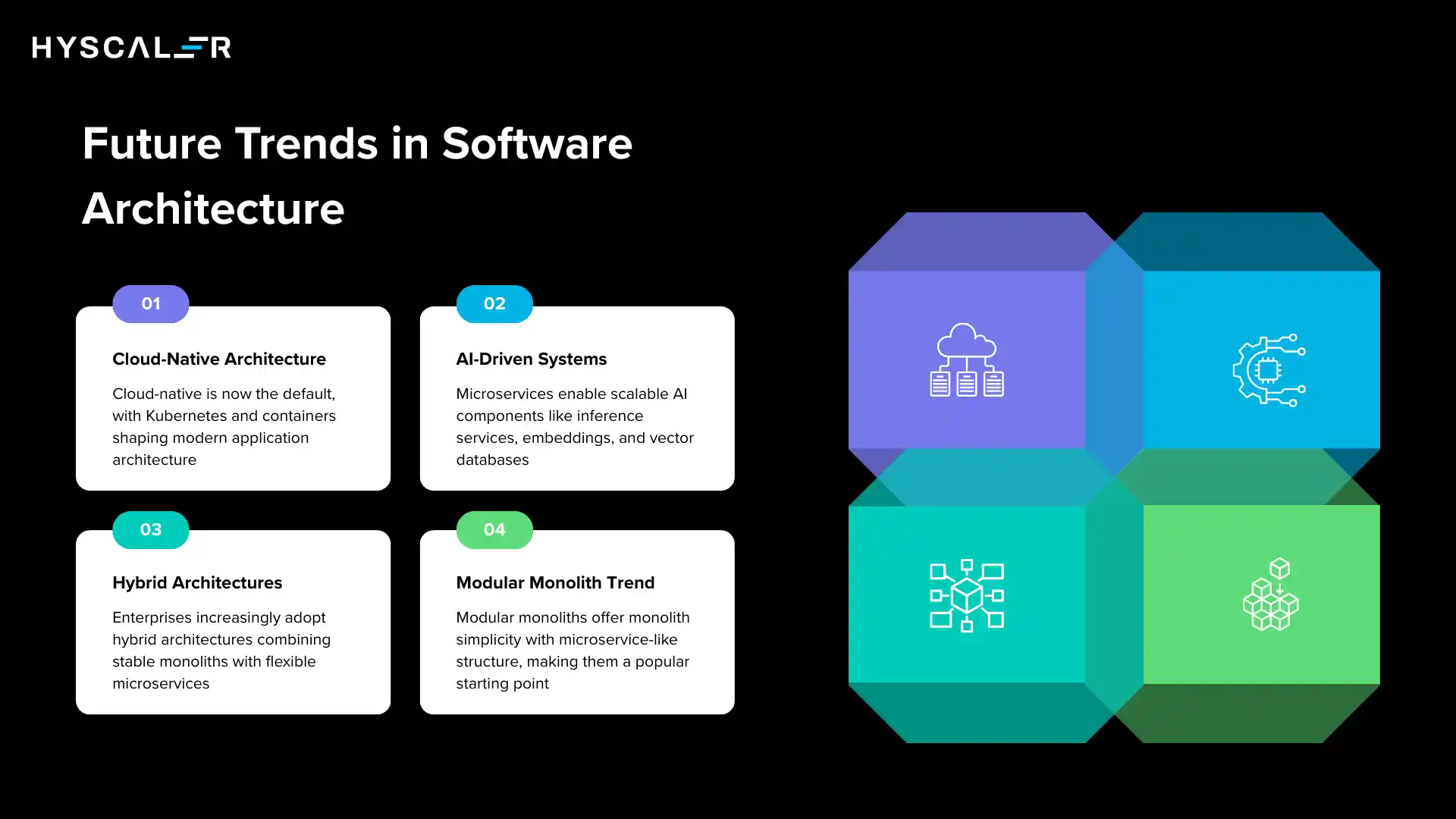
In 2026, cloud-native is no longer a differentiator; it is the default.
Kubernetes has become the operating system of the cloud, and architectural decisions are increasingly made with containerization and orchestration as given constraints.
Service meshes like Istio and Linkerd are maturing, making microservices observability and traffic management easier than ever before.
AI-Driven Systems
The rise of large language models and AI-integrated applications is creating new architectural patterns.
AI inference services, embedding pipelines, vector databases, and model serving infrastructure all benefit from the independent scalability of microservices.
In 2026, most enterprise applications will have at least one AI component, and microservices make it easier to integrate, update, and scale these components independently.
Hybrid Architectures
The binary choice between monolith and microservices is giving way to hybrid approaches.
Many enterprises run a core monolith for stable, well-understood domains, while building new capabilities as microservices.
This pragmatic approach avoids the all-or-nothing trap and lets organizations evolve their architecture as their needs change.
Modular Monolith Trend
The modular monolith is having a renaissance.
Pioneered by teams at companies like Shopify and DHH’s community, the modular monolith enforces strict module boundaries within a single deployment unit.
It provides the developer experience of a monolith with the organizational clarity of microservices, and is increasingly seen as the right starting point for most enterprise applications before microservices decomposition becomes necessary.
How HyScaler Helps Enterprises Build Scalable Architectures
| Architecture Consulting: Expert guidance on architectural decisions, migration strategies, and technology roadmaps from our senior architects. | Cloud Migration: Seamlessly migrate your applications to AWS, GCP, or Azure with minimal risk and maximum performance gains. |
| Enterprise Software Development: Custom enterprise applications built for scale, security, and long-term maintainability across industries. | Architecture Consulting: Expert guidance on architectural decisions, migration strategies, and technology roadmaps from our senior architects. |
Conclusion
The microservices vs monolith debate does not have a universal answer, and that is precisely the point.
Both architectural patterns are valid, powerful, and in widespread use by successful companies in 2026.
The key is matching your architecture to your current reality and future trajectory.
Monoliths offer simplicity, speed, and lower cost, making them the right foundation for startups, MVPs, and applications with limited scale requirements.
A well-structured modular monolith can take you further than you might expect, and is far easier to maintain than a poorly designed microservices system.
Microservices offer scalability, resilience, and team autonomy, making them the right choice for enterprises managing large engineering organizations, high-traffic applications, cloud-native infrastructure, and AI-integrated systems.
The investment in DevOps maturity and infrastructure is real, but at enterprise scale, the returns are substantial.
The most important advice: do not choose an architecture based on what Netflix or Amazon did.
Choose based on your team size, budget, scalability requirements, and organizational maturity.
Start with the simplest architecture that meets your needs today, and evolve thoughtfully as your needs change.
If you are uncertain where to start, HyScaler’s architecture consulting team has helped dozens of enterprises make this decision and build systems that scale with confidence.
FAQs
What is monolithic architecture?
Monolithic architecture is a software design where all components of an application are built and deployed as a single unified codebase.
What is microservices architecture?
Microservices architecture structures an application as multiple small, independent services that communicate through APIs.
What is the main difference between monolith and microservices?
A monolith is a single, tightly integrated application, while microservices split the application into independent, loosely coupled services.
When should enterprises use monolithic architecture?
Monolithic architecture is ideal for smaller applications, early-stage products, and teams that want simpler development and deployment.
When should enterprises adopt microservices?
Microservices are suitable for large-scale applications that require independent scaling, faster releases, and multiple development teams.
Are microservices better than monoliths?
Not always. Microservices offer scalability and flexibility, while monoliths provide simplicity and easier management for smaller systems.
What are the challenges of microservices architecture?
Microservices introduce higher operational complexity, distributed system management, and the need for advanced DevOps practices.
What are the benefits of monolithic architecture?
Monolithic systems are simpler to build, test, and deploy, especially for small teams or applications with limited complexity.
Can enterprises migrate from monolith to microservices?
Yes, many organizations gradually break down monolithic applications into microservices using incremental migration strategies.
What is the future of enterprise architecture in 2026?
Most enterprises are adopting hybrid architectures, combining monoliths for core systems and microservices for scalable, cloud-native services.