
Table of Contents
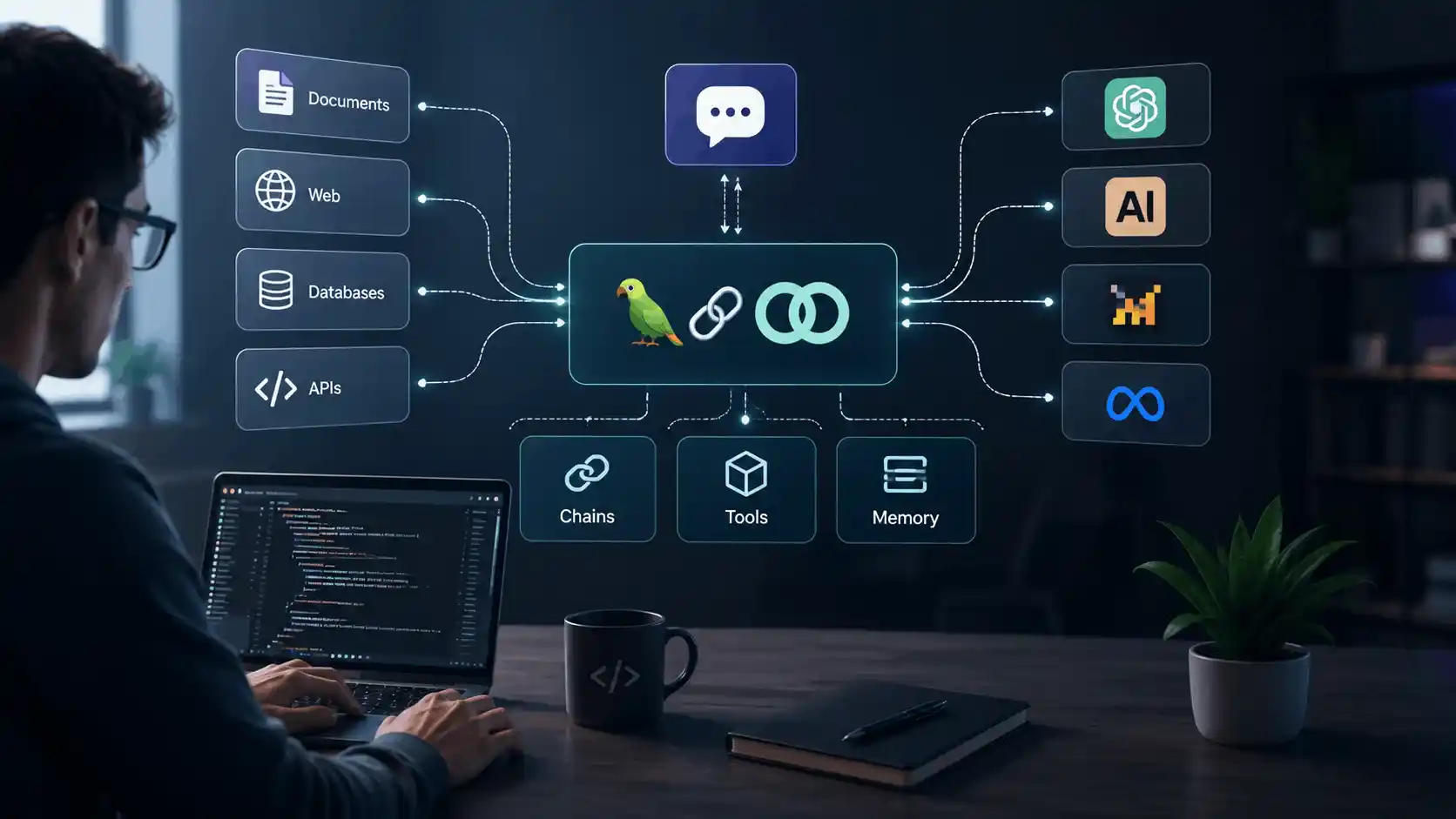
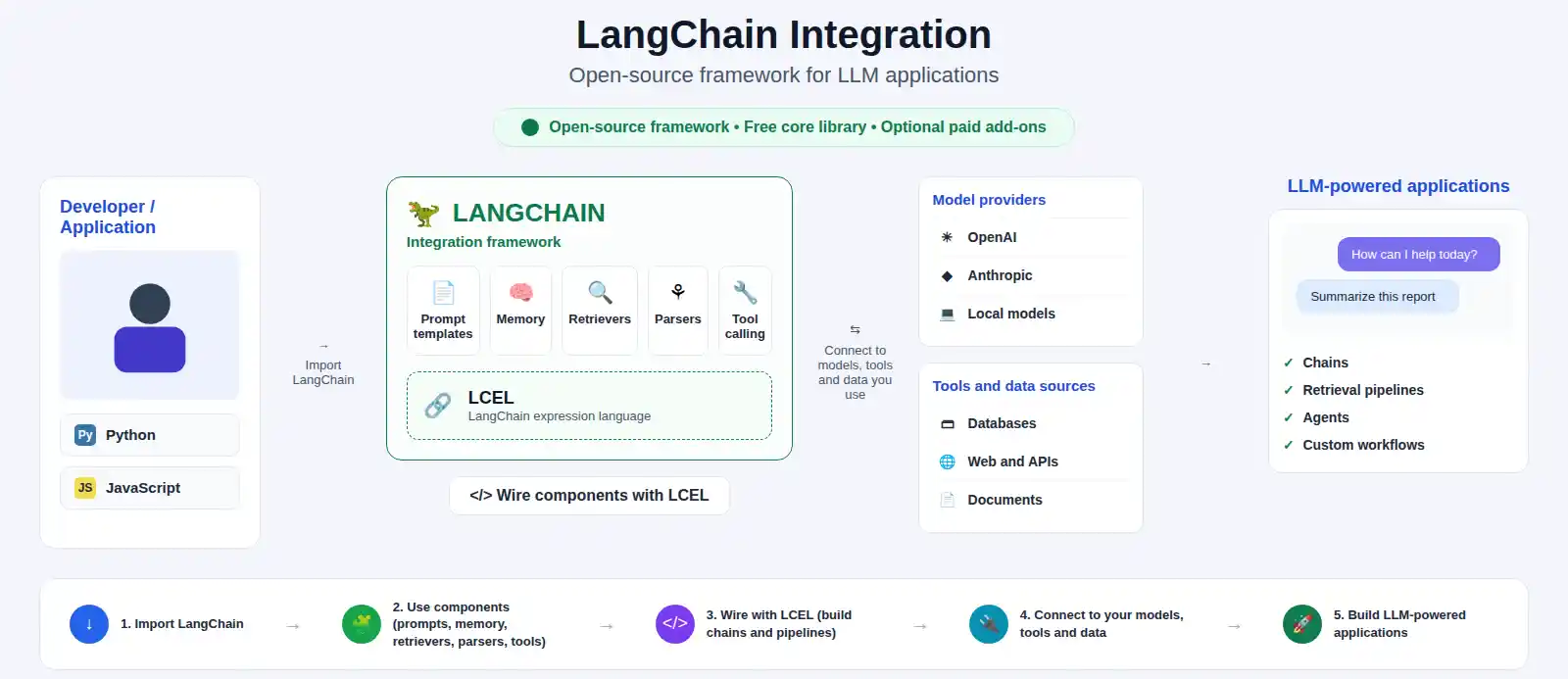
LangChain integration is how developers plug LangChain’s open-source framework into their applications to build LLM-powered chains, retrieval pipelines, and agents without writing all the plumbing from scratch. It isn’t a hosted platform with a subscription plan; it’s a Python and JavaScript toolkit wrapping the repetitive parts of working with language models: prompt templates, memory, retrievers, parsers, and tool calling.
That distinction matters because older content often treats LangChain like a SaaS product developers “subscribe to.” In practice, working with the framework means importing a library, wiring components with LCEL (LangChain Expression Language), and connecting the result to a model provider you’re already using, such as OpenAI, Anthropic, or a local model.
The Problem LangChain Integration Actually Solves
Before reaching for LangChain, most teams building an LLM feature run into the same set of problems, over and over, regardless of the use case.
Problem 1: Manual Model-to-Service Connections
- Every LLM feature eventually needs to talk to something else: a vector database, an API, a document store, or a search tool. Wiring each of these up by hand means writing custom connection logic for every new service, then maintaining it as APIs change.
- How LangChain integration solves it: It ships a standardized interface for connecting models to external services. Instead of custom glue code per integration, developers use a common pattern that works the same way across providers and tools.
Problem 2: No Clear Way to Track Data Flow
- As an LLM app grows past a single prompt-response call, it starts chaining steps together: retrieve context, format a prompt, call the model, parse the output, and maybe call another tool. Without structure, this becomes a tangle of ad hoc function calls that’s hard to trace or debug.
- How LangChain integration solves it: Chains and pipelines give this flow an explicit structure, so data moves through defined steps instead of scattered logic. This makes it easier to see what’s happening at each stage and to debug when something breaks.
Problem 3: Conversation Context Gets Lost
- A chatbot that can’t remember what was said two turns ago feels broken. Building memory from scratch means deciding how to store history, when to prune it, and how to feed it back into the model efficiently.
- How LangChain integration solves it: Built-in memory components handle storing and retrieving conversation history, so context persists across turns without the developer reinventing storage and retrieval logic each time.
Problem 4: Rebuilding Everything to Scale or Switch Providers
- A prototype built around one model provider’s API often has to be rewritten if the team scales up or switches providers later due to different SDKs, different conventions, and different integration code.
- How LangChain integration solves it: Its abstraction layer decouples the app logic from any single provider, so swapping models or scaling the system doesn’t mean starting over.
LCEL: The Backbone of Modern LangChain Integration
Most LangChain integration work today runs through LCEL, which uses a pipe operator to connect components in a readable sequence: a prompt template feeds a model, the model’s output feeds a parser, and the parser returns structured data your app can use. LCEL lets you declare that sequence once and let the framework handle execution, streaming, and error handling.
For a support chatbot, this looks like a prompt template injecting the question and retrieved documents; the model generates a response, and a parser converts it into JSON the front end can render, a few lines instead of hand-rolled request handling.
The Core Building Blocks You’re Actually Integrating
“LangChain integration” is really an umbrella term for wiring together a handful of components. Here’s what each one does:
| Component | What It Does | Typical Use |
|---|---|---|
| Models | Wraps the LLM provider (OpenAI, Anthropic, local models) behind one consistent interface | Swapping providers without rewriting app code |
| Prompt Templates | Injects variables into a reusable prompt structure | Keeping prompts consistent across requests |
| Retrievers | Pulls relevant chunks from a vector store or document set | RAG and document Q&A |
| Memory | Persists conversation history or state between turns | Multi-turn chatbots |
| Tools / Agents | Lets the model call functions or APIs based on the input | Booking actions, running calculations, checking order status |
| Output Parsers | Converts raw model text into structured data | Feeding results into a UI or database |
Seeing the pieces laid out this way makes the appeal of LangChain integration more concrete: it’s six small, swappable parts, not one black box.
LangChain vs. LangGraph: Where Integration Gets Serious
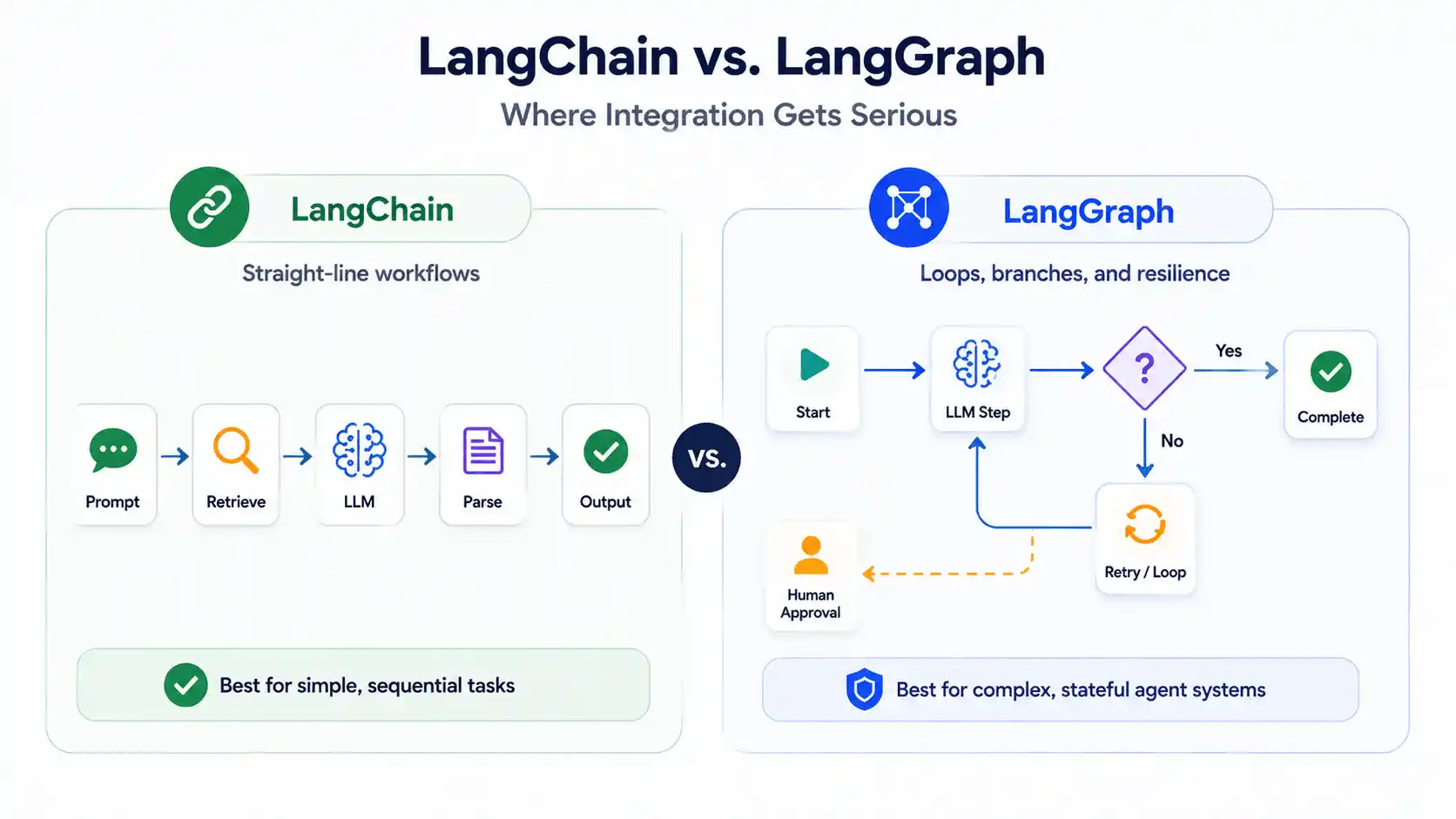
A simple LangChain integration, a straight-line sequence with no branching, is usually enough for prototypes. Once an agent needs to loop, retry a failed step, branch on a decision, or pause for human approval, teams reach for LangGraph, built on top of LangChain, using the same components as graph nodes.
The practical rule of thumb: a straight-line workflow only needs plain LangChain. Loops, conditional branches, or checkpoint-and-resume means LangGraph is the layer to add on top. Most production agent systems use both: LangChain for component logic and LangGraph for orchestration.
Where LangChain Integration Shows Up in Production
Establishing that LangChain integration isn’t a demo-only framework, showing which companies run it in production, what kinds of problems it’s actually solving for them, and how a developer can map those same patterns onto their own project.
LangChain integration is the practice of connecting a language model to external data, tools, and memory through a standardized framework, instead of writing custom plumbing for each connection by hand. In production, this takes one of a few recurring shapes: retrieval over private data, agents that call tools and hand off to humans, and pipelines that turn unstructured input into structured output.
Production deployments cluster around four patterns. Each one pairs a technical building block with a real example of it running in production:
1. Retrieval-Augmented Generation (RAG)
Connecting a model to a company’s own documents so it answers questions grounded in real content instead of guessing. LangChain handles document loading, chunking, embedding, and retrieval, so a developer goes from raw PDFs to a working Q&A system without
building a custom vector-search pipeline first. This is the most common entry point into LangChain integration.
In production: a documentation search assistant that answers product questions by retrieving directly from a company’s own docs and changelogs, instead of surfacing generic search results.
2. Customer Support Agents
A retriever pulls relevant help center articles, a prompt template frames tone and constraints, and a tool layer checks order status or triggers a refund, combined into one pipeline that hands off to a human when confidence is low.
In production: an e-commerce support bot that answers a shipping question by pulling the live order status instead of giving a generic canned reply.
3. Internal Developer Tools
Tool-calling support lets a model read a codebase, propose a diff or upgrade path, and run tests before a change reaches an engineer.
In production: an internal tool that scans a service for deprecated API calls and opens a pull request with the fix pre-tested.
4. Security and Data Operations
Agents that triage logs or alerts, correlate signals across systems, and surface only what needs human review; the same underlying pattern also shows up in content work like summarizing documents into consistent formats or extracting fields from unstructured text into a database.
In production: a security operations agent that reads incoming alerts overnight and escalates only the handful matching a real attack pattern, instead of paging someone for every false positive.
Real-World Use Cases
In the ever-evolving landscape of technology, LangChain’s versatile capabilities find application in a multitude of real-world scenarios, opening the door to innovation and efficiency across various domains. Below, we explore some of the tangible use cases where LangChain integration shines.
Language Translation Services:
Developers can tap into LangChain integration’s formidable language processing capabilities to craft cutting-edge language translation applications. For instance, envision a developer creating a mobile app empowered by LangChain’s prowess, allowing travelers to experience seamless real-time translation of spoken words from one language to another. Such an application not only bridges language barriers but also enhances communication, making the world a more interconnected and accessible place.
G-Translate is an innovative translation tool that integrates seamlessly with LangChain, offering travelers a world of interconnected communication.
UniSpeak is a language translation app enhanced by LangChain that breaks down language barriers and fosters global connectivity.
Sentiment Analysis Tools:
LangChain integration’s natural language understanding takes center stage when it comes to constructing sentiment analysis tools. Businesses, in particular, stand to gain significantly from this capability. With LangChain as their ally, they can analyze customer feedback and scrutinize social media posts with unprecedented precision. By gauging public sentiment about their products or services, organizations can make more informed decisions. This data-driven approach empowers them to refine strategies, address concerns promptly, and ultimately elevate customer satisfaction.
Sentinet Solutions is a data analytics company that partners with LangChain to offer advanced sentiment analysis tools to businesses. Using LangChain’s natural language understanding capabilities, Sentinet Solutions provides businesses with unparalleled precision in analyzing customer feedback and social media posts. This partnership empowers organizations to make data-driven decisions, refine their strategies, address concerns promptly, and ultimately enhance customer satisfaction.
Content Generation:
In the age of information, content is king, and LangChain integration’s language generation abilities offer a royal advantage. Developers can harness LangChain to automate content creation, a boon for bloggers, content marketers, and businesses alike. Imagine a scenario where LangChain generates high-quality articles, product descriptions, or engaging social media posts effortlessly. Tailored to specific topics and keywords, these automated creations not only save time but also maintain the quality and consistency required to captivate audiences in the digital realm.
ContentMatic is a content automation platform that partners with LangChain to revolutionize content creation. By integrating LangChain’s language generation capabilities, ContentMatic offers bloggers, content marketers, and businesses an efficient solution for generating high-quality articles, product descriptions, and engaging social media posts. ContentMatic’s collaboration with LangChain ensures that automated content is tailored to specific topics and keywords, saving time while maintaining the quality and consistency required to captivate digital audiences.
Challenges and Future Opportunities
The synergy between LangChain integration and the developer ecosystem has undeniably ushered in a new era of possibilities, but as with any innovative technology, challenges and opportunities coexist on the path to progress.
Challenges
- Migrating off deprecated patterns: AgentExecutor is in maintenance mode, with LangChain steering new agents toward
create_agentLangGraph instead, ahead of its scheduled end-of-life. - A real learning curve: chains, agents, memory, retrievers, and parsers – enough breadth that new developers need a few weeks to pick the right component confidently.
- Fast-moving APIs: module paths and method signatures shift between versions, breaking code written against an older release.
- Cost visibility: multi-call chains (retrieval, reasoning, formatting) can quietly multiply token spend if usage isn’t tracked per step.
- Debugging multi-step chains: tracing which step introduced a wrong answer needs observability tooling like LangSmith, not guesswork.
Future Opportunities
- More capable agent orchestration: branching, retries, and multi-turn decisions handled natively via LangGraph’s state-graph model.
- Built-in observability: LangSmith-style tracing pinpoints which step failed, instead of guesswork.
- Cross-domain agentic applications: beyond chatbots, into healthcare, finance, and education workflows with defined action spaces.
- Standardized human-in-the-loop patterns: native support for pausing execution and waiting on approval, without custom-built gates.
- Responsible-AI tooling built into the framework: bias checks, privacy-preserving retrieval, and audit trails as first-class features rather than bolt-ons.
Conclusion
In the ever-evolving landscape of technology, LangChain integration with the developer ecosystem stands as a resounding testament to its unwavering commitment to driving innovation and fostering collaborative excellence. This synergistic relationship is the bedrock upon which the future of technological progress is being built, a future filled with limitless possibilities and groundbreaking advancements.
LangChain’s transformative impact within the developer ecosystem is underpinned by a trio of core pillars: developer-friendly features, community engagement initiatives, and robust support for multiple programming languages. These pillars collectively empower developers with the tools and resources needed to forge ahead on the path of ingenuity.
FAQs
Is LangChain worth learning, or is it overhyped?
For anything beyond a single prompt-response call, RAG, multi-step agents, and tool use, most developers find it saves real time. For one API call, it’s unnecessary overhead.
Is LangChain overkill for a simple chatbot?
Often, yes. One prompt and one response are simpler as a direct API call. The framework pays off once you add retrieval, memory, or multiple tools.
What’s the difference between a chain and an agent in LangChain integration?
A chain follows a fixed sequence of steps; an agent decides which steps or tools to use based on the input.
Why is debugging so hard when something goes wrong?
Abstractions that hide the underlying prompts make it harder to see what was actually sent to the model; tracing tools like LangSmith exist to make each step inspectable.
How is LangChain different from LlamaIndex?
LlamaIndex focuses narrowly on data indexing and retrieval, while LangChain covers a broader set of components, chains, agents, memory, and tool calling.
Can LangChain work with any LLM provider?
Yes, it supports OpenAI, Anthropic, and other providers through a common interface, so switching models doesn’t mean rewriting your pipeline.
Does LangChain handle memory across conversations?
Yes, through memory components that persist chat history, though LangGraph’s checkpointing is more robust for longer-running agents.