

Table of Contents
Google has always been at the forefront of AI innovation, contributing to the open community with groundbreaking technologies such as Transformers, TensorFlow, BERT, T5, JAX, AlphaFold, and AlphaCode. Now, Google is proud to announce a new family of open models that can help developers and researchers create AI applications responsibly and efficiently. Meet Gemma, the new precious stone of AI.
What are Gemma open models? Gemma open models are lightweight, state-of-the-art AI models that are built from the same research and technology used to create the Gemini models, Google’s largest and most capable AI models widely available today. Gemma is inspired by Gemini, and the name reflects the Latin gemma, meaning “precious stone.”
Gemma open models are developed by Google DeepMind and other teams across Google, and they are designed with Google’s AI Principles in mind. They are also accompanied by tools and resources to support developer innovation, foster collaboration, and guide responsible use of Gemma models.
Gemma open models are available worldwide, starting today. You can access them for free or for a low cost, depending on your needs and preferences.
What are the benefits of Gemma open models?
Gemma open models offer many advantages for AI developers and researchers, such as:
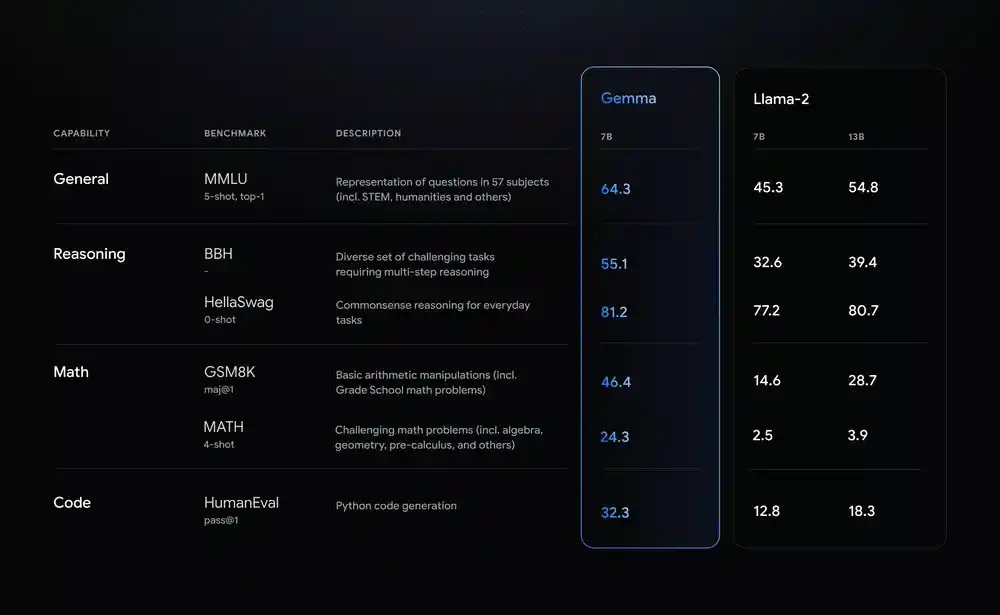
- Performance: Gemma open models achieve best-in-class performance for their sizes compared to other open models. They can run directly on your laptop or desktop computer, or on Google Cloud with easy deployment options. They also surpass significantly larger models on key benchmarks while adhering to rigorous standards for safe and responsible outputs. You can see the technical report for more details on performance, dataset composition, and modeling methodologies.
- Flexibility: Gemma open models are released in two sizes: Gemma 2B and Gemma 7B. Each size is released with pre-trained and instruction-tuned variants. You can fine-tune Gemma models on your data to adapt to specific application needs, such as summarization or retrieval-augmented generation (RAG). You can also choose your favorite framework, as Gemma supports inference and fine-tuning across multi-framework Keras 3.0, native PyTorch, JAX, and Hugging Face Transformers.
- Compatibility: Gemma open models run across popular device types, including laptop, desktop, IoT, mobile, and cloud, enabling broadly accessible AI capabilities. They are also optimized across multiple AI hardware platforms, ensuring industry-leading performance, including NVIDIA GPUs and Google Cloud TPUs. Google has partnered with NVIDIA to optimize Gemma for NVIDIA GPUs, from data centers to the cloud to local RTX AI PCs, ensuring integration with cutting-edge technology.
- Responsibility: Gemma’s open models are designed with safety and reliability in mind. Google has used automated techniques to filter out certain personal information and other sensitive data from training sets. Google has also used extensive fine-tuning and reinforcement learning from human feedback (RLHF) to align instruction-tuned models with responsible behaviors.
- To understand and reduce the risk profile for Gemma models, Google has conducted robust evaluations including manual red-teaming, automated adversarial testing, and assessments of model capabilities for dangerous activities. These evaluations are outlined in the Model Card.
- Support: Gemma’s open models are accompanied by a new Responsible Generative AI Toolkit that provides guidance and essential tools for creating safer AI applications with Gemma. The toolkit includes a novel methodology for building robust safety classifiers with minimal examples, a model debugging tool that helps you investigate Gemma’s behavior and address potential issues, and best practices for model builders based on Google’s experience in developing and deploying large language models.
- Accessibility: Gemma open models are built for the open community of developers and researchers powering AI innovation. You can start working with Gemma today using free access in Kaggle, a free tier for Colab notebooks, and $300 in credits for first-time Google Cloud users. Researchers can also apply for Google Cloud credits of up to $500,000 to accelerate their projects. Gemma’s open models also allow responsible commercial usage and distribution for all organizations, regardless of size.
How to get started with Gemma open models?
You can explore more about Gemma and access quickstart guides on ai.google.dev/gemma. You can also find ready-to-use Colab and Kaggle notebooks, alongside integration with popular tools such as Hugging Face, MaxText, NVIDIA NeMo, and TensorRT-LLM, to make it easy to get started with Gemma.
As Google continues to expand the Gemma model family, it looks forward to introducing new variants for diverse applications. Stay tuned with Hyscaler updates for events and opportunities in the coming weeks to connect, learn, and build with Gemma.