Table of Contents
For over a decade, the mantra of “cloud-first” dominated enterprise IT strategy.
Organizations rushed to migrate their applications, data, and workloads to public cloud platforms like AWS, Azure, and Google Cloud, lured by promises of cost savings, scalability, and operational flexibility.
However, as we move on from 2025 to 2026, a significant counter-trend has emerged: cloud repatriation.
This strategic shift isn’t about abandoning the cloud entirely; rather, it represents a maturation of cloud strategy, where organizations are making more informed decisions about where their workloads should truly reside.
Recent data reveals that 86% of CIOs plan to move some workloads from public cloud back to private cloud or on-premises infrastructure, marking the highest rate ever recorded.
Understanding Cloud Repatriation
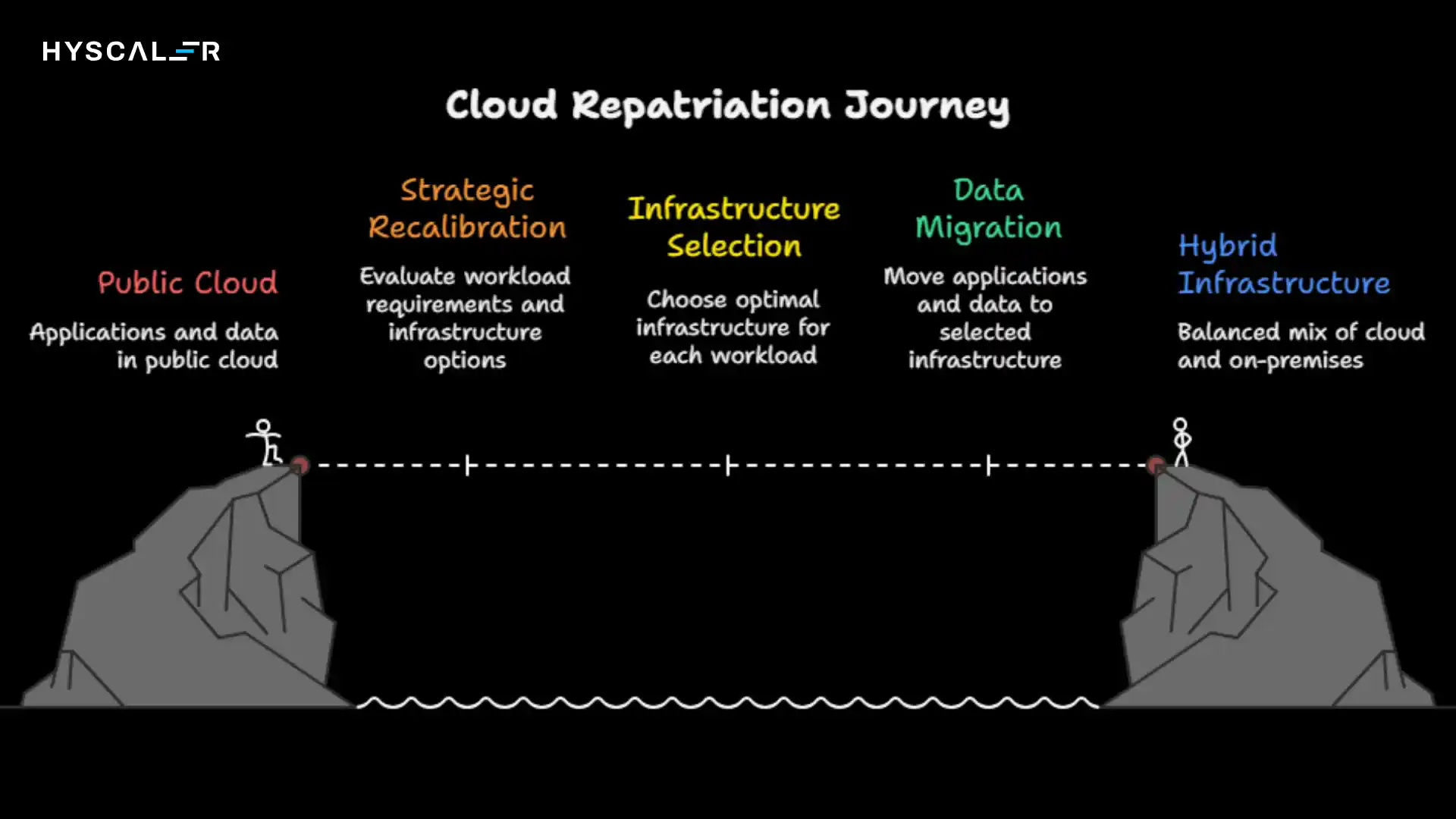
Cloud repatriation, also known as reverse cloud migration or data repatriation, is the process of moving applications, services, workloads, and data from public cloud environments back to alternative infrastructure.
This can include:
- On-premises data centers
- Private cloud environments
- Colocation facilities
- Hybrid cloud setups
- Bare metal server hosting
It’s important to note that cloud repatriation doesn’t represent a wholesale rejection of cloud computing.
Instead, it reflects a strategic recalibration where organizations are seeking the optimal balance between public cloud, private infrastructure, and hybrid solutions based on specific workload requirements.
The Evolution: From Cloud-First to Cloud-Appropriate
The COVID-19 pandemic accelerated cloud adoption at an unprecedented rate.
With the sudden need for remote work capabilities and distributed access, many organizations migrated to public cloud platforms, sometimes without adequate planning or consideration of long-term implications.
Now, with the benefit of experience and operational data, companies are adopting a “cloud-appropriate” strategy.
This approach involves evaluating each workload individually and placing it in the environment where it will perform best, cost least, and meet compliance requirements most effectively.
Why Cloud Repatriation is Gaining Momentum in 2026
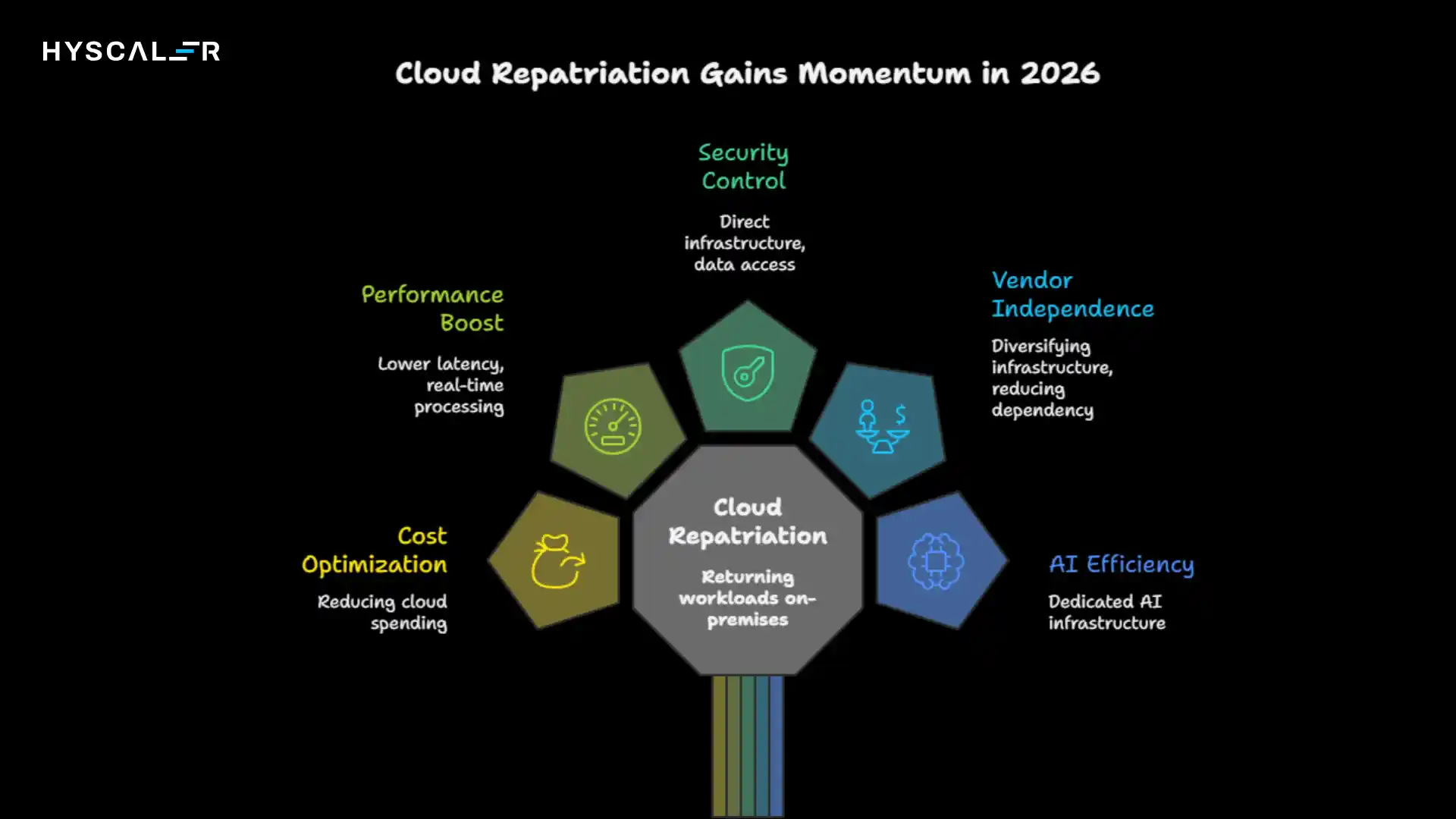
1. Cost Optimization and Budget Control
Cost remains the primary driver behind cloud repatriation decisions. According to recent surveys, 84% of organizations cite managing costs as their biggest cloud challenge.
What initially appeared as cost-effective pay-as-you-go pricing often evolves into a financial burden as usage scales.
The Cost Reality:
- Data egress fees can be substantial and unpredictable
- Continuous API calls and storage access charges accumulate rapidly
- For many organizations, public cloud has become the dominant part of infrastructure spend
- Approximately 27% of cloud infrastructure spending is wasted on underused resources, according to Flexera’s 2025 report (up from 32% in earlier years)
Organizations with predictable, steady workloads often find that owning infrastructure becomes more economical than renting it. For instance, 37signals estimates roughly $1.3–$1.5M in annual savings after repatriating from AWS, with the company citing approximately $7M in savings over five years.
2. Performance and Latency Requirements
Applications requiring real-time processing or low-latency responses, such as financial trading platforms, industrial automation systems, and high-frequency data processing, often perform better on dedicated infrastructure closer to end users.
Public cloud environments introduce latency when data must travel between cloud servers and end users or data sources.
For mission-critical applications where milliseconds matter, on-premises or edge computing solutions provide superior performance.
3. Security and Compliance Concerns
While public cloud providers offer robust security measures, certain industries face stringent regulatory requirements that make private infrastructure more attractive:
- Financial services dealing with sensitive transaction data
- Healthcare organizations managing protected health information
- Government entities with data sovereignty requirements
- Companies subject to GDPR, CCPA, or industry-specific regulations
Having direct control over physical infrastructure, security protocols, and data access provides peace of mind and simplifies compliance audits.
With 92% of IT leaders expressing confidence in on-premises cybersecurity compared to only 78% in fully cloud-based environments, the security advantage of repatriation is evident.
4. Avoiding Vendor Lock-in
Heavy reliance on a single cloud provider creates dependency risks. Proprietary services, specialized APIs, and platform-specific tools make it increasingly difficult and expensive to migrate to alternative providers or bring workloads back on-premises.
Repatriation allows organizations to:
- Diversify their infrastructure
- Reduce dependency on single vendors
- Maintain flexibility in strategic decisions
- Negotiate better terms with providers
5. The AI Revolution’s Impact
Perhaps the most significant 2025 driver of cloud repatriation is artificial intelligence. AI workloads have fundamentally challenged traditional cloud economics:
AI-Specific Challenges in Public Cloud:
- Massive computing power requirements (specialized GPUs)
- Continuous, predictable resource usage rather than elastic demand
- Expensive data storage and transfer for training datasets
- Quota limitations and throttling policies
- Need for fine-tuned hardware optimization
For organizations running AI workloads consistently, building dedicated AI infrastructure on-premises or in colocation facilities often proves more cost-effective than paying premium public cloud rates. Additionally, hosting AI models privately provides greater control over training data, proprietary algorithms, and intellectual property.
Cloud Repatriation Statistics: The Numbers Tell the Story
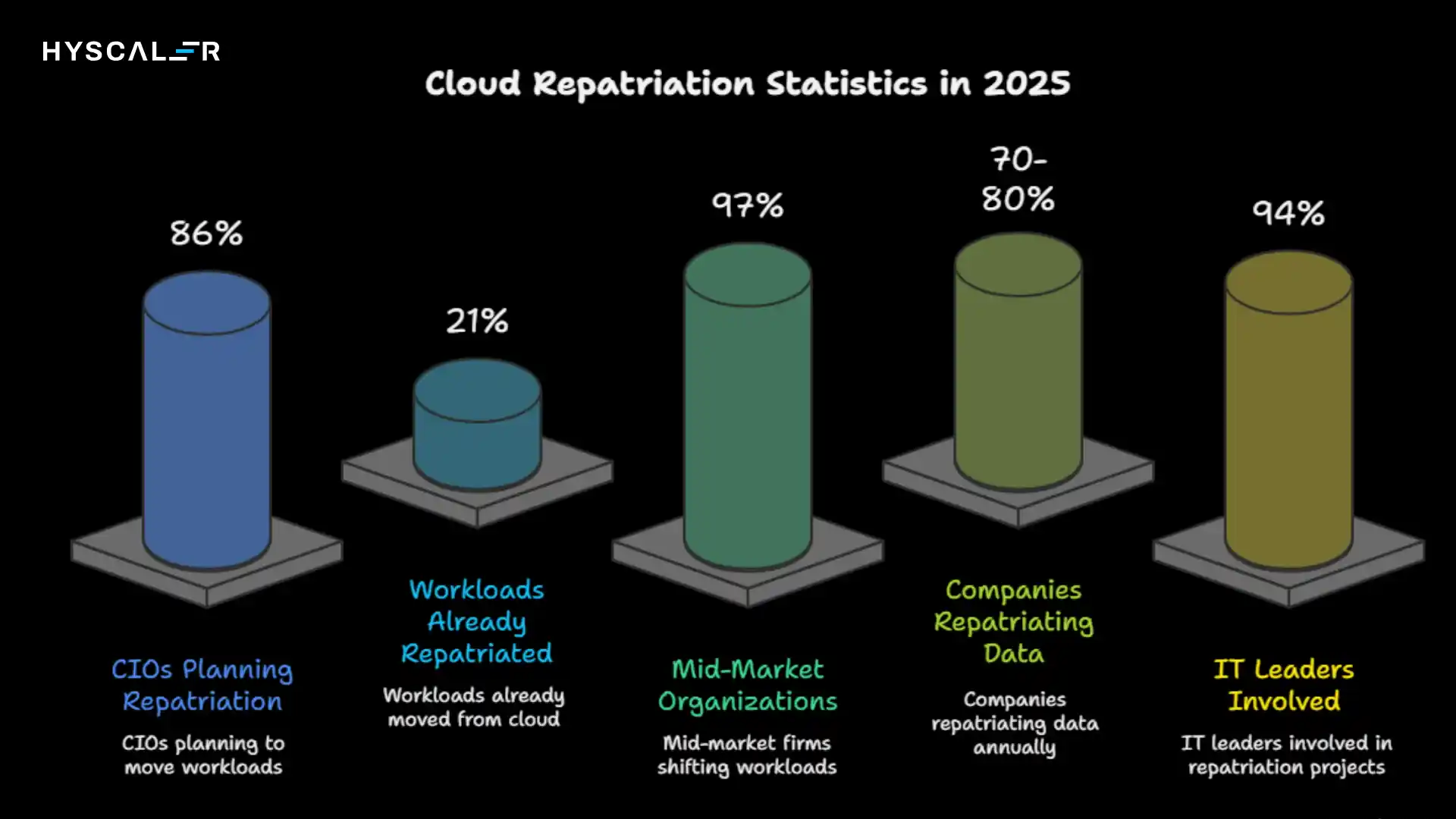
The trend toward repatriation is backed by compelling data:
- 86% of CIOs planned to repatriate some public cloud workloads in 2025 (Barclays CIO Survey)
- 21% of workloads and data have already been repatriated (Flexera 2025 State of the Cloud Report)
- 97% of mid-market organizations plan to shift select workloads away from public cloud environments
- 70-80% of companies are repatriating at least some data annually (IDC)
- 94% of IT leaders have been involved in cloud repatriation projects within the past three years
Importantly, public cloud spending continues to grow, with Gartner forecasting $723.4 billion in worldwide public cloud expenditure for 2025, up 21% from 2024.
This indicates that repatriation is strategic and selective rather than a mass exodus.
Real-World Cloud Repatriation Examples
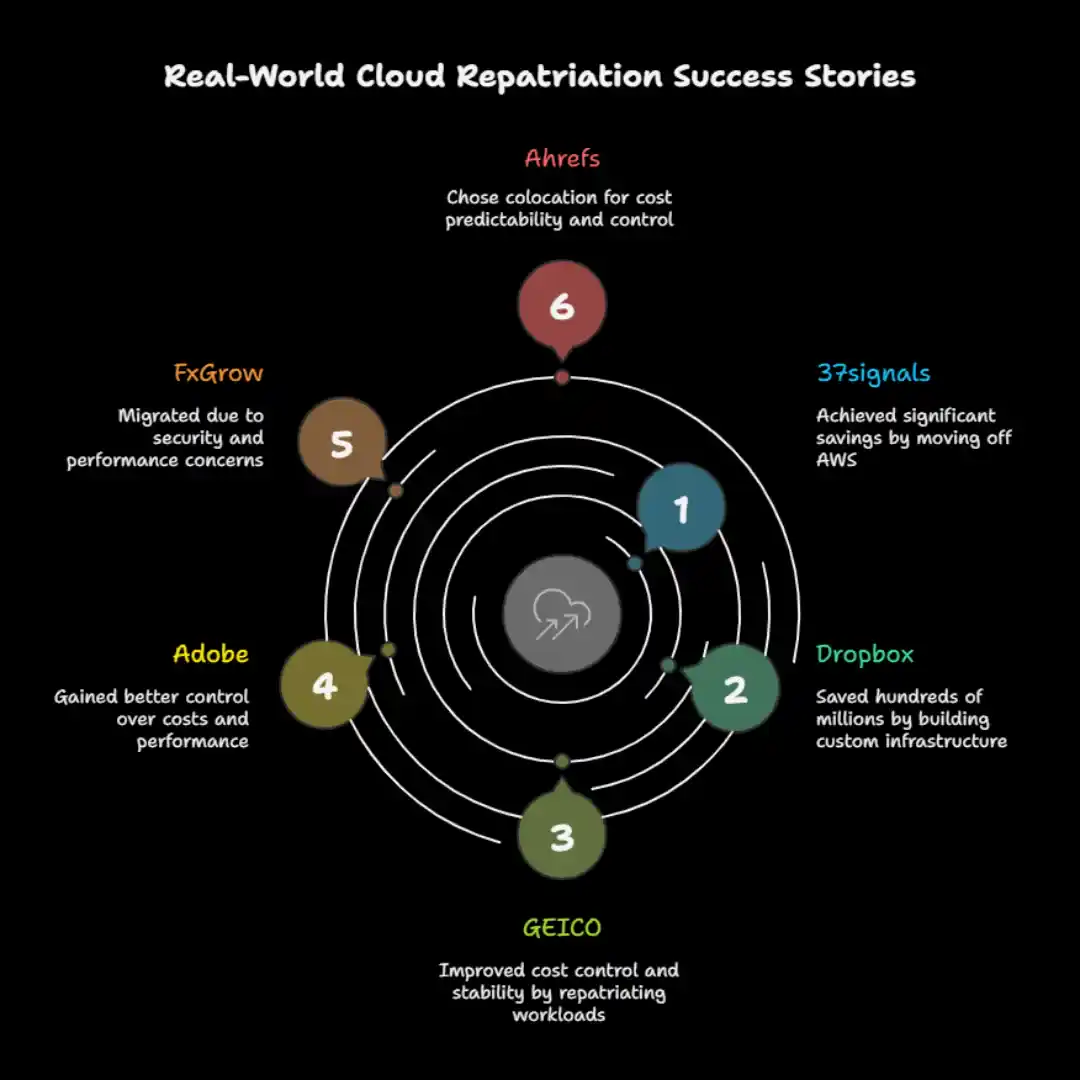
1. 37signals (Basecamp and HEY)
One of the most vocal advocates for cloud repatriation, 37signals moved its entire infrastructure off AWS in 2022. Initially projecting $7 million in savings over five years, they exceeded expectations with $2 million in annual savings, translating to approximately $10 million over five years. The company maintains that while cloud is ideal for startups, it becomes “grotesquely expensive” for established companies with predictable, heavy workloads.
2. Dropbox
An early pioneer of cloud repatriation, Dropbox saved 75 million dollars (In 2 Years) by building its own infrastructure after outgrowing public clouds. Between 2015-2016, they moved 90% of customer data off AWS to custom-built data centers, focusing on storage optimization where they had specific expertise. This strategic move significantly improved their unit economics.
3. GEICO
After spending a decade migrating over 600 applications to the public cloud, GEICO faced 2.5x higher costs along with reliability challenges and vendor lock-in. They’re now repatriating workloads to a private cloud powered by OpenStack and Kubernetes, prioritizing cost control and operational stability.
4. Adobe
Adobe performed a major cloud repatriation to gain better control over costs and performance for its creative suite services, demonstrating that even digital-native companies find value in hybrid approaches.
5. FxGrow
This online forex brokerage migrated its infrastructure away from hyperscale cloud primarily due to security, support, and performance concerns. They experienced frequent disconnections, server downtime, and even a security breach, prompting the move to more reliable infrastructure.
6. Ahrefs
The SEO tools company operates from a rented colocation center in Singapore with a centralized structure, choosing this approach for better control and cost predictability for its data-intensive operations.
Cloud Repatriation Trends in 2025
Trend 1: Selective Rather Than Complete Repatriation
Very few organizations are moving everything off the cloud. Instead, they’re identifying specific workloads that benefit from repatriation:
- Production databases with steady demand
- Backup and disaster recovery systems
- Compute-intensive AI/ML workloads
- Applications with strict compliance requirements
- Workloads with high data transfer volumes
Meanwhile, they retain public cloud for:
- Development and testing environments
- Elastic workloads with unpredictable demand
- Geographic expansion and global reach
- Rapid prototyping and innovation
- Services requiring global CDN distribution
Trend 2: Rise of Hybrid and Multicloud Strategies
The future of enterprise IT isn’t binary; it’s hybrid.
Organizations are building sophisticated architectures that leverage:
- Private cloud for mission-critical, performance-sensitive workloads
- Public cloud for elastic, variable-demand applications
- Edge computing for IoT and real-time processing
- Colocation for cost-effective dedicated infrastructure
This “cloud-plus” approach provides maximum flexibility while optimizing for cost, performance, and compliance across different workload types.
Trend 3: Sustainability and Carbon Footprint Tracking
Environmental considerations are increasingly influencing infrastructure decisions. In 2025, 57% of organizations either have or plan to implement sustainability initiatives that include tracking the carbon footprint of cloud usage. Among European respondents, 43% already track their cloud carbon footprint.
Repatriating workloads to more energy-efficient on-premises data centers or colocation facilities with renewable energy sources can reduce environmental impact while potentially lowering costs.
Trend 4: Data Sovereignty and Geopolitical Concerns
As geopolitical tensions rise and data protection regulations become increasingly stringent globally, organizations are becoming increasingly concerned about the physical location of their data. European regulations, such as GDPR and the Digital Operational Resilience Act (DORA), are driving companies to ensure that data remains within specific jurisdictions.
“Geo-repatriation” is emerging as a key consideration, particularly in regions like:
- Southeast Asia
- European Union
- Latin America
- Middle East
Companies want assurance that foreign governments cannot access their data without proper legal processes, making regional or local infrastructure more attractive.
Trend 5: AI-Driven Infrastructure Decisions
As AI becomes central to business strategy, infrastructure decisions increasingly revolve around AI requirements. Organizations are building dedicated AI infrastructure that includes:
- High-performance GPU clusters
- Custom networking for model training
- Optimized storage for massive datasets
- Low-latency processing pipelines
Public cloud quotas, throttling policies, and per-hour GPU costs make dedicated AI infrastructure economically attractive for sustained AI operations.
Challenges of Cloud Repatriation
While repatriation offers significant benefits, organizations must navigate several challenges:
1. Determining What to Repatriate
Not all workloads are suitable candidates for repatriation. Organizations must conduct rigorous cost-benefit analysis considering:
- Current and projected cloud costs vs. on-premises TCO
- Performance requirements and latency sensitivity
- Compliance and regulatory obligations
- Application architecture and dependencies
- Staffing and expertise requirements
2. Infrastructure Investment
Repatriation requires upfront capital expenditure for:
- Hardware acquisition (servers, storage, networking)
- Data center facilities or colocation space
- Power and cooling infrastructure
- Backup and disaster recovery systems
3. Staffing and Skills
Managing on-premises infrastructure demands different skills from cloud-native operations:
- Hardware maintenance expertise
- Network administration
- Physical security management
- Capacity planning and scaling
Organizations must ensure they have (or can acquire) the necessary talent.
4. Data Transfer Costs and Complexity
Moving data out of public cloud environments incurs:
- Data egress charges (though some providers like AWS offer free data out in certain scenarios)
- Network bandwidth costs
- Application downtime during migration
- Refactoring requirements for cloud-optimized applications
5. Maintaining Agility
One of cloud’s greatest advantages is rapid provisioning and scaling. Organizations must implement infrastructure-as-code, automation, and modern DevOps practices to maintain agility after repatriation.
Repatriation Strategies: The 7Rs Framework
Similar to cloud migration strategies, organizations can employ different approaches for repatriation:
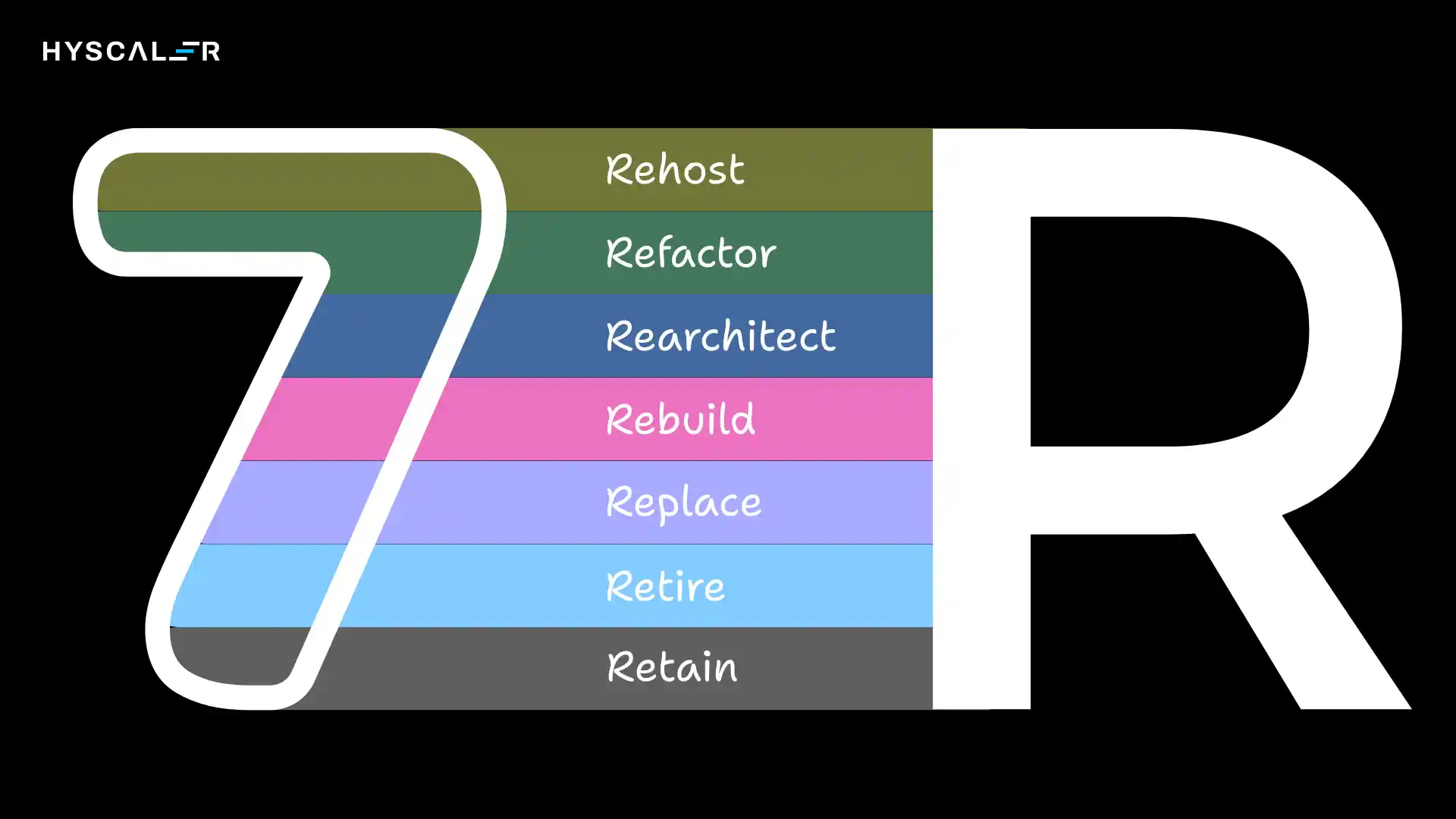
1. Rehost (Lift and Shift)
Move workloads as-is without architectural changes. Suitable for applications that don’t require cloud-specific services.
2. Refactor
Modify applications to work optimally in the new environment, potentially removing cloud dependencies and optimizing for on-premises performance.
3. Rearchitect
Redesign applications to take full advantage of on-premises capabilities, potentially adopting microservices architectures with Kubernetes.
4. Rebuild
Create new applications from scratch for the target environment, discarding legacy cloud implementations.
5. Replace
Substitute cloud-native applications with on-premises or commercial off-the-shelf alternatives.
6. Retire
Eliminate redundant or unnecessary applications during the repatriation process.
7. Retain
Keep certain workloads in the cloud where they continue to provide optimal value.
Planning Your Cloud Repatriation Journey
If you’re considering cloud repatriation, follow these strategic steps:
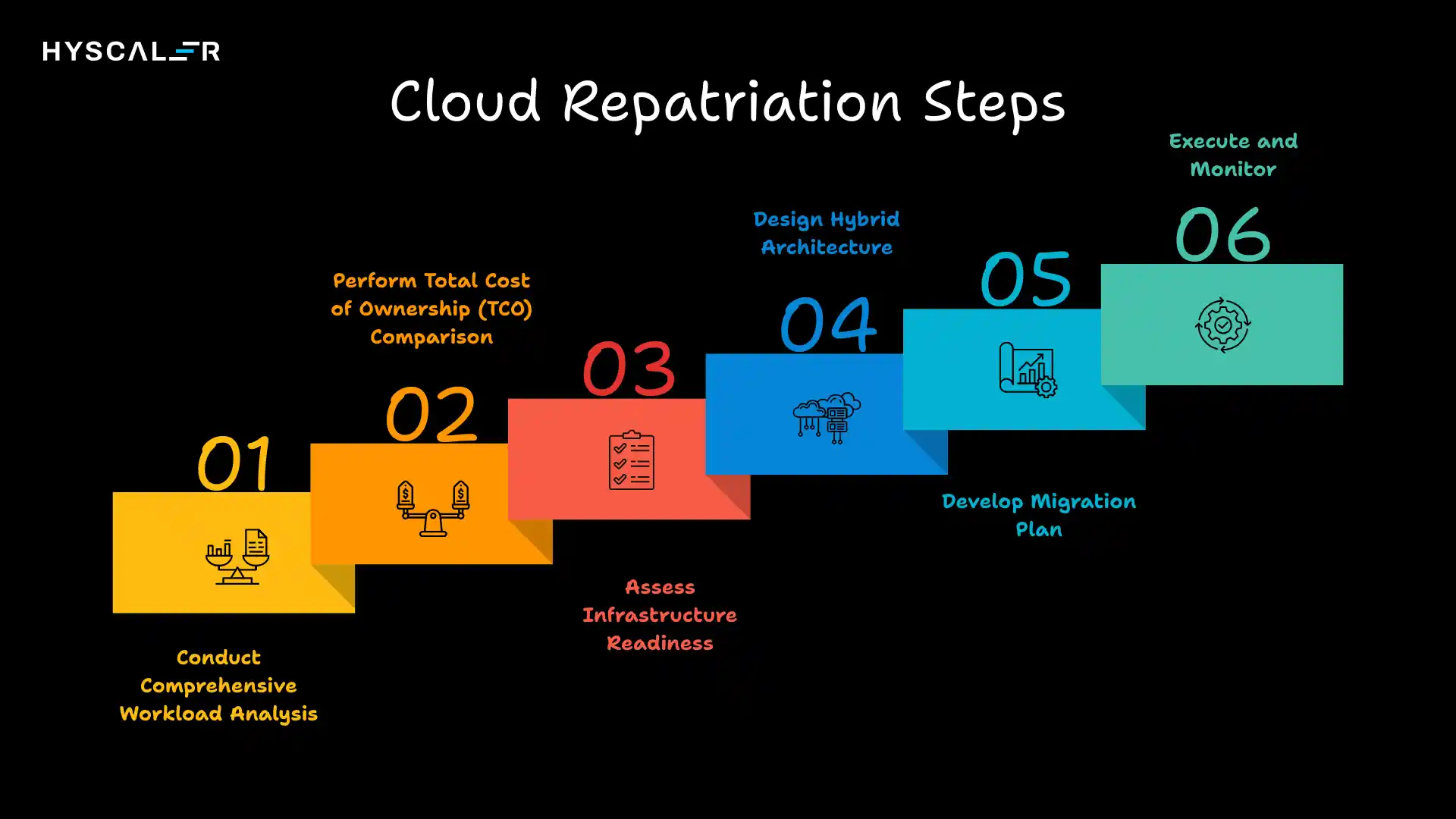
Step 1: Conduct Comprehensive Workload Analysis
- Map all current cloud workloads and their dependencies
- Document performance metrics, costs, and compliance requirements
- Identify candidates based on predictable demand, cost efficiency, and regulatory needs
Step 2: Perform Total Cost of Ownership (TCO) Comparison
Calculate both cloud and on-premises costs, including:
- Compute, storage, and network expenses
- Data transfer fees
- Management and operational overhead
- Hardware depreciation and refresh cycles
- Power, cooling, and facility costs
Step 3: Assess Infrastructure Readiness
- Evaluate existing data center capacity
- Determine hardware and software requirements
- Identify gaps in staffing and expertise
- Plan for backup, disaster recovery, and business continuity
Step 4: Design Hybrid Architecture
- Define which workloads stay in the cloud vs. move on-premises
- Establish connectivity between environments
- Implement security and access controls
- Plan for workload portability and avoid new lock-in
Step 5: Develop Migration Plan
- Prioritize workloads by risk and value
- Create detailed migration runbooks
- Plan for testing and validation
- Define rollback procedures
Step 6: Execute and Monitor
- Migrate in phases to minimize risk
- Monitor performance and costs closely
- Optimize configurations based on real-world data
- Document lessons learned for future migrations
Technology Stack Considerations
When repatriating workloads, organizations need to identify on-premises equivalents for cloud services:
| Cloud Service Type | Public Cloud Examples | On-Premises Alternatives |
| Compute | EC2, Azure VMs, GCE | VMware, KVM, Hyper-V, OpenStack |
| Containers | EKS, AKS, GKE | Kubernetes, OpenShift, Rancher |
| Object Storage | S3, Azure Blob, GCS | MinIO, Ceph, Swift |
| Databases | RDS, CosmosDB, Cloud SQL | PostgreSQL, MySQL, MongoDB, Cassandra |
| Message Queues | SQS, Service Bus, Pub/Sub | RabbitMQ, Apache Kafka, ActiveMQ |
| Monitoring | CloudWatch, Azure Monitor | Prometheus, Grafana, ELK Stack |
| Load Balancing | ELB, Azure LB | HAProxy, NGINX, Traefik |
| CI/CD | CodePipeline, Azure DevOps | Jenkins, GitLab, ArgoCD |
Choosing open-source, portable solutions helps avoid creating new vendor lock-in scenarios.
The Future: Beyond the Binary Choice
Cloud repatriation doesn’t signal the end of cloud computing.
It represents evolution toward more sophisticated, nuanced infrastructure strategies. The future belongs to organizations that can:
- Assess workloads objectively without cloud-first or on-premises-first bias
- Leverage multiple deployment models based on specific requirements
- Maintain workload portability through containerization and infrastructure-as-code
- Continuously optimize placement as business needs and economics change
- Balance cost, performance, security, and compliance across hybrid environments
The most successful organizations will be those that view infrastructure not as a destination but as a strategic tool, one that can be adapted, reconfigured, and optimized continuously to deliver business value.
Choosing the Right Deployment Model
The best deployment model depends on several factors:
- Cost sensitivity: Public cloud for variable costs; private for predictable, high-volume usage
- Compliance requirements: Private or hybrid for strict regulations
- Workload characteristics: Public for elastic demand; private for steady-state
- Performance needs: Private for low-latency, high-performance requirements
- Organizational maturity: Public for quick start; hybrid/private for sophisticated needs
- Scale and growth: Public for rapid expansion; private for controlled growth
Many successful organizations today employ multiple models simultaneously, strategically placing workloads where they perform best and cost least, the essence of a truly optimized cloud strategy.
Cloud Repatriation and Infrastructure Trends to Watch in 2026
As we look ahead to 2026, several emerging trends will further reshape the cloud repatriation landscape and broader enterprise infrastructure strategies.
These trends reflect the continued maturation of cloud computing, the explosive impact of AI, and growing geopolitical considerations.
1. Mass Adoption of Hybrid-First Architecture
The yes or no choice between cloud and on-premises is officially dead.
In 2026, hybrid architecture will become the default standard, with Gartner predicting that 40% of enterprises will adopt hybrid compute architectures in mission-critical workflows, up from just 8% previously.
This isn’t just about having both cloud and on-premises infrastructure.
It’s about seamless orchestration between them.
Key Developments:
- Unified management platforms spanning cloud, edge, and on-premises environments
- Container-based workload portability using Kubernetes across all infrastructure types
- Infrastructure-as-Code is becoming mandatory for managing hybrid complexity.
- Cross-environment security and compliance automation
- Intelligent workload placement based on real-time cost, performance, and regulatory factors
Organizations will increasingly view infrastructure as a fluid resource pool where workloads can move dynamically based on changing business needs, regulatory requirements, and cost optimization opportunities.
2. The Rise of “Neoclouds” and Alternative Cloud Providers
The hyperscaler dominance of AWS, Azure, and Google Cloud faces unprecedented challenges from emerging “neocloud” providers offering AI-native infrastructure, specialized regional services, and transparent pricing models.
These new entrants are specifically designed to address the pain points driving cloud repatriation.
What Makes Neoclouds Different:
- AI-first architecture optimized for GPU workloads and model training
- Transparent, predictable pricing without hidden egress fees
- Specialized services for specific industries or regulatory environments
- Regional data sovereignty built in from day one
- More flexible terms and reduced vendor lock-in
Forrester predicts these new cloud players will capture significant market share as enterprises diversify their infrastructure to reduce dependence on hyperscalers and gain negotiating leverage.
3. Major Cloud Outages Will Accelerate Diversification
2026 will likely witness at least two major multi-day cloud outages from hyperscale providers.
The increasing complexity of cloud infrastructure, combined with aggressive AI infrastructure buildouts, creates fragility that traditional operational approaches struggle to manage.
Expected Fallout:
- Enterprises will demand infrastructure renovations from cloud providers to mitigate operational risk.
- Board-level discussions about cloud resilience and business continuity
- Increased investment in multi-cloud and hybrid strategies for redundancy
- Service-level agreement renegotiations with stricter penalties
- Greater emphasis on disaster recovery and failover capabilities
These outages won’t cause mass cloud exodus but will fundamentally change how enterprises architect for resilience, making selective repatriation a risk management strategy rather than just a cost optimization tactic.
4. Private AI Deployments Surge
Perhaps the most significant 2026 trend is the explosive growth of private AI infrastructure.
Forrester predicts that at least 15% of enterprises will shift toward private AI deployments built atop private clouds in response to rising AI costs, data lock-in concerns, and operational risks in public clouds.
Why Private AI Makes Sense:
- Cost Control: Predictable, flat-rate infrastructure costs versus volatile public cloud GPU pricing
- Data Sovereignty: Training proprietary AI models on sensitive company data without external exposure
- Intellectual Property Protection: Keeping algorithms, training methodologies, and model architectures completely private
- Performance Optimization: Hardware specifically tuned for the organization’s AI workload characteristics
- Regulatory Compliance: Meeting strict data residency and processing requirements for AI applications
Organizations will build dedicated AI infrastructure featuring high-density GPU clusters, optimized networking for distributed training, and specialized storage architectures.
Colocation providers and private cloud platforms are already seeing massive demand for AI-specific infrastructure packages.
5. Digital Sovereignty and Geo-Repatriation Intensify
Geopolitical tensions and regulatory evolution will drive “geo-repatriation”, moving data back to specific geographic regions or countries.
The EU’s Digital Operational Resilience Act (DORA), effective January 2025, requires financial institutions to demonstrate operational resilience and maintain control over critical services.
Regional Hotspots for Geo-Repatriation:
- European Union: GDPR enforcement tightening, DORA requirements for financial services, concerns about the U.S. CLOUD Act
- Southeast Asia: Data localization laws in Singapore, Indonesia, and Vietnam are driving regional infrastructure
- Middle East: Government mandates for local data storage and processing
- Latin America: Growing data sovereignty regulations in Brazil, Mexico, and Argentina
- United Kingdom: Post-Brexit data regulations requiring demonstrated control and exit strategies
The sovereign cloud market is projected to reach $630.93 billion by 2033, growing at a 23.22% CAGR.
Organizations operating globally will maintain data presence in multiple jurisdictions to satisfy local regulations while managing the complexity this creates.
6. Trusted Execution Environments Enable Secure Multicloud
Trusted Execution Environment (TEE) technologies will transition from concept to game-changing implementation in 2026.
TEE creates segregated, encrypted areas of memory and CPU isolated from the rest of the system, enabling secure computation across untrusted environments.
What This Enables:
- Decentralized Compute: Safely splitting workloads across multiple clouds, regional providers, and on-premises infrastructure
- Confidential Computing: Processing sensitive data in a public cloud without exposing it to the cloud provider
- Multi-Provider Architectures: Running compute wherever it’s most advantageous without security compromises
- Reduced Lock-in Risk: True workload portability between providers with maintained security posture
This technology breakthrough removes one of the biggest barriers to multi-cloud adoption, the security concerns of distributing sensitive workloads across multiple vendors and environments.
7. Quantum Computing as a Cloud Service Matures
While still emerging, quantum computing will see significant advancement in cloud accessibility during 2026.
AWS Braket, Azure Quantum, and Google Quantum AI are expanding quantum hardware access and hybrid classical-quantum workflows.
2026 Quantum Developments:
- More accessible quantum computing services for enterprise experimentation
- Practical applications in pharmaceuticals, logistics, financial modeling, and cryptography
- Hybrid quantum-classical algorithms are becoming production-ready for specific use cases
- Increased investment in quantum-resistant cryptography as the quantum threat becomes tangible
Organizations will begin strategic planning for quantum computing integration while also addressing quantum security threats to existing encryption methods.
8. Sustainability Becomes Infrastructure Selection Criteria
Environmental impact will significantly influence infrastructure decisions in 2026. With data center power demand potentially increasing 300% from 2022 levels, sustainability moves from a corporate responsibility talking point to a strategic imperative.
Green Infrastructure Trends:
- GreenOps: Optimizing workload placement based on renewable energy availability and carbon intensity
- Energy-Efficient Repatriation: Moving workloads to more energy-efficient on-premises or colocation facilities
- Provider Selection Based on ESG: Choosing cloud and colocation providers based on environmental commitments
- Carbon Footprint Tracking: 43% of European organizations already track cloud carbon footprint; this will become standard practice
- Liquid Cooling and Advanced Technologies: Adoption of next-generation cooling for AI infrastructure
Organizations will increasingly evaluate total environmental impact across their infrastructure portfolio, sometimes finding that repatriation to modern, efficient data centers reduces carbon footprint compared to older hyperscaler facilities.
9. Budget Reallocation from Cloud Sprawl to AI Innovation
CFOs and CIOs will face mounting pressure to fund AI initiatives while controlling total IT spending.
This creates strong motivation to eliminate cloud waste and repatriate predictable workloads to free up budget for AI experimentation and deployment.
The Budget Shift:
- Cloud optimization initiatives targeting 20-30% cost reductions
- Repatriation of stable workloads to fund AI infrastructure investments
- FinOps practices are becoming mandatory across organizations
- Strict governance around new cloud resource provisioning
- Business case requirements for cloud spending, demonstrating clear ROI
Expect widespread cloud optimization projects in early 2026 as organizations prepare annual budgets and seek funding sources for AI initiatives without increasing total IT spending.
10. Automation and AIOps Become Infrastructure Standard
Managing increasingly complex hybrid, multi-cloud, and repatriated infrastructure requires advanced automation.
AI-powered operations (AIOps) will become standard practice for scaling modern cloud systems.
AIOps Capabilities in 2026:
- Predictive Maintenance: AI identifying potential failures before they occur, reducing downtime by up to 40%
- Automated Optimization: Dynamic resource allocation based on ML-driven predictions
- Intelligent Cost Management: AI recommending workload placement for optimal cost-performance balance
- Security Threat Detection: ML-powered anomaly detection and automated response
- Self-Healing Systems: Automated remediation of common infrastructure issues
Organizations managing repatriated infrastructure alongside cloud resources will particularly benefit from AIOps, as the tooling provides unified visibility and management across diverse environments.
11. Edge Computing Proliferation Drives Decentralization
Edge computing will explode in 2026, with network edge data centers projected to grow from 250 to nearly 1,200.
This represents a fundamental shift toward processing data where it’s created rather than transmitting it to centralized cloud regions.
Edge Use Cases Driving Growth:
- AI Inference: Running trained models at the edge for real-time decisions
- IoT and Industrial Applications: Processing sensor data locally to reduce latency
- 5G-Enabled Services: Supporting low-latency mobile applications
- Autonomous Systems: Self-driving vehicles, robotics, and drone operations
- Smart Cities: Traffic management, public safety, and infrastructure monitoring
Edge computing creates a third infrastructure tier alongside cloud and on-premises, further complicating, but also optimizing, workload placement strategies.
Many edge deployments will be managed through hybrid cloud platforms that seamlessly extend to edge locations.
12. Platform Engineering and Internal Developer Platforms
Organizations will invest heavily in platform engineering to enable self-service infrastructure consumption while maintaining security, compliance, and cost controls.
Internal Developer Platforms (IDPs) will become standard for managing complex hybrid and multi-cloud environments.
Platform Engineering Benefits:
- Self-Service Capabilities: Developers provisioning infrastructure without waiting for IT
- Standardized Patterns: Gold-standard configurations ensuring consistency and compliance
- Automated Guardrails: Policy enforcement, preventing security vulnerabilities, and cost overruns
- Unified Experience: Consistent developer experience across cloud, on-premises, and edge
- Faster Time-to-Market: Reducing infrastructure provisioning from weeks to minutes
This trend directly supports organizations managing repatriated workloads alongside cloud resources by providing unified interfaces and standardized deployment patterns regardless of underlying infrastructure.
13. WebAssembly System Interface (WASI) Cloud Adoption
Cloud platforms will increasingly adopt WebAssembly System Interface (WASI) to enable high-performance, portable applications.
This technology provides more modular development that overcomes the limitations of traditional microservices and serverless approaches.
WASI Advantages:
- True Portability: Run once, deploy anywhere, cloud, edge, or on-premises
- Enhanced Security: Sandboxed execution with fine-grained permissions
- Improved Performance: Near-native execution speeds
- Smaller Footprint: Reduced resource consumption compared to containers
- Language Agnostic: Support for multiple programming languages
WASI could become a game-changer for organizations pursuing hybrid and multi-cloud strategies, as it enables genuine “write once, run anywhere” capabilities without vendor-specific dependencies.
The 2026 Reality: Precision Over Ideology
The trends shaping 2026 point to a future where infrastructure decisions are made with surgical precision rather than broad mandates.
The “cloud everywhere” ideology gives way to sophisticated analysis of where each workload performs best, costs least, and meets regulatory requirements most effectively.
Organizations succeeding in 2026 will be those that:
- Embrace complexity while implementing tools and processes to manage it effectively
- Maintain flexibility to shift strategies as technologies, costs, and regulations evolve
- Invest in expertise spanning cloud, on-premises, edge, and emerging technologies
- Adopt automation to manage hybrid environments at scale
- Think strategically about infrastructure as a competitive advantage rather than a commodity
The acceleration of cloud repatriation alongside continued cloud growth creates a paradox that defines modern enterprise IT: more resources in the cloud than ever before, yet also more workloads returning to private infrastructure.
This apparent contradiction reflects maturity, the recognition that different workloads have different optimal homes, and that home can change as circumstances evolve.
Conclusion: The Balanced Future of Enterprise IT
Cloud repatriation represents a coming-of-age moment for enterprise IT strategy.
After a decade of cloud-first mandates, organizations are now mature enough to make nuanced, workload-specific decisions based on data rather than ideology.
The future isn’t about cloud versus on-premises.
It’s about the intelligent, strategic placement of workloads across a spectrum of deployment options.
Organizations that succeed will be those that:
- Evaluate workloads objectively based on cost, performance, and compliance
- Maintain architectural flexibility and avoid lock-in
- Continuously optimize placement as requirements evolve
- Leverage public cloud for what it does best while repatriating what fits better elsewhere
- Build hybrid capabilities that provide genuine optionality
As we progress through 2026, expect cloud repatriation to continue growing, not as a rejection of cloud computing, but as a refinement of when, where, and how cloud is most effectively deployed.
The winners in this new era will be those organizations that master the art of strategic workload placement across the full spectrum of infrastructure options.
FAQ
Will Cloud Repatriation Pick Up Pace in 2026?
Cloud repatriation will accelerate through 2026, but as a sign of cloud maturity, not abandonment.
Organizations are selectively moving workloads back for AI economics, cost control, compliance, and sustainability, while public cloud spending continues to grow.
The future is balanced hybrid and multicloud architectures, where each workload runs where it delivers the most value.
What is repatriation in cloud computing?
Cloud repatriation is the selective move of workloads from public cloud platforms like AWS, Azure, or Google Cloud back to on-prem, private cloud, or hybrid environments.
It’s a strategic optimization, driven by cost, performance, compliance, or business needs, not a full cloud exit.
Is cloud repatriation happening?
Cloud repatriation is now a mainstream 2025 reality, driven by optimization, not cloud rejection.
Surveys show 86% of CIOs planning workload shifts, with many having already moved back on-prem or to private cloud.
Companies like 37signals, Dropbox, GEICO, and Adobe have proven the business case.
Even Amazon Web Services acknowledges it, repatriation is about right-fit workload placement, alongside continued cloud growth.
What are the 4 types of cloud deployment?
1. Public Cloud
2. Private Cloud
3. Hybrid Cloud
4. Community Cloud / Multicloud
What is a colocation facility?
A data center that rents out its space for your hardware is known as a colocation facility or colocation data center.