Table of Contents
Cloud-native application development has fundamentally reshaped how modern software is built, deployed, and scaled. As organisations accelerate their shift to the cloud, the complexity of managing cloud-native application development at scale has grown exponentially.
“In 2024, Gartner predicted that by 2026, more than 80% of large software engineering organizations will establish platform engineering teams. ” That forecast is already coming true.
Across the globe, engineering leaders are moving beyond ad-hoc DevOps practices and investing in dedicated Internal Developer Platforms (IDPs), curated self-service environments that let developers ship software:
- Faster: streamlined workflows with less manual overhead
- Safer: built-in guardrails, governance, and compliance
- At scale: consistent tooling across teams and environments
This article unpacks why platform engineering has become the new backbone of cloud-native application development and what it means for modern software teams.
What Is Platform Engineering?
Platform engineering is the practice of building and maintaining the “golden path”, a curated, self-service infrastructure layer that lets developers focus on cloud-native application development without managing the underlying complexity themselves.
Two terms, one clear distinction:
| Cloud Native | Platform Engineering | |
| What it is | Ecosystem of principles & technologies | A role and practice within that ecosystem |
| Covers | Microservices, containers, dynamic orchestration | Building & maintaining the cloud-native infrastructure |
| Who it serves | The entire software architecture | Application developers, so they never worry about infra |
If cloud-native is the city, platform engineering is the road system that makes it navigable.
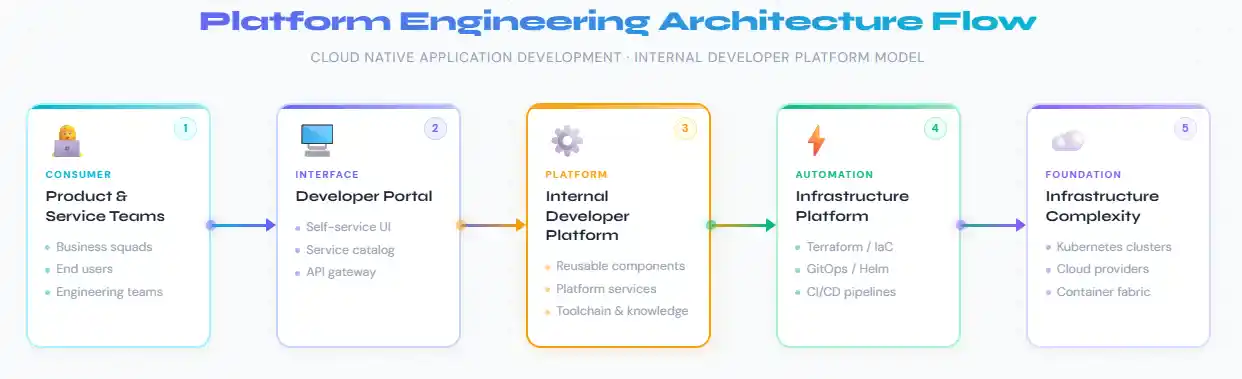
The platform team acts as an internal product team; their customers are other engineers. Their product is the Internal Developer Platform (IDP): Kubernetes-based container orchestration, automated CI/CD pipelines, observability tooling, and policy guardrails, all behind a developer-friendly interface. Organisations that invest in cloud-native technologies without investing in platform engineering end up with powerful infrastructure that slows developers down rather than accelerating them.
Why Cloud-Native Application Development Demands a New Approach
Cloud-native application development built on microservices, containers, dynamic orchestration, and declarative APIs has fundamentally changed how software is architected and delivered. While microservices architecture offers agility and scalability, it also introduces serious operational complexity that traditional DevOps practices simply cannot handle at speed:
- Hundreds of services mean hundreds of deployment pipelines to manage.
- Kubernetes is powerful, but its learning curve is steep without abstraction layers.
- Cloud-native infrastructure automation requires deep expertise in Terraform, Helm, and GitOps tooling.
- Security, compliance, and cost governance must be enforced consistently across every service.
- Developer experience deteriorates when engineers spend more time fighting infrastructure than building features.
Without a dedicated platform, cloud-native application development becomes a bottleneck rather than a competitive advantage. Platform engineering solves this by abstracting infrastructure concerns away from application developers while still giving them the freedom and speed they need to excel in cloud-native application development.
The Core Pillars of a Modern IDP
A well-designed Internal Developer Platform built for cloud-native application development typically rests on five key pillars. Each one addresses a real pain point, from cloud infrastructure provisioning to cloud-native app deployment:
| Pillar | What It Delivers |
| Container Orchestration | Kubernetes-based deployment, scaling, and self-healing for every microservice. |
| CI/CD Pipeline Automation | Cloud-native CI/CD pipelines (GitLab CI, GitHub Actions, and Tekton) that enforce quality gates automatically. |
| Infrastructure Automation | Terraform, Pulumi, and Crossplane enable teams to provision cloud resources declaratively. |
| Developer Self-Service | Portals like Backstage allow developers to spin up environments, view service catalogs, and trigger deployments without Ops tickets. |
| Observability | Unified logging, metrics, and tracing (Prometheus, Grafana, and OpenTelemetry) give instant visibility across the entire microservices landscape. |
Each pillar is designed to remove a specific layer of friction from cloud-native application development, allowing engineering teams to focus entirely on writing and shipping great software. Together, they form the operational backbone every cloud-native application development team needs to scale without burning out.
Platform Engineering vs. Traditional DevOps
DevOps was a cultural revolution. Platform engineering is its operational maturity, and the gap becomes most visible as cloud-native application development scales.
| Dimension | 🔴 Traditional DevOps | 🟢 Platform Engineering |
|---|---|---|
| CI/CD | Each team builds its own pipelines from scratch | The central platform team owns shared tooling |
| Cloud Infrastructure | Provisioned manually, team by team | Declarative, version-controlled, reproducible |
| Security | Enforced inconsistently across services | Built in by default at every stage |
| Developer Time | Split between features and fighting infra | 100% focused on building features |
| Scalability | Toil multiplies as teams grow | Golden path scales without repeated effort |
| Ownership | Every team owns everything | Central platform team owns shared tooling |
For organisations serious about cloud-native application development, this shift to centralised platform ownership is the single biggest productivity unlock available today.
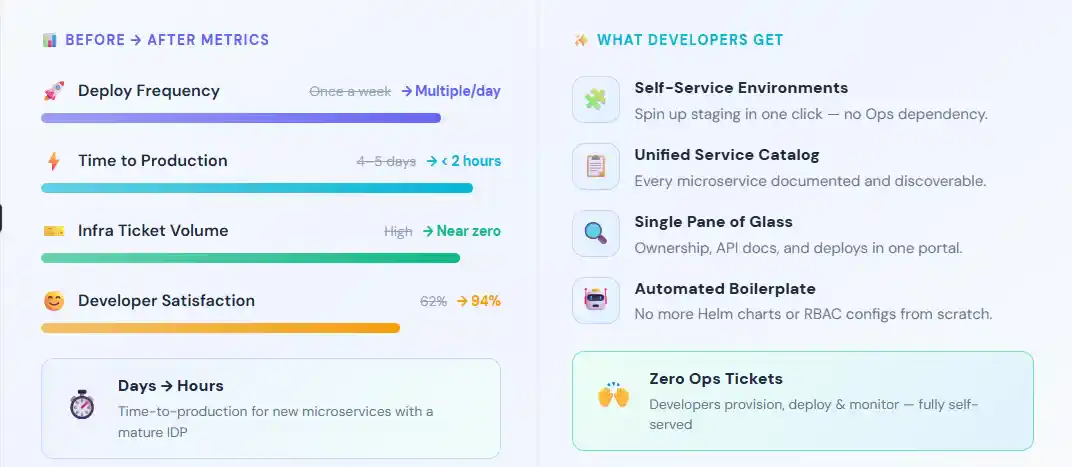
Improving Developer Experience at Scale
Real-World Impact: Who Is Doing This Well?
Some of the most successful cloud-native application development teams in the world have pioneered platform engineering at scale:
- Spotify created Backstage, now a CNCF-incubated project, to manage thousands of microservices across hundreds of teams engaged in cloud-native application development.
- Netflix built a sophisticated Internal Developer Platform that abstracts the complexity of deploying to its global cloud infrastructure, enabling its engineers to focus entirely on cloud-native application development and product innovation.
- Airbnb, LinkedIn, and Uber all have dedicated platform engineering teams that support thousands of engineers without adding operational friction to their cloud-native application development workflows.
The common thread?
These companies treat the developer platform as a product with a roadmap, user research, and dedicated engineering resources.
They measure success not by infrastructure uptime but by developer satisfaction and deployment frequency, the two metrics that matter most in cloud-native application development.
Getting Started: Building Your Platform Engineering Practice
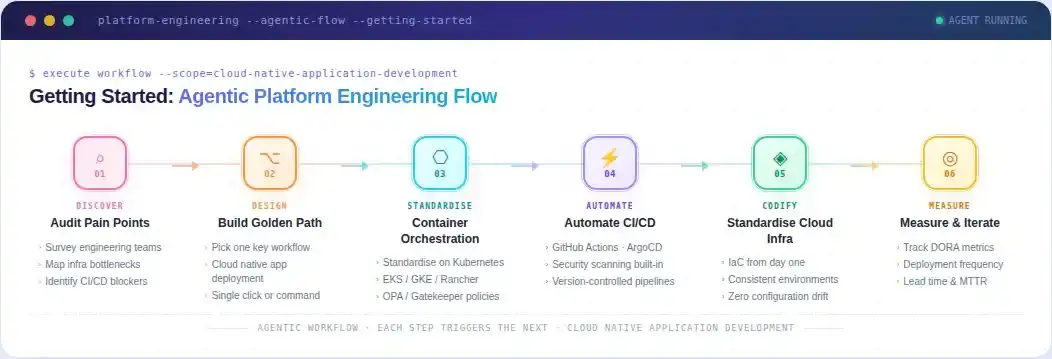
Platform engineering is not an overnight transformation. Here is a pragmatic starting point for any team investing in cloud-native application development:
- Audit developer pain points: Survey your engineering teams. Where do they lose the most time? Common answers: environment provisioning, CI/CD configuration, and Kubernetes debugging.
- Start small with a golden path: Pick one common workflow, say, cloud-native app deployment of a new microservice, and build an opinionated, automated version of it. Reduce it to a single command or portal click.
- Adopt container orchestration standards: Standardise on Kubernetes. Invest in cluster management tooling (Rancher, EKS, GKE) and enforce policies with tools like OPA/Gatekeeper.
- Automate your CI/CD pipeline: A cloud-native CI/CD pipeline should be version-controlled, reproducible, and integrated with security scanning. This is non-negotiable for any serious cloud-native application development practice. Tools like GitHub Actions, ArgoCD, and Flux are popular choices.
- Standardise cloud infrastructure: Define your cloud infrastructure as code from day one. Consistent cloud infrastructure across environments eliminates the “works on my machine” problem and ensures every cloud-native app deployment is reproducible.
- Measure and iterate: Track DORA metrics, deployment frequency, lead time for changes, change failure rate, and mean time to recovery. Let data drive your platform roadmap.
Conclusion
The rise of platform engineering represents the next evolutionary step in cloud-native application development. As microservices architectures grow more complex and the demands on engineering teams intensify, the organisations that invest in robust Internal Developer Platforms will have a decisive competitive advantage. A unified cloud-native DevOps pipeline, consistent cloud-native infrastructure automation, and a self-service IDP are no longer optional; they are the baseline for engineering teams that want to compete. They will ship faster, fail less often, and attract better engineering talent, because great engineers want to build products, not fight infrastructure.
“Platform engineering is not just a trend; it is the foundation of sustainable, scalable cloud-native application development. The question is no longer whether your organisation needs it. “
The question is how quickly you can build it.
FAQs
What is cloud-native application development?
It is an approach to building and running apps using microservices, containers, CI/CD pipelines, and dynamic cloud infrastructure for speed and scale.
What is platform engineering, and why does it matter?
It is the practice of building self-service infrastructure tools so developers can ship software faster without managing complex cloud systems themselves.
What is an Internal Developer Platform (IDP)?
An IDP is a self-service layer built by platform teams that gives developers one-click access to environments, pipelines, and deployment workflows.
What is container orchestration in cloud-native development?
It is the automated management of containerised services handling deployment, scaling, and self-healing primarily through Kubernetes.
How does a CI/CD pipeline work in cloud-native application development?
It automatically builds, tests, scans, and deploys code every time a developer pushes a change, reducing manual effort and human error.
How does platform engineering improve developer experience?
It eliminates repetitive infrastructure tasks, giving developers self-service access to environments and pipelines so they focus entirely on building features.