Table of Contents
Blockchain fundamentally changes Intellectual Property management for creators, enterprises, and legal teams. It strengthens innovation protection. However, many organizations explore this technology but fail to achieve results. They misunderstand where blockchain offers true value and where it lacks. To guide this shift, we assembled a comprehensive resource. This guide covers real costs, landmark litigation, a decision framework, and a jurisdiction-specific legal analysis. Read this guide. Discover how blockchain transitions from a textbook definition to operational IP infrastructure in 2026.
In March 2025, a French court set a landmark precedent. In the case of AZ Factory vs. Valeria Moda, the Tribunal Judiciaire of Marseille accepted blockchain timestamps as conclusive legal proof of prior design ownership. A fashion house had logged its designs on a blockchain platform called BlockchainYourIP. Within seconds, a sealed digital record was created. Months later, that record won the copyright case, without the court requiring any traditional intermediaries to verify the evidence.
This is not a theory. It is a concrete legal outcome that signals a global shift most IP professionals are not yet prepared for.
The business case demands attention. Blockchain IP registries slash filing times by over 60%. They cut administrative costs by about 35%. They also decrease IP disputes by roughly 45%. Despite these powerful advantages, most content on “blockchain and intellectual property” only defines the technology and lists common benefits. This guide answers the practical questions that those articles ignore.
Which specific Intellectual Property types benefit most from blockchain? What does it actually cost? Which courts accept blockchain evidence, and which do not? How does it interact with generative AI? We address each of these questions with data, case law, and actionable recommendations below.
What Blockchain in Intellectual Property Actually Means in 2026
From 2020 to 2024, the standard blockchain definition for IP was simple: “a shared ledger that stores IP records.” This definition, though technically accurate, no longer serves practitioners making investment or legal decisions.
The 2026 reality is complex. Blockchain will not replace national IP offices or traditional filing systems. Instead, it functions as an evidence layer. It makes existing IP workflows faster, cheaper, and cryptographically verifiable.
Most enterprises now use a hybrid architecture. Sensitive data and full legal contracts stay off-chain in conventional databases. Critical evidence, cryptographic hashes, digital IDs, timestamps, and rights-transfer events are anchored on-chain. This strategic shift moved the operational mindset. It changed from “blockchain stores everything” to “blockchain proves everything.”
Zero-knowledge protection is a foundational concept. The system never uploads actual IP files to a public blockchain. Only a cryptographic hash, a unique digital fingerprint of the file, is recorded on the ledger. This allows creators and enterprises to establish mathematically certain proof that a work existed at a specific time without disclosing the underlying confidential content. This capability protects trade secrets, proprietary source code, and unpatented inventions.
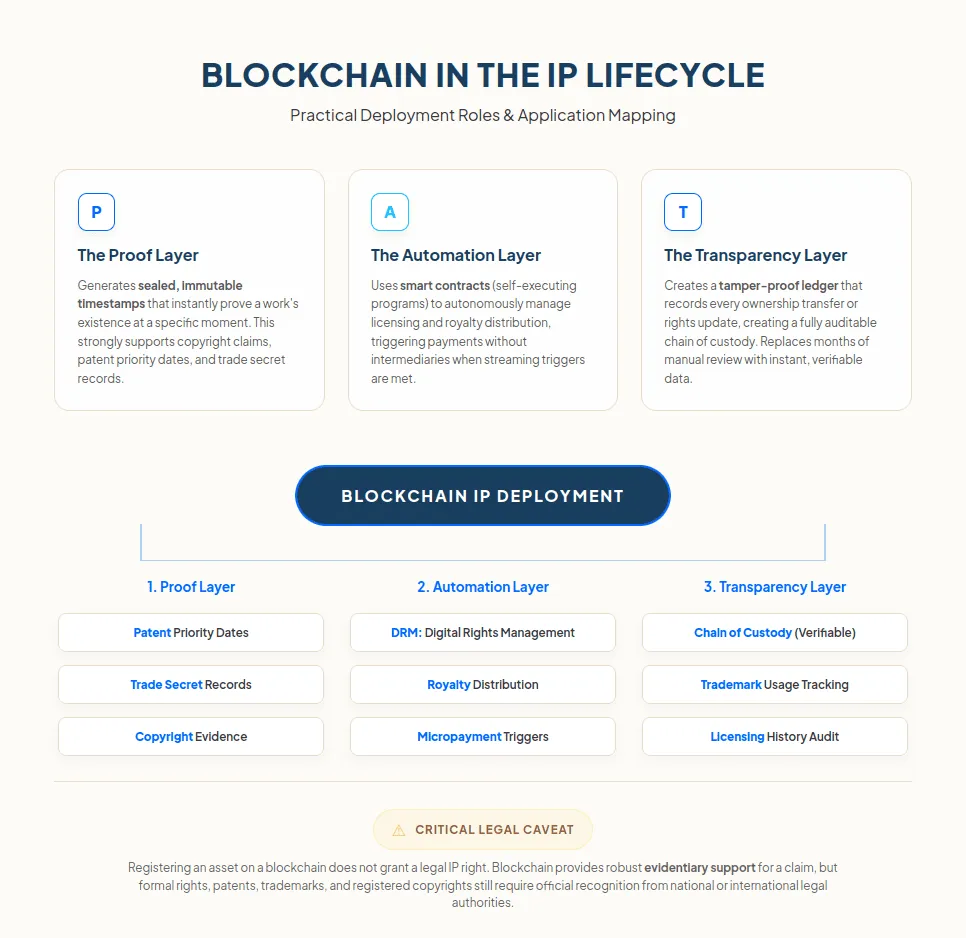
In practical deployment, blockchain serves three distinct roles within the Intellectual Property lifecycle:
The Proof Layer. It generates sealed, immutable timestamps. These timestamps instantly prove that a work existed at a specific moment. This strongly supports copyright claims, patent priority dates, and trade secret records.
The Automation Layer. Smart contracts are self-executing programs stored on the blockchain. They autonomously manage licensing and royalty distribution. For example, a contract instantly triggers a royalty payment to all rights holders when a song streams a set number of times. This requires no manual intervention or intermediary.
The Transparency Layer. The tamper-proof ledger records every ownership transfer, licensing event, or rights update. This creates a fully auditable chain of custody. It replaces months of manual legal review with instant, verifiable data.
One critical caveat must be emphasized: registering an asset on a blockchain does not grant a legal IP right. Blockchain provides robust evidentiary support for a claim, but formal rights, patents, trademarks, and registered copyrights still require official recognition from national or international legal authorities.

How Blockchain Protects Each Type of IP: 5 Core Use Cases
Blockchain technology is not a monolithic solution. Its applications, tools, and limitations vary significantly across different categories of intellectual property. Below are the five core use cases, each with platform examples, practical benefits, and explicit limitations.
1. Copyright Protection
Blockchain secures copyrights by generating an immutable, timestamped record of authorship. A creator, a songwriter, a designer, or a developer logs work onto the blockchain. The resulting cryptographic hash verifies that the work existed at that time.
Platforms like Binded register copyrights on the Bitcoin blockchain for free. Ascribe tracks digital art ownership transfers. Sony Music Entertainment uses blockchain to manage copyrights and royalties across its catalog.
Smart contracts automate licensing. They track streams, downloads, and usage. Then they pay royalties to all rights holders instantly.
Key limitation: On-chain proof gives strong supporting evidence, but it is not legal copyright in most places. It does not replace registration with the U.S. Copyright Office or similar national bodies.
2. Patent Management
Blockchain and patents intersect in two key ways: proving when an invention began and keeping auditable invention logs. Companies like IBM, Alibaba, and nChain keep filing blockchain patents. This cements blockchain as a major patent category.
IPwe (built on Casper Network and Hyperledger Fabric) ran the most ambitious patent tokenization project so far. In 2023, IPwe and Casper Labs minted 25 million patents as dynamic NFTs. This marked the largest enterprise blockchain deployment to date. By turning patents into tokens, they created a tradable asset class. It supports global search, valuation, licensing, and financing.
Bernstein builds timestamped records for each stage of innovation. This includes tests, prototypes, and design iterations.
Key limitation: No patent office accepts blockchain records instead of a formal filing. Blockchain only serves as evidence. It proves when an invention first appeared, which matters in prior art disputes.
3. Trademark Protection
Brands use blockchain to create tamper-proof logs of trademark use. These logs prove first use, counter abandonment claims, and trigger licensing rules through smart contracts.
VeChain leads product authentication. It pairs blockchain with NFC chips, QR codes, and 3D material fingerprints. Consumers and customs officers can verify products on the spot. The European Union Intellectual Property Office runs a blockchain register. It tracks millions of trademark and design records across Europe.
Key limitation: Blockchain provides proof of use and logging. It cannot prove consumer recognition. Doctrines like secondary meaning and likelihood of confusion sit outside its scope.
4. Trade Secret Protection
Trade secrets need to remain confidential to remain legally protected. Blockchain systems like Bernstein offer a way to protect them without disclosure. They create mathematically certain proof that you held specific knowledge at a given time. This proof matters in litigation.
Key limitation: Storing readable confidential data on a public blockchain destroys the trade secret instantly. Private blockchains reduce this risk, but introduce governance trade-offs.
5. Digital Rights Management (DRM)
Smart contracts automate licensing for music, images, software, and video. They encode usage rules, download limits, regional restrictions, and time-based access directly on the blockchain. When users meet these conditions, the system triggers payments instantly. This removes intermediaries and cuts fees.
IP tokenization lets creators issue dynamic NFTs. These tokens embed licensing terms and resale royalties in the asset itself. Creators earn again when the NFT resells.
Key Limitation: Owning an NFT does not grant IP ownership. The buyer gets the token, not the underlying intellectual property, unless the contract explicitly transfers those rights.
Which of these 5 use cases is most relevant to your IP strategy? Understanding which category your assets fall into is the essential first step.
How Blockchain Solves the Generative AI Authorship Problem
No competitor ranking on Google’s first page for “blockchain in intellectual property” addresses the intersection of blockchain and artificial intelligence. This represents a critical content and strategic gap.
Generative AI tools, ChatGPT, Midjourney, Sora, and others, can now produce logos, software, music, and entire creative works. The resulting question is pressing: who owns what AI makes? In the United States, fully AI-generated content is generally not eligible for copyright protection. Proving that a human directed the creative process, rather than simply entering a prompt, becomes an increasingly complex evidentiary challenge.
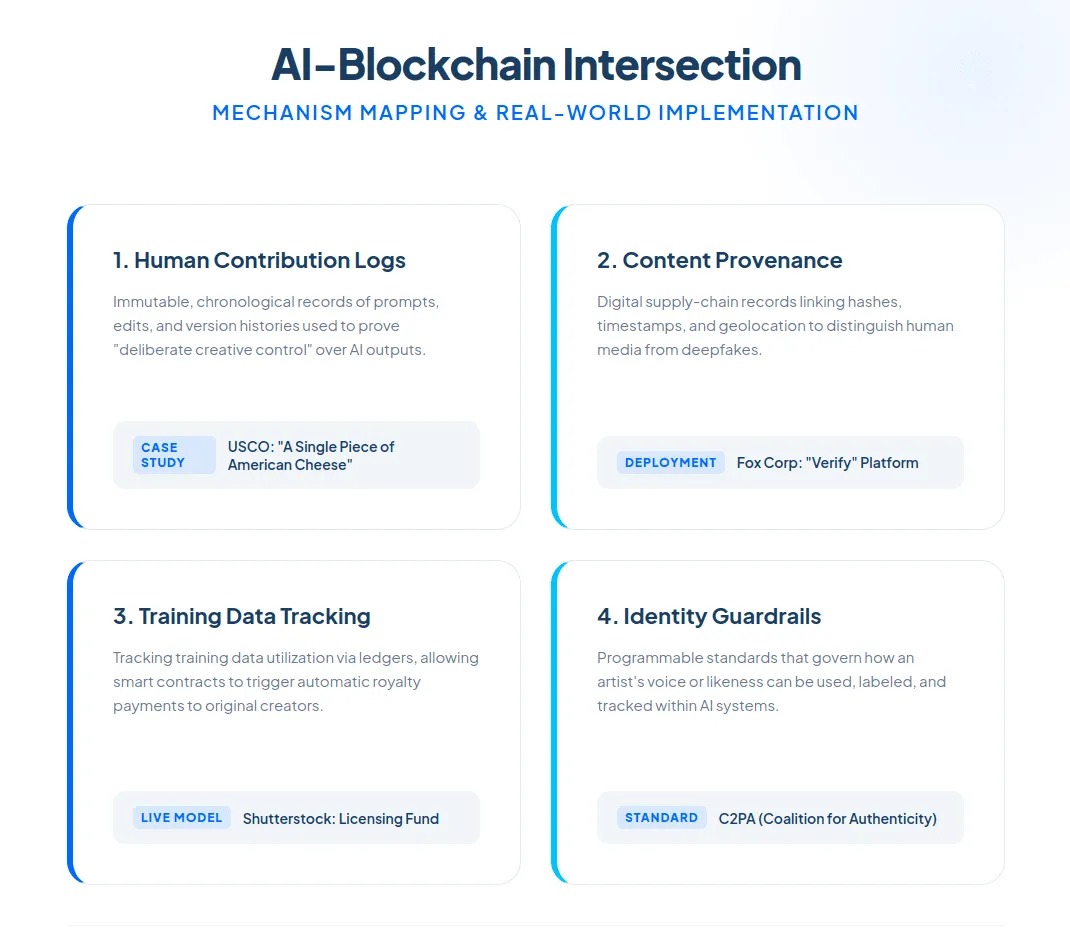
Blockchain addresses this challenge through four specific mechanisms:
1. Documenting Human Creative Contribution: Blockchain enables creators to record “human contribution logs”, timestamped sequences of prompts, AI outputs, editing decisions, and version histories. This generates an immutable, chronological trail of the deliberate creative process. In January 2025, the U.S. Copyright Office validated this approach by granting copyright to an AI-assisted image called “A Single Piece of American Cheese” after the creator documented a comprehensive 35-step creative process. Blockchain anchors exactly this type of evidence.
2. Establishing Content Provenance: As deepfakes and synthetic media proliferate, blockchain functions as a supply-chain record for digital facts. Linking files to cryptographic hashes, timestamps, and geolocation data, it helps distinguish genuine human-created content from AI-generated fabrications. Fox Corporation launched its Verify platform to authenticate original content and protect it from unauthorized AI training and reproduction.
3. Tracking AI Training Data and Automating Compensation: Generative AI models rely on billions of existing creative works for training data. This raises significant fair compensation questions. Blockchain addresses the gap by tracking which data was used to train or fine-tune a model. Smart contracts can then trigger royalty payments automatically. Shutterstock has already implemented this model, licensing data to AI companies and distributing resulting payments back to original artists.
4. Implementing Identity Guardrails: Unauthorized deepfake songs and voice cloning present a growing threat. Blockchain enables artists to establish strict, programmable rules governing how their voices and content may be used by AI systems. Emerging standards like C2PA (Coalition for Content Provenance and Authenticity) track the specific “ingredients” of creative works, helping the industry label AI-derived content appropriately.
How is your organization currently documenting the human contribution in AI-assisted creative works?
Blockchain IP Evidence in Court: A Jurisdiction-by-Jurisdiction Breakdown (2026)
A critical question for anyone is: “Will a court accept blockchain evidence?” The answer varies significantly by jurisdiction. Below is the current legal landscape based on landmark rulings and regulatory developments.
France and the European Union
The AZ Factory vs. Valeria Moda ruling (March 2025) established a watershed precedent. The Tribunal Judiciaire of Marseille treated blockchain timestamps as conclusive, independent proof of prior creation in a fashion copyright dispute. The court did not treat blockchain evidence as merely supplementary; it used it as the core evidentiary foundation.
Across the EU, the eIDAS regulation establishes legal certainty for “qualified time-stamps,” directly supporting blockchain-based evidence. Germany is actively exploring blockchain-secured data as admissible court evidence.
However, the GDPR creates a structural tension. The regulation’s “right to be forgotten” (right to erasure) conflicts with blockchain’s inherent immutability. The European Data Protection Board (EDPB) advises that personal data must be stored off-chain, with only cryptographic hashes anchored on-chain.
China
China has established itself as the global pioneer in judicial blockchain adoption. The Hangzhou Internet Court accepted blockchain evidence in a copyright case as early as 2018. In 2019, the Beijing Internet Court launched “Balance Chain”, a proprietary judicial blockchain that cross-checks evidence hashes in real time during submission. The Supreme People’s Court has issued formal provisions encouraging all courts to utilize blockchain for authenticating electronic data.
However, China’s national ban on cryptocurrencies and strict data localization requirements under the Cybersecurity Law make cross-border blockchain implementations complex.
United States
U.S. courts are beginning to exempt blockchain-generated records from hearsay rules, making them more readily admissible.
Regulatory infrastructure is strengthening. The federal GENIUS Act (2025) and California’s Digital Financial Assets Law are establishing clearer frameworks for digital assets. New York’s adoption of UCC Article 12 now allows digital assets to serve as legal collateral.
United Arab Emirates
The UAE actively supports blockchain through its Dubai Blockchain Strategy. Alongside the UK and Canada, UAE courts accept blockchain timestamps as valid proof of prior creation and ownership.
India
India’s IT Act covers digital evidence broadly, but no court has issued a definitive ruling on blockchain IP evidence. Organizations with IP exposure in India should monitor this space closely.
When On-Chain Proof Failed
In several cross-jurisdictional cases, blockchain evidence has been rejected. The primary failure point is the identity gap; a wallet address is not linked to a verified real-world identity. Without KYC verification or enterprise identity tools, blockchain records prove that something was logged, but not who logged it. Many legal systems still classify blockchain records as “private documents” requiring expert testimony or certification from a trust service provider.
The takeaway is clear: blockchain creates strong proof of timing and existence. Proof of ownership requires an identity layer on top. Organizations that pair timestamps with verified identities possess court-ready evidence.
What jurisdiction-specific risks are most relevant to your IP portfolio?
What Does Blockchain IP Protection Actually Cost? A Realistic Breakdown
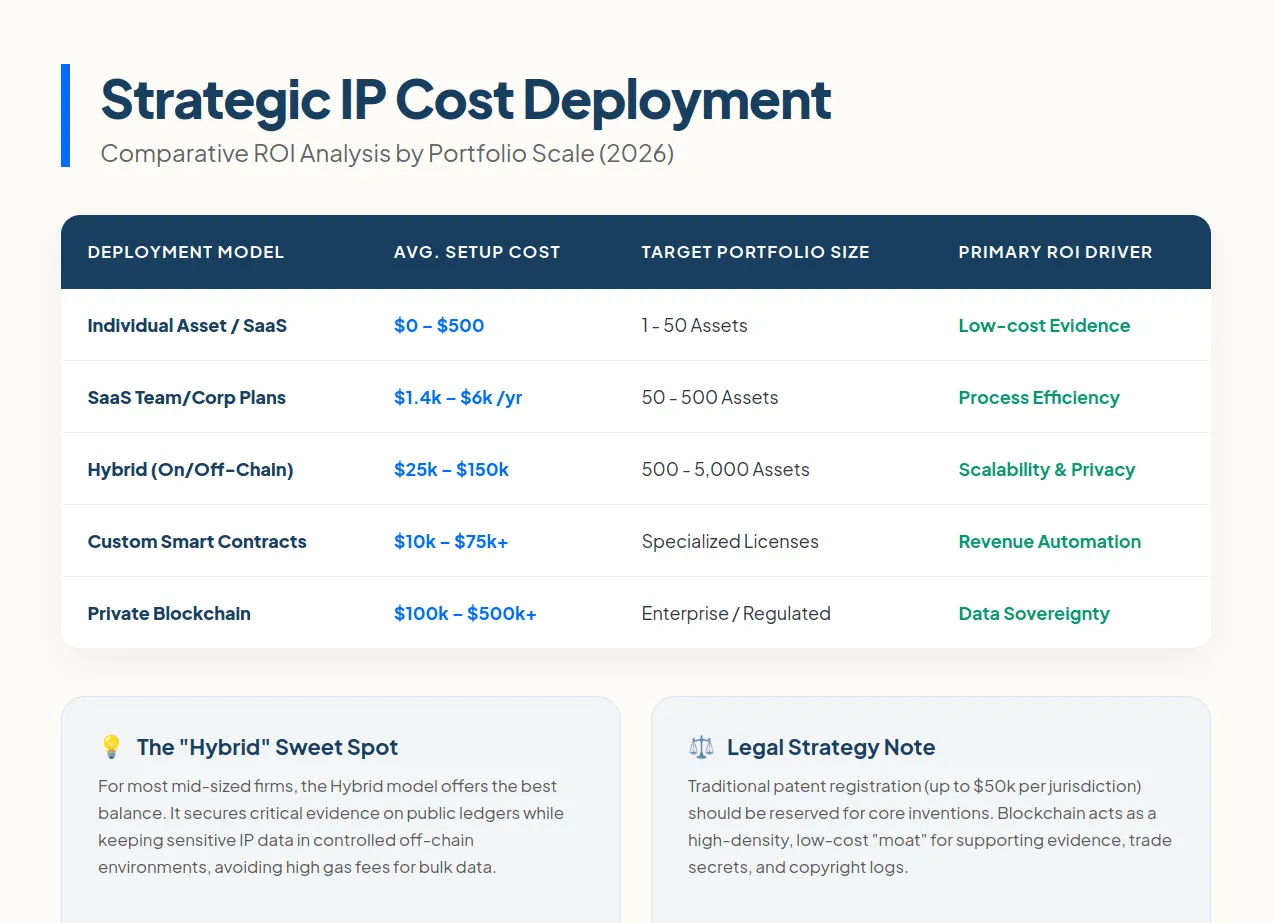
Traditional patent registration alone can cost $1,000 to $50,000 or more per jurisdiction. Blockchain offers a significantly more cost-effective alternative. Below is a breakdown of what blockchain IP tools actually cost in practice, organized by deployment model.
Individual Asset Registration
For independent creators or startups, logging a single asset on a public blockchain costs $5 to $50, depending on network congestion. This represents the most affordable path to creating proof of creation.
SaaS Certification Platforms
Platforms like Bernstein, IPwe, and Blockai provide user-friendly interfaces that require no blockchain expertise. Bernstein’s pricing tiers.
| Plan | Cost | Registrations |
| Pay-as-you-go | $54–$60 per use | Single registration |
| Team | $115/month | Up to 5/month |
| Corporate | $480/month | Up to 30/month |
Blockai (Binded) offers free, one-click copyright registration, the best starting point for most independent creators.
Custom Smart Contracts
Organizations requiring bespoke licensing rules, record labels, software firms, and content studios should expect to invest $10,000 to $75,000 for custom smart contracts on Ethereum, Polygon, or Solana, plus gas fees, developer costs, and a $5,000–$15,000 security audit. Timeline: two to six months.
Recommendation: Pursue custom development only if standard SaaS platforms cannot accommodate your licensing structure.
Enterprise Private Blockchain
For large enterprises or regulated industries, a private blockchain (typically Hyperledger Fabric) requires $100,000 to $500,000+ for setup. Ongoing costs range from $20,000 to $100,000 per year. Deployment timeline: six to eighteen months.
Recommendation: This investment is justified only for organizations with extensive IP portfolios, strict compliance requirements, or data sovereignty mandates.
Hybrid Off-Chain/On-Chain Architecture
The most popular enterprise model in 2026. Sensitive data remains in conventional off-chain databases while critical evidence (hashes, timestamps, rights events) is anchored on a public blockchain. Setup costs: $25,000 to $150,000. Ongoing: $5,000 to $50,000/year.
Recommendation: This is the optimal model for mid-size firms with growing IP portfolios and international operations.
Organizations should also budget for ongoing variable costs, including gas fees, off-chain storage, and general system maintenance.
Which cost tier aligns with your current IP portfolio size and operational needs?
The 5-Question Decision Framework: Should You Use Blockchain for Your IP?
Traditional IP systems answer “what exclusive rights does the law grant?” Blockchain answers “what happened, when, and by whom?” Both functions are essential. Before investing, evaluate your position against these five criteria:
Question 1: Is proof of creation date critical to your IP strategy? If you frequently encounter disputes over who created something first, blockchain timestamps deliver immediate value.
Question 2: Do you need to automate licensing or royalty distribution? If you manage multiple licensees or distribution partners, smart contracts remove administrative bottlenecks and delays.
Question 3: Is your IP primarily digital? If your core assets are code, designs, music, or datasets, blockchain integrates naturally. If your IP is mainly physical, the benefit is more limited.
Question 4: Do you operate across multiple jurisdictions? Blockchain property rights tools help track IP globally, but legal acceptance varies; see the jurisdiction breakdown above.
Question 5: Is your annual IP budget above $50,000? If not, start with a SaaS platform at under $500/month. If yes, evaluate custom or hybrid deployments.
Scoring:
- Yes to 3 or more: Blockchain is a strong strategic investment.
- Yes to 1–2: Begin with a limited SaaS pilot.
- No to all: You may not need blockchain yet, but reassess annually.
The strategic recommendation: Adopt blockchain as part of a hybrid strategy. Use it for documenting creation processes, establishing prior art, and automating royalty payments. Pair blockchain tools with traditional legal agreements and official IP registrations to combine the speed and automation of distributed ledgers with the legal enforceability of formal rights.
WIPO’s Blockchain Task Force: The Global Standard for the Next Decade
WIPO established the Blockchain Task Force under the Committee on WIPO Standards (CWS), designated as Task No. 59 and led by Rospatent (Russia’s patent office). Its mandate is to prepare a unified global standard for the application of blockchain technology within IP ecosystems.
The task force has refined its focus to five practical use cases for standardization:
- Timestamping as proof of existence for digital files.
- Digital identity verification for applicants and rights holders.
- Distributed IP registers enabling real-time data sharing between national offices.
- Evidence of IP rights generation to document iterative creation processes.
- Priority document exchange for secure cross-border transfers between IP offices.
In its comprehensive white paper, WIPO formally recognized blockchain’s value for “tamper-proof documentation bearing a precise date and time” and specifically acknowledged platforms like Bernstein.
At the CWS/13 session (November 2025), the task force reported progress on the working draft but flagged a critical operational challenge: insufficient active participation from member states due to limited hands-on blockchain experience. WIPO is not constructing a global blockchain registry. It is creating the framework that national offices can adopt. Organizations that align their systems with this emerging standard will gain a significant first-mover advantage.
Blockchain IP Platforms Compared: Choosing the Right Tool
Rather than listing platforms generically, the comparison below is organized by use case and user profile to support informed decision-making.
| Platform | Best For | IP Type | Blockchain | Price | Key Feature |
| Bernstein | Startups, R&D teams | Patents, Trade Secrets | Bitcoin, Ethereum | Free tier / $54+ per use | Zero-knowledge architecture |
| IPwe (IBM) | Enterprises | Patents | Casper, Hyperledger | Enterprise pricing | 25M patents as NFTs |
| Blockai (Binded) | Solo creators | Copyright | Bitcoin | Free | One-click registration |
| Verisart | Artists, brands | Copyright, Art | Ethereum | Free + paid tiers | Tamper-proof certificates |
| VeChain | Brands, supply chain | Trademarks | VeChainThor | Enterprise | Product authentication |
| BlockchainYourIP | Designers, creatives | Copyright, Design | , | Varies | Validated in the French court |
| Fox Verify | Media companies | Content auth. | , | Enterprise | Anti-AI-training protection |
For most organizations at the beginning of their blockchain IP journey, Bernstein or Blockai delivers the fastest time-to-value with minimal upfront investment.
7 Challenges That Could Derail Your Blockchain IP Strategy
Most articles identify “legal uncertainty” and “lack of standards” as blockchain IP challenges. While accurate, these observations are too generic to guide operational decisions. Below are nine specific risks that must be addressed in any implementation plan.
1. The Deletion Problem: GDPR’s “right to be forgotten” conflicts directly with blockchain’s immutability. Organizations subject to EU privacy regulations should store personal data off-chain and record only cryptographic hashes on the ledger.
2. Smart Contract Vulnerabilities: A coding error in a licensing or royalty contract can trigger unpaid royalties, unauthorized sharing, or irreversible miscalculations. Blockchain has no undo function. Every IP-related smart contract requires a formal, independent security audit before deployment.
3. The Oracle Problem: Smart contracts cannot independently verify real-world events. They depend on external data feeds called “oracles.” If an oracle provides incorrect data, such as falsely validating a counterfeit product or reporting inflated streaming numbers, the blockchain permanently records a “cryptographically secured lie.” The integrity of input data is as critical as the integrity of the system itself.
4. Code Rigidity vs. Business Nuance: Business agreements frequently require flexibility, grace periods, renegotiation, and subjective interpretation of terms like “material breach.” Smart contracts operate on binary logic and are exceptionally difficult to modify after deployment. This rigidity can lock organizations into unfavorable outcomes.
5. Energy Consumption Perception: Bitcoin’s Proof-of-Work consensus consumes significant energy. However, most enterprise IP platforms now operate on Proof-of-Stake chains (Ethereum, Polygon, Solana), which use over 99% less power. Public perception has not yet caught up with this technical shift.
6. Platform Silos and Interoperability: An IP registered on Ethereum is invisible to Hyperledger or VeChain. Cross-chain standards are still under development. WIPO’s interoperability initiative is years from completion.
7. Scalability Constraints: Managing IP at a global scale, logging every stream, micro-payment, or supply chain checkpoint, requires millions of transactions. Public blockchains are susceptible to congestion. When demand spikes, gas fees increase and confirmation latency rises. Layer-2 solutions provide partial relief, but the challenge remains.
Which of these 8 challenges represents the most significant risk for your organization’s blockchain IP plans?
Blockchain Will Not Replace IP Law, It Will Supercharge It
Blockchain intellectual property protection is not a silver bullet. It is evidence infrastructure that makes IP management faster, more affordable, and more transparent. The organizations achieving the highest returns in 2026 are not those with the most sophisticated blockchain deployments; they are those who combine blockchain tools with rigorous legal strategies.
Three steps to take this week:
First, evaluate your current IP portfolio using the five-question decision framework above. A score of three or higher indicates a strong business case for blockchain adoption.
Second, launch a limited pilot. Bernstein or Blockai costs under $500/month, with free plans available, and can produce actionable data within 30 days.
Third, consult an IP attorney with expertise in blockchain regulations across your target markets. The legal landscape varies significantly by jurisdiction. Evidence that holds up in China may not be admissible in the U.S.
The question is no longer whether blockchain will transform IP management. It already has. The question is: will you build your evidence systems now, while the strategic advantage is clear? Or will you wait until the standard has been written by others?
Frequently Asked Questions
How can blockchain be used in intellectual property?
Blockchain generates permanent, timestamped records of IP creation, ownership transfers, and licensing events. It also enables IP tokenization, converting static rights into tradable digital assets such as NFTs.
What are the 4 types of blockchain used for IP?
Public permissionless (Ethereum, Bitcoin), fully open, best for copyright proof and NFTs.
Public permissioned, transparent, but with controlled membership, suitable for regulatory compliance.
Private (Hyperledger Fabric), high performance, and confidentiality, optimal for enterprise trade secrets and patent management.
Consortium shared infrastructure among multiple organizations, effective for industry-wide licensing collaborations.
Most enterprises in 2026 adopt a hybrid model that combines off-chain data privacy with on-chain proof.
Can blockchain evidence be used in court for IP disputes?
The 2025 French AZ Factory ruling accepted blockchain timestamps as conclusive proof. China’s Internet Courts have accepted blockchain evidence since 2018, with Beijing’s “Balance Chain” verifying evidence in real time. U.S. courts are exempting blockchain records from hearsay rules. The EU’s eIDAS regulation recognizes “qualified time-stamps.” UK, UAE, and Canadian courts are also accepting blockchain evidence. However, the identity layer, linking wallet addresses to verified identities, frequently determines whether the evidence is admitted.
How much does blockchain IP protection cost?
Individual registration: $5–$50. SaaS platforms like Bernstein: $60–$480/month. Blockai: free. Custom smart contracts: $10,000–$75,000. Enterprise private blockchains: $100,000–$500,000+. Hybrid architectures: $25,000–$150,000.
Is blockchain IP recognized by WIPO?
Yes. WIPO’s Blockchain Task Force (CWS Task No. 59) is developing a global standard covering timestamping, digital identity, distributed registers, and priority document exchange.
Which blockchain platform is best for IP protection?
No single platform is universally optimal. Bitcoin (via Bernstein) for trade secret protection with zero-knowledge architecture. Ethereum for copyright, NFTs, and royalty automation (ERC-721, ERC-20 standards). Hyperledger Fabric for enterprise patent management, IPwe uses it to manage 25 million tokenized patents. EUIPO operates its blockchain-based trademark register on Hyperledger.