Table of Contents
AI is no longer just about automation.
Two ideas are reshaping how we build intelligent systems: Generative AI, which creates content, and Agentic AI, which takes action.
Understanding the difference is no longer optional; you need to know why Agentic AI vs Generative AI is creating an impact
What is Generative AI?
Generative AI is the technology behind tools like ChatGPT and DALL·E.
Simply put, it’s AI that creates things, text, images, code, and video by learning patterns from massive data and using that knowledge to produce something new.
Think of it as a very well-read assistant.
You give it a prompt, and it generates a response.
It doesn’t go off and do anything on its own; it just creates what you ask it to.
How It Works
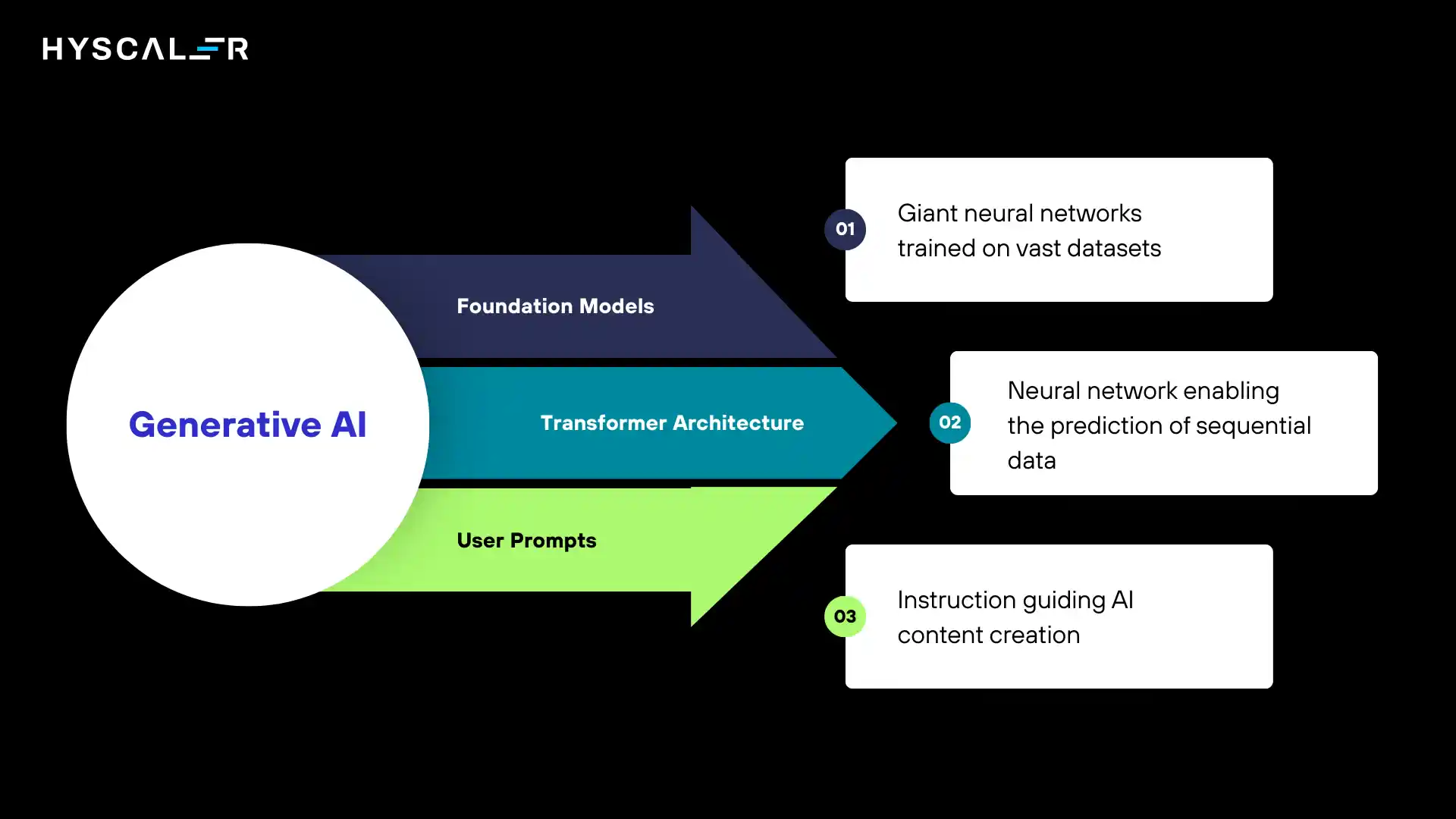
Generative AI is built on foundation models, giant neural networks trained on billions of examples.
These models learn to predict “what comes next”: the next word, the next pixel, the next line of code.
The underlying architecture powering most of these systems is called a transformer.
Popular Tools
- ChatGPT
- Claude
- DALL·E
- Midjourney
- GitHub Copilot
What It’s Great For
| Content & Creative Work: Writing blog posts, marketing copy, scripts, and social content at scale. | Code & Design: Drafting code snippets, suggesting fixes, and generating UI mockups in real time. |
Pros and Cons
| Strengths: Highly creative output. Fast results in seconds. Scales easily. Lowers content creation costs. | Limitations: Needs a human prompt every time. Can confidently make things up. Limited autonomy raises copyright questions. |
What is Agentic AI?
Agentic AI is a step up in ambition.
Instead of just responding to prompts, an agentic AI system is given a goal, and then it figures out on its own how to achieve it.
It plans, uses tools, checks its work, and keeps going until the task is done(the result is achieved).
A good Analogy: if Generative AI is a talented writer you can call up for help, then Agentic AI is a full-time employee who takes a project brief and delivers results, no hand-holding needed.
Defining Characteristics
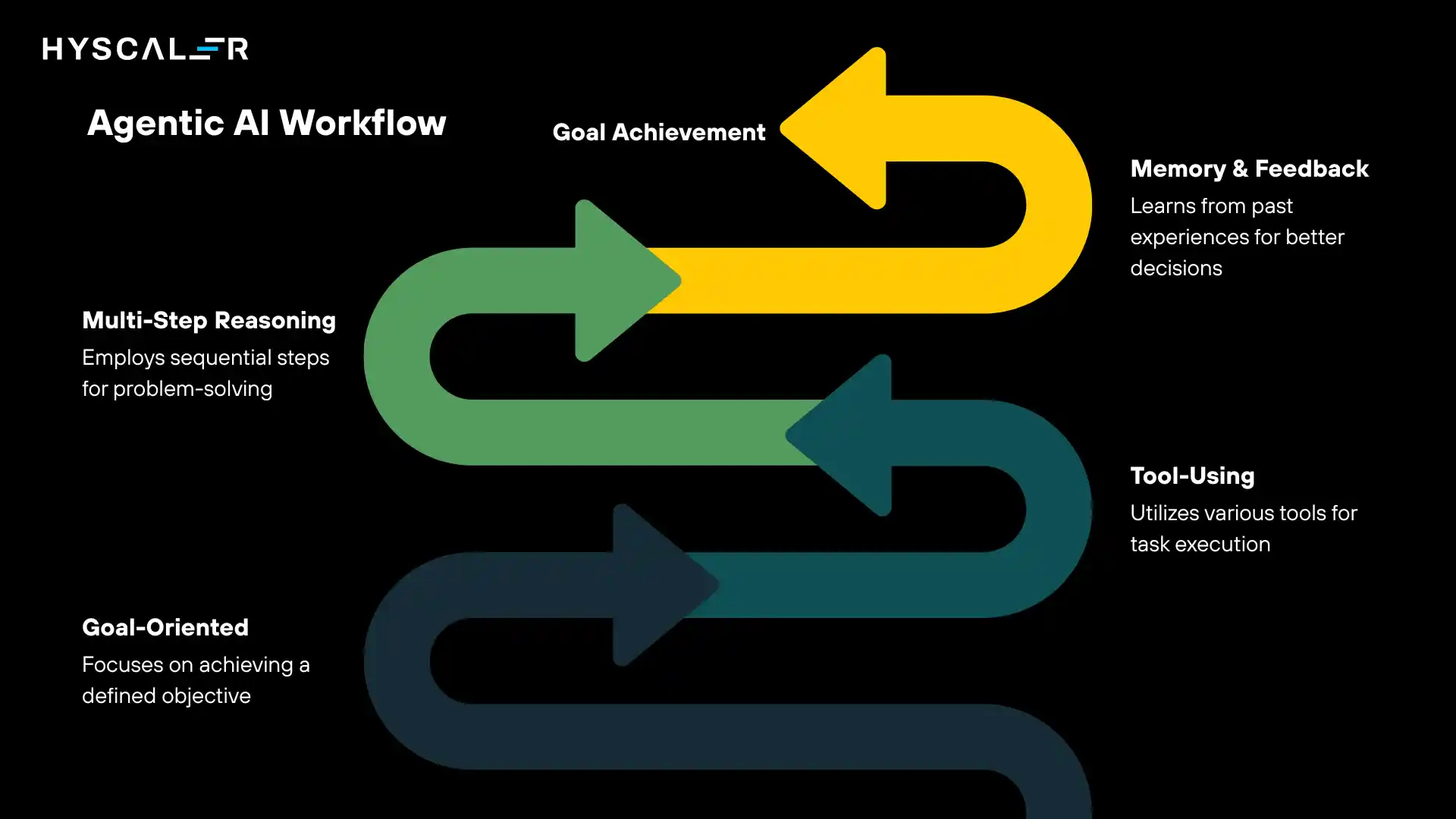
- Goal-Oriented: You give it an objective, not a prompt
- Tool-Using: It browses the web, writes code, sends emails, and queries databases
- Multi-step Reasoning: It evaluates results, adjusts its plan, and keeps moving forward
- Memory & Feedback: Remembers earlier steps and uses context for smarter decisions
How An Agentic AI Works, Step By Step
- Goal Input: You tell the agent what you want to achieve
- Planning: The agent breaks the goal into sub-tasks
- Execution: It runs each sub-task, using tools as needed
- Feedback Loop: It reviews outputs, catches errors, and refines
- Delivery: The final result is delivered with minimal human input
Pros and Cons
| Strengths: Works independently end-to-end. Handles complex multi-step tasks. Dramatically reduces human effort. Can manage workflows 24/7 | Limitations: Can make hard-to-catch errors. Raises security and safety concerns. More expensive to run. Accountability is still murky. |
Head-to-Head Comparison (Agentic AI vs Generative AI)
| Feature | Generative AI | Agentic AI |
|---|---|---|
| Primary Purpose | Create content | Execute tasks autonomously |
| How You Interact | Give it a prompt | Give it a goal |
| Decision Making | Minimal | Advanced, multi-step |
| Task Complexity | Usually single-step | Multi-step workflows |
| Autonomy Level | Low | High |
| Needs Human Input? | Every time | Only at the start (ideally) |
| Best Example | ChatGPT, Claude | AutoGPT, Devin AI |
How They Work Together
Here’s something worth knowing: In Agentic AI vs Generative AI, Agentic AI doesn’t replace Generative AI, but it uses it.
Most agentic systems have a Generative AI model sitting at the core, acting as the “brain” that does the reasoning and writing, similar to how platforms like InClaw AI operate.
| Key Insight: Generative AI is the intelligence layer. Agentic AI is the action layer. Together, they create systems that can both think and act, where the real power lies. |
In a typical agentic workflow: you give the agent a goal → the agent plans sub-tasks → it calls a generative model to reason through each step → it uses tools to act → it loops back to evaluate and improve.
Real-World Industry Applications
| Software Development: AI coding agents, automated debugging, and self-improving software systems | Enterprise Operations: Autonomous workflow management, intelligent process automation |
| Finance: Fraud detection agents, portfolio management AI, and regulatory reporting | Healthcare: Research assistants, clinical documentation automation, and drug discovery |
Challenges & Risks
Neither technology is without its drawbacks.
As these systems grow more capable, the risks grow too.
| Generative AI Risks: Hallucinations, bias in training data, copyright ownership disputes, and over-reliance without verification. | Agentic AI Risks: Loss of control, security vulnerabilities, ethical concerns, and unclear accountability when errors occur. |
The Future: What Comes Next
The most exciting development isn’t choosing between these two paradigms.
It’s not Agentic AI vs Generative AI, it’s combining them into systems that are more powerful than either alone.
| Generative AI: The Intelligence Layer – reasoning, language, and creativity | Agentic AI: The Action Layer – planning, execution, autonomy |
Emerging Trends
- Multi-Agent Ecosystems: Teams of AI agents collaborating on complex tasks
- Autonomous Enterprise Systems: AI running entire departments end-to-end
- AI Operating Systems: Agents that manage other software and tools
- Persistent AI Workers: Agents with long-term memory and ongoing roles
Which One Should Your Business Use?
The honest answer: probably both, for different things.
Here’s a simple way to decide:
| Choose Generative AI when you need – Content creation at scale, Design and creative generation, Coding assistance, Customer-facing chatbots, Quick, on-demand outputs | Choose Agentic AI when you need – Autonomous multi-step workflows. Decisions made without human loops. End-to-end task completion. Integration across multiple systems, Ongoing, repeated processes |
Conclusion
Agentic AI vs Generative AI isn’t a rivalry; they’re partners.
One gives AI the ability to think and create; the other gives it the ability to act and deliver.
For businesses, the takeaway is clear: build literacy around both.
Understand what each does well, where each falls short, and, most importantly, how they work together to solve problems that neither could tackle alone.
The age of autonomous, intelligent digital workers isn’t on the horizon.
It’s already beginning.
FAQ
What is the main difference between Agentic AI and Generative AI?
Generative AI creates content, text, images, and code when you give it a prompt. Agentic AI goes further: you give it a goal, and it plans and executes the steps to achieve it, often without further human input.
Is ChatGPT considered Agentic AI?
No, ChatGPT is primarily a Generative AI system. It responds to prompts but doesn’t act autonomously. However, it can be embedded inside agent frameworks to become part of an agentic system.
Can Agentic AI exist without Generative AI?
In theory, some simpler rule-based agents can. But most modern agentic systems rely on generative models for reasoning, planning, and language understanding; the two technologies are deeply intertwined.
Is Agentic AI the future of automation?
Widely, yes. Agentic AI is expected to drive the next major wave of automation by enabling AI systems that can handle complex, multi-step tasks from start to finish, independently.
Are AI agents safe for enterprise use?
They can be, but safety requires careful implementation: proper access controls, human oversight on critical decisions, audit trails, and robust testing before deployment in high-stakes environments.