

Table of Contents
Speed decides winners now. The team that gets a working product in front of real users first usually gets the market, and that’s exactly why MVP development with AI has become the default approach for founders, product managers, and innovation teams who can’t afford a six-month build cycle before hearing a single word of feedback. Instead of guessing what users want and building for months in the dark, teams are now using AI to compress research, design, coding, and testing into weeks.
This guide breaks down what MVP development with AI actually looks like in practice, which tools genuinely move the needle, and how to avoid the mistakes that turn an AI-assisted MVP into an expensive prototype nobody wanted.
What Is MVP Development with AI?
An MVP, or Minimum Viable Product, is the leanest version of a product that still solves a real problem for a real user, with just enough functionality to test a hypothesis without building every feature you eventually imagine. MVP development with AI takes that same lean philosophy and layers artificial intelligence across the process, so research, design, development, and iteration all move faster because AI absorbs the repetitive, time-consuming work that used to eat entire sprints.
Broken down, the approach rests on a few core characteristics:
- Lean, hypothesis-driven scope: The product is still built around one core problem and one testable assumption. AI accelerates delivery, but it doesn’t replace the discipline of keeping scope narrow.
- AI embedded across the whole lifecycle: Rather than a single tool bolted onto one step, AI touches research, design, coding, and post-launch analysis, so gains compound instead of showing up in just one phase.
- Evidence over assumption: Decisions about what to build are grounded in AI-processed user data reviews, support tickets, and behavioral analytics instead of internal guesswork.
- Compressed validation timeline: An idea that once took a founding team three to four months to validate can now reach a testable state in three to four weeks, because AI removes the manual bottlenecks between an idea and a working prototype.
- Human judgment stays in the loop: AI speeds up execution, but scope decisions, quality checks, and user empathy still sit with the product team. AI is the accelerant, not the decision-maker.
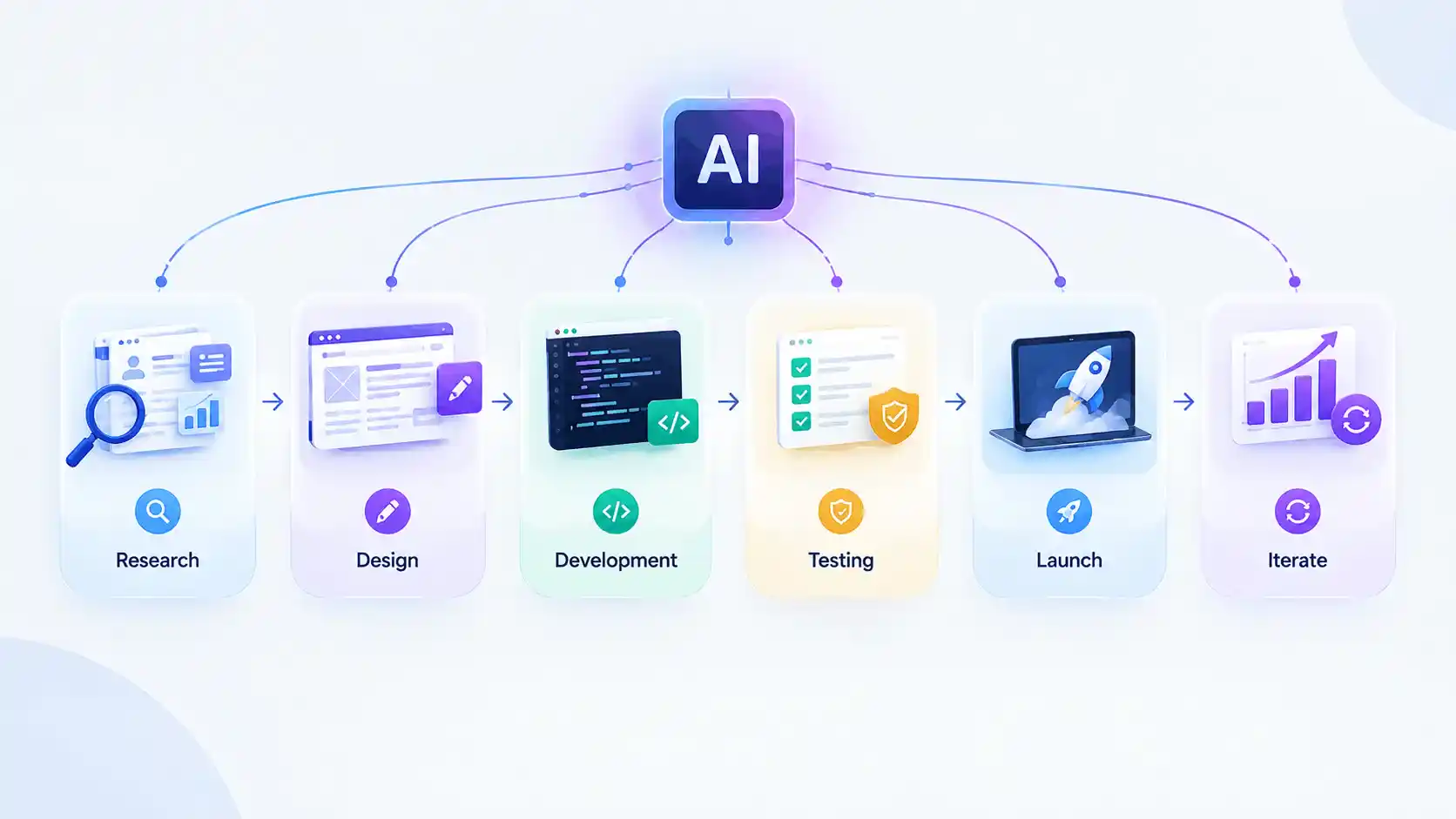
How AI Transforms the MVP Development Process
Smarter, Faster Market Research
Before a single line of code gets written, this stage of MVP development with AI runs on natural language processing (NLP) and large language models (LLMs) applied to unstructured data reviews, forum threads, support tickets, and competitor changelogs to extract patterns a manual read-through would miss. Technically, this looks like:
- Sentiment and topic clustering: NLP models tag thousands of reviews or comments by sentiment and topic, grouping recurring complaints (e.g., “onboarding is confusing”) into ranked clusters instead of leaving a team to skim data manually.
- Competitor feature-gap analysis: LLMs summarize competitor documentation, changelogs, and release notes to flag which features are table stakes versus differentiators, reducing weeks of manual teardown to a few hours.
- Semantic search over support tickets: Vector embeddings let teams query historical support data in plain language (“what do users struggle with after signup?”) instead of relying on keyword search or tags.
- Automated survey and interview synthesis: AI transcribes and summarizes user interviews, tagging themes across sessions so patterns surface without a human cross-referencing every transcript by hand.
Faster Design and Prototyping
At the design stage, generative models trained on UI patterns and design systems convert a text brief or low-fidelity sketch directly into structured interface components. Under the hood:
- Text-to-UI generation: Diffusion and transformer-based design models map a plain-language prompt to layout, component hierarchy, and spacing, producing an editable interface rather than a static image.
- Design-system-aware output: AI plugins reference an existing component library (buttons, cards, tokens) so generated screens stay consistent with brand and code-ready design tokens instead of needing a rebuild later.
- Automated variant generation: The same prompt can produce multiple layout or flow variations in parallel, letting a team A/B a concept before any engineering time is spent.
- Design-to-code handoff: Some tools export directly to React, HTML/CSS, or Figma dev-mode specs, cutting the translation gap between what design produces and what engineering has to rebuild.
Code Generation and Faster Builds
This is where MVP development with AI shows its clearest technical ROI, since code-generation models now handle far more than autocomplete. Specifically:
- Full-stack scaffolding: AI app builders generate project structure, routing, database schema, and API endpoints from a plain-language spec, producing a runnable codebase instead of a static template.
- Context-aware autocomplete: Coding copilots read the surrounding codebase types, function signatures, and imports to generate contextually correct completions rather than generic boilerplate.
- Automated test generation: LLMs can write unit and integration tests directly from function signatures and docstrings, improving test coverage without dedicating separate QA cycles early on.
- Static analysis and bug detection: AI-assisted code review flags null-pointer risks, unhandled exceptions, and security anti-patterns (e.g., unsanitized inputs) before a pull request reaches a human reviewer.
- API and third-party integration: AI can read API documentation and generate the corresponding client code and error handling, cutting integration time for payments, auth, or data providers.
Continuous, Data-Backed Iteration
Once an MVP is live, the same AI infrastructure shifts from build-time to run-time, turning raw usage data into a prioritized product backlog. This stage typically includes:
- Behavioral event modeling: ML models cluster user sessions by behavior pattern (power users, drop-offs, one-time visitors) instead of relying on manual funnel analysis alone.
- Automated funnel and churn prediction: Predictive models flag users likely to churn based on early usage signals, giving teams a lead indicator before churn shows up in the numbers.
- Session replay with AI tagging: AI reviews session recordings at scale, and auto-tags rage clicks, dead clicks, or confusion patterns that would take a human reviewer hours to find manually.
- Feedback-to-backlog automation: NLP pipelines route incoming feedback (support tickets, in-app surveys, and app-store reviews) into categorized, de-duplicated backlog items, closing the loop between what users say and what gets built next in MVP development with AI.
AI Tools for Accelerating MVP Development
Several AI tools and platforms can be leveraged to speed up MVP development with the AI process:
- ChatGPT: This AI-powered chatbot can be used for automating customer support, generating content, and providing initial interaction with users. Benefits include handling repetitive inquiries, providing consistent information, and collecting user feedback efficiently.
- Figma with AI Plugins: This design and prototyping platform offers AI-enhanced tools for creating user interfaces and user experiences. AI plugins can automate design tasks, generate design variations, and optimize user interfaces based on user data.
- MonkeyLearn: This AI platform for text analysis offers tools for sentiment analysis, keyword extraction, and classification. It can be useful for analyzing customer feedback, identifying trends, and extracting actionable insights to refine the MVP.
- Airtable with AI Integrations: This flexible database can be integrated with AI tools for enhanced data management and analysis. It can be used for organizing user feedback, managing feature requests, and integrating with AI models to predict user needs and optimize product features.
- Buzzy: This AI-powered platform allows product managers to rapidly transform ideas into prototypes, accelerating the MVP development process.
Best Practices for MVP Development with AI
- Define the core problem first, not the feature list. AI can build almost anything quickly; that’s exactly why scope discipline matters more, not less.
- Example: A team building a scheduling tool for freelancers fed AI-processed forum threads and app-store reviews into an LLM and found one dominant complaint: double-booking across platforms, so they scoped the entire MVP around solving just that.
- Prioritize ruthlessly. A simple must-have/should-have/could-have split keeps a lean MVP lean, even when AI makes it tempting to add “just one more” feature.
- Example: In that same scheduling-tool build, calendar sync and conflict detection made the cut; notifications and team accounts waited for a later release.
- Bring real users in early. AI can simulate personas, but nothing replaces actual feedback from people who might pay for the product.
- Example: The team turned a plain-language brief into three AI-generated interface variants in an afternoon, then picked one after feedback from five target users instead of guessing internally.
- Automate the build-and-deploy pipeline. Pairing AI-generated code with CI/CD automation keeps release cycles short and consistent.
- Example: An AI app builder scaffolded the core app calendar sync, conflict detection, and basic auth, while a coding copilot handled the API integration with the two scheduling platforms.
- Keep a human reviewing every AI output. Generated code, copy, and designs need a sanity check before they ship; speed shouldn’t come at the cost of quality.
- Example: A human developer reviewed every generated pull request before merging and caught an unhandled edge case in the sync logic that the AI had missed.
- Document decisions as you go. Fast iteration cycles make it easy to lose track of why a feature was cut or changed; a lightweight decision log keeps the whole team aligned.
- Close the loop after launch. Post-launch usage data should feed directly back into the roadmap, not sit in a dashboard no one reviews.
- Example: Once the scheduling tool was live with a small beta group, AI-tagged session replays showed users hesitating on the conflict-resolution screen; that single insight became the top item in the next sprint.
Conclusion
In the era of rapid innovation, leveraging AI to accelerate MVP development with AI is a strategic advantage. By automating repetitive tasks, providing insights, enhancing personalization, and improving decision-making, AI can help teams bring their ideas to market faster and more efficiently. By adopting AI tools and best practices, product managers can transform their MVP development process with AI, delivering value to customers and gaining a competitive edge in their respective industries.
HyScaler, a Technology consulting & services agency, can be advantageous for startups looking to leverage AI in technical requirements, digital engineering, and design thinking. HyScaler specializes in creating remarkable solutions through a blend of technology, user experience, and design, helping businesses unlock their full potential and adapt to the future of success.
With a team that thrives on customer success, HyScaler offers scalable solutions that are tailored to your needs, ensuring that your digital presence is revitalized and your brand is positioned for the digital era.
As a decade-old company with over 150 team members, 50 delighted clients, and expertise across more than 40 technologies, HyScaler brings over a decade of trust and commitment to your project. Whether you’re looking to join the tech revolution or supercharge your IT landscape, partnering with HyScaler provides you with the exceptional advantages of their dynamic and passionate team.
FAQs
What is MVP development with AI?
It’s the process of building a Minimum Viable Product using AI tools to speed up research, design, coding, and testing.
How long does an AI-assisted MVP take to build?
Most AI-assisted MVPs go from idea to testable prototype in 1–4 weeks, compared to 3–6 months with traditional development, depending on scope and complexity.
Can AI actually replace developers in building an MVP?
No, AI handles boilerplate, scaffolding, and repetitive coding, but architecture decisions, edge-case judgment, and product thinking still need a human developer in the loop.
What’s the best AI tool to build an MVP?
There’s no single “best” tool; most teams combine one for coding (like Cursor or a copilot), one for design (Figma AI plugins), and one for research/synthesis (ChatGPT or Perplexity).
How does semantic search over support tickets actually work?
Vector embeddings convert ticket text into numerical representations, letting you query historical data in plain language instead of relying on exact keyword matches.
What’s the difference between context-aware autocomplete and generic boilerplate?
Context-aware copilots read surrounding types, function signatures, and imports before completing code, while generic autocomplete just pattern-matches without project context.
How does AI generate API integration code from documentation?
It parses the API docs to produce matching client code and error-handling logic, cutting manual integration time for things like payments or auth providers.
What is behavioral event modeling in post-launch analytics?
ML models cluster user sessions by behavior pattern, power users, drop-offs, and one-time visitors instead of relying on manual funnel analysis.
What’s the risk of using AI for database schema generation?
AI can miss normalization edge cases or indexing needs specific to your query patterns, so schema output should be reviewed against actual access patterns before migration.
How accurate is AI-based churn prediction for early-stage products?
It flags at-risk users based on early usage signals, but with a new MVP’s limited data, it works better as a directional signal than a precise forecast.